












Nickel-catalyzed cross-coupling reactions of benzylic zinc reagents with aromatic bromides, chlorides and tosylates
Literature Information
Publication Date
2008-04-24
DOI
10.1039/B803072C
Impact Factor
6.222
Authors
Matthias A. Schade, Albrecht Metzger, Stephan Hug, Paul Knochel
View Original
Abstract
Benzylic zinc reagents prepared by direct insertion of zinc to benzylic chlorides in the presence of LiCl undergo smooth cross-coupling reactions with aromatic chlorides, bromides and tosylates using Ni(acac)2 and PPh3 as a catalyst system.
Related Literature
First-principles study of adsorption–desorption kinetics of aqueous V2+/V3+ redox species on graphite in a vanadium redox flow battery
Zhen Jiang, Konstantin Klyukin
2017-05-16
Communication
DOI: 10.1039/C7CP02350B
Extra electronic outer-shell peculiarities accessible under a joint XPS and DFT study
A. R. Cholach, A. A. Bryliakova
2017-05-22
Paper
DOI: 10.1039/C7CP00900C
Reaction mechanism and product branching ratios of the CH + C3H4 reactions: a theoretical study
Joao Marcelo Ribeiro, Alexander M. Mebel
2017-05-05
Paper
DOI: 10.1039/C7CP01873H
Electromagnetic field coupling characteristics in graphene plasmonic oligomers: from isolated to collective modes
Junbo Ren, Weibin Qiu, Houbo Chen, Pingping Qiu, Zhili Lin, Jia-Xian Wang, Qiang Kan, Jiao-Qing Pan
2017-05-17
Paper
DOI: 10.1039/C7CP01734K
Unifying the microscopic picture of His-containing turns: from gas phase model peptides to crystallized proteins
Woon Yong Sohn, Sana Habka, Eric Gloaguen, Michel Mons
2017-06-06
Paper
DOI: 10.1039/C7CP03058D
Predicting photon cascade emission in Pr3+ doped fluorides
Amador García-Fuente, Andrés Vega
2017-05-22
Paper
DOI: 10.1039/C7CP02786A
Cool white, persistent room-temperature phosphorescence in carbon dots embedded in a silica gel matrix
Julin Joseph, Aji A. Anappara
2017-05-31
Paper
DOI: 10.1039/C7CP02731A
Specific DNA sequences allosterically enhance protein–protein interaction in a transcription factor through modulation of protein dynamics: implications for specificity of gene regulation
Abhishek Mazumder, Subrata Batabyal, Manas Mondal, Tanumoy Mondol, Susobhan Choudhury, Raka Ghosh, Tanaya Chatterjee, Dhananjay Bhattacharyya, Samir Kumar Pal, Siddhartha Roy
2017-05-26
Paper
DOI: 10.1039/C7CP01193H
You might also like
Compound Q&A
Are there alternatives to 1-(4-Chlorophenyl)-N-hydroxymethanimine (CAS: 3848-36-0) in synthesis?
When considering alternatives to 1-(4-Chlorophenyl)-N-hydroxymethanimine (CAS: 3...
3848-36-01-(4-Chlorophenyl)-N...
Compound Q&A
How should (1R,9S,10S,12S,14E,16S,19R,20R,21S,22R)-3,9,21-Trihydroxy-5,10,12,14,16,20,22-heptamethyl-23,24-dioxatetracyclo[17.3.1.1~6,9~.0~2,7~]tetracosa-2,5,7,14-tetraen-4-one (CAS: 183202-73-5) be stored?
This compound should be stored in a cool, dry place away from direct sunlight. I...
183202-73-5(1R,9S,10S,12S,14E,1...
Compound Q&A
How is 3-(4-Bromophenyl)-5-(2-fluorophenyl)-1,2,4-oxadiazole (CAS: 419553-16-5) typically synthesized?
3-(4-Bromophenyl)-5-(2-fluorophenyl)-1,2,4-oxadiazole is synthesized through a m...
419553-16-53-(4-Bromophenyl)-5-...
Compound Q&A
How is 5-Chloro-2-(4-chlorophenyl)-4-methyl-6-[3-(1-piperidinyl)propoxy]pyrimidine (CAS: 1639220-19-1) typically synthesized?
5-Chloro-2-(4-chlorophenyl)-4-methyl-6-[3-(1-piperidinyl)propoxy]pyrimidine (CAS...
1639220-19-15-Chloro-2-(4-chloro...
Compound Q&A
What industries use 2-Chloro-4-(difluoromethoxy)pyridine (CAS: 1206978-15-5)?
2-Chloro-4-(difluoromethoxy)pyridine is used in the pharmaceutical industry for ...
1206978-15-52-Chloro-4-(difluoro...
Compound Q&A
What regulatory guidelines apply to 3-Chloro-6-methylpyridazine (CAS: 1121-79-5)?
3-Chloro-6-methylpyridazine (CAS: 1121-79-5) is classified under the Globally Ha...
1121-79-53-Chloro-6-methylpyr...
Compound Q&A
Are there alternatives to Methyl 4,5-dimethyl-2-nitrobenzoate in synthesis?
Several alternatives can be used in the synthesis of Methyl 4,5-dimethyl-2-nitro...
90922-74-0Methyl 4,5-dimethyl-...
Compound Q&A
Are there alternatives to (2E,2'E)-3,3'-(1,4-Phenylene)bisacrylaldehyde in synthesis?
Alternatives to (2E,2'E)-3,3'-(1,4-Phenylene)bisacrylaldehyde include other acry...
63405-68-5(2E,2'E)-3,3'-(1,4-P...
Compound Q&A
What is 3-Amino-5-chloropyridin-2-ol hydrochloride (CAS: 1261906-29-9)?
3-Amino-5-chloropyridin-2-ol hydrochloride is an organic compound with the CAS n...
1261906-29-93-Amino-5-chloropyri...
Compound Q&A
What precautions should be taken when handling 6,7-Difluoro-2,3-dihydro-4H-chromen-4-one (CAS: 1092349-93-3)?
When handling 6,7-Difluoro-2,3-dihydro-4H-chromen-4-one, it is essential to wear...
1092349-93-36,7-Difluoro-2,3-dih...
Source Journal
Chemical Communications

CiteScore:
8.6
Self-citation Rate:
4.7%
Articles per Year:
2458
ChemComm publishes urgent research which is of outstanding significance and interest to experts in the field, while also appealing to the journal’s broad chemistry readership. Our communication format is ideally suited to short, urgent studies that are of such importance that they require accelerated publication. Our scope covers all topics in chemistry, and research at the interface of chemistry and other disciplines (such as materials science, nanoscience, physics, engineering and biology) where there is a significant novelty in the chemistry aspects. Major topic areas covered include: Analytical Chemistry Catalysis Chemical Biology and medicinal chemistry Computational Chemistry and Machine Learning Energy and sustainable chemistry Environmental Chemistry Green Chemistry Inorganic Chemistry Materials Chemistry Nanoscience Organic Chemistry Physical Chemistry Polymer Chemistry Supramolecular Chemistry
Recommended Compounds
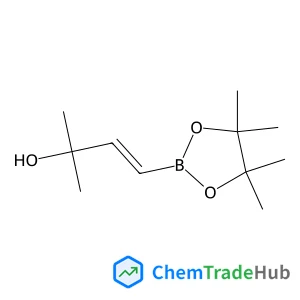
(E)-2-methyl-4-(4,4,5,5-tetramethyl-1,3,2-dioxaborolan-2-yl)but-3-en-2-ol
CAS Number:
581802-26-8
Molecular Formula:
C11H21BO3
Recommended Suppliers





Disclaimer
This page provides academic journal information for reference and research purposes only. We are not affiliated with any journal publishers and do not handle publication submissions. For publication-related inquiries, please contact the respective journal publishers directly.
If you notice any inaccuracies in the information displayed, please contact us at support@chemtradehub.com. We will promptly review and address your concerns.