












Ground and excited electronic states of AuH2via detachment energies on AuH2− using state-of-the-art relativistic calculations
Literature Information
Publication Date
2020-11-02
DOI
10.1039/D0CP05204C
Impact Factor
3.676
Authors
Trond Saue, Leonardo Belpassi
View Original
Abstract
Photoelectron spectroscopy (PES) is a well-known technique which provides unique information about the electronic structure of anionic and neutral species of simple molecules containing heavy elements; however, the detailed interpretation of the resulting experimental spectra can be very complex and theoretical support is mandatory. In this work, based on the available vibrationally resolved PES experiments for gold dihydride (Liu, H.-T. et al., Chem. Sci., 2012, 3, 3286), we have employed several relativistic theoretical approaches with the aim of reproducing experimental photoelectron Detachment Energies (DEs) of AuH2− to give a neutral open-shell molecule, AuH2. The results are discussed in terms of relativistic effects, orbital relaxation and electron correlation. In order to reproduce accurate DEs it has been necessary to include all these effects in a consistent manner at a high degree of accuracy, by means of the equation-of-motion coupled-cluster theory (EOM-IP-CCSD) based on the relativistic exact two-component Hamiltonian (Shee A. et al. J. Chem. Phys., 2018, 174113). This method has also been applied for investigating the ground and low-lying electronic potential energy surfaces of the neutral open shell AuH2 species. The equilibrium geometry of the AuH2 ground state is found to be bent, which is fully consistent with the experimental findings, while all the excited states, including the first, which was previously suggested to have a slightly bent structure, are found to be linear. In the linear centrosymmetric nuclear configuration (which corresponds to the equilibrium geometry of the anion, AuH2−), we find that the first excited state and ground state are very close in energy and the ground state is characterized by an unexpected symmetry breaking in the direction of the asymmetric stretching, due to the pseudo-Jahn–Teller effect. This effect depends on the energy difference between these two electronic states and disappears when the spin–orbit coupling is neglected. The picture that emerges here is intriguing and demonstrates that the interpretation, for which the vibronic transitions that were previously assigned to a slightly bent structure of the first excited state needs to be revised and that a full rationalization of the PES spectra would require the explicit inclusion of the nuclear dynamical effects, beyond the Born–Oppenheimer (BO) approximation. From a methodological point of view, the relativistic EOM-IP-CCSD method results are highly accurate and capable of giving a well-balanced description of the anionic and neutral species, which is a key aspect for the interpretation of the PES spectra in open-shell heavy element compounds.
Related Literature
The nanostructure of a lithium glyme solvate ionic liquid at electrified interfaces
Samuel W. Coles, Susan Perkin, Vladislav B. Ivaništšev
2017-04-05
Communication
DOI: 10.1039/C7CP00837F
Mapping the ionic fingerprints of molecular monolayers
Joshua Lehr, Justin R. Weeks, Adriano Santos, Gustavo T. Feliciano, Melany I. G. Nicholson, Jason J. Davis, Paulo R. Bueno
2017-05-12
Paper
DOI: 10.1039/C7CP01500C
Umbrella sampling molecular dynamics simulations reveal concerted ion movement through G-quadruplex DNA channels
Parisa Akhshi, Gang Wu
2017-03-16
Paper
DOI: 10.1039/C7CP01028A
Approximate quantum chemical methods for modelling carbohydrate conformation and aromatic interactions: β-cyclodextrin and its adsorption on a single-layer graphene sheet
Panichakorn Jaiyong, Richard A. Bryce
2017-06-02
Paper
DOI: 10.1039/C7CP02160G
Electron-triggered chemistry in HNO3/H2O complexes
Milan Ončák, Juraj Fedor, Jaroslav Kočišek, Andriy Pysanenko, Martin K. Beyer, Michal Fárník
2017-03-24
Paper
DOI: 10.1039/C7CP01205E
Interrelationship between TiO2 nanoparticle size and kind/size of dyes in the mechanism and conversion efficiency of dye sensitized solar cells
Pooya Tahay, Meisam Babapour Gol Afshani, Ali Alavi, Zahra Parsa, Nasser Safari
2017-03-31
Paper
DOI: 10.1039/C7CP01159H
Effect of water on the effective Goldschmidt tolerance factor and photoelectric conversion efficiency of organic–inorganic perovskite: insights from first-principles calculations
Ya-Nan Zhu, Zhi-Feng Xu, Li-Min Liu
2017-05-19
Paper
DOI: 10.1039/C7CP02659E
Reaction mechanism and product branching ratios of the CH + C3H4 reactions: a theoretical study
Joao Marcelo Ribeiro, Alexander M. Mebel
2017-05-05
Paper
DOI: 10.1039/C7CP01873H
Fano resonances in the photoinduced H-atom elimination dynamics in the πσ* states of pyrrole
Sergy Yu. Grebenshchikov, David Picconi
2017-05-24
Communication
DOI: 10.1039/C7CP01401E
A promising single atom catalyst for CO oxidation: Ag on boron vacancies of h-BN sheets
Peng Lv, Shuo Li, Dongwei Ma, Ruqian Wu
2017-06-02
Paper
DOI: 10.1039/C7CP02430D
You might also like
Compound Q&A
Are there alternatives to 1-(4-Chlorophenyl)-N-hydroxymethanimine (CAS: 3848-36-0) in synthesis?
When considering alternatives to 1-(4-Chlorophenyl)-N-hydroxymethanimine (CAS: 3...
3848-36-01-(4-Chlorophenyl)-N...
Compound Q&A
How should (1R,9S,10S,12S,14E,16S,19R,20R,21S,22R)-3,9,21-Trihydroxy-5,10,12,14,16,20,22-heptamethyl-23,24-dioxatetracyclo[17.3.1.1~6,9~.0~2,7~]tetracosa-2,5,7,14-tetraen-4-one (CAS: 183202-73-5) be stored?
This compound should be stored in a cool, dry place away from direct sunlight. I...
183202-73-5(1R,9S,10S,12S,14E,1...
Compound Q&A
How is 3-(4-Bromophenyl)-5-(2-fluorophenyl)-1,2,4-oxadiazole (CAS: 419553-16-5) typically synthesized?
3-(4-Bromophenyl)-5-(2-fluorophenyl)-1,2,4-oxadiazole is synthesized through a m...
419553-16-53-(4-Bromophenyl)-5-...
Compound Q&A
How is 5-Chloro-2-(4-chlorophenyl)-4-methyl-6-[3-(1-piperidinyl)propoxy]pyrimidine (CAS: 1639220-19-1) typically synthesized?
5-Chloro-2-(4-chlorophenyl)-4-methyl-6-[3-(1-piperidinyl)propoxy]pyrimidine (CAS...
1639220-19-15-Chloro-2-(4-chloro...
Compound Q&A
What industries use 2-Chloro-4-(difluoromethoxy)pyridine (CAS: 1206978-15-5)?
2-Chloro-4-(difluoromethoxy)pyridine is used in the pharmaceutical industry for ...
1206978-15-52-Chloro-4-(difluoro...
Compound Q&A
What regulatory guidelines apply to 3-Chloro-6-methylpyridazine (CAS: 1121-79-5)?
3-Chloro-6-methylpyridazine (CAS: 1121-79-5) is classified under the Globally Ha...
1121-79-53-Chloro-6-methylpyr...
Compound Q&A
Are there alternatives to Methyl 4,5-dimethyl-2-nitrobenzoate in synthesis?
Several alternatives can be used in the synthesis of Methyl 4,5-dimethyl-2-nitro...
90922-74-0Methyl 4,5-dimethyl-...
Compound Q&A
Are there alternatives to (2E,2'E)-3,3'-(1,4-Phenylene)bisacrylaldehyde in synthesis?
Alternatives to (2E,2'E)-3,3'-(1,4-Phenylene)bisacrylaldehyde include other acry...
63405-68-5(2E,2'E)-3,3'-(1,4-P...
Compound Q&A
What is 3-Amino-5-chloropyridin-2-ol hydrochloride (CAS: 1261906-29-9)?
3-Amino-5-chloropyridin-2-ol hydrochloride is an organic compound with the CAS n...
1261906-29-93-Amino-5-chloropyri...
Compound Q&A
What precautions should be taken when handling 6,7-Difluoro-2,3-dihydro-4H-chromen-4-one (CAS: 1092349-93-3)?
When handling 6,7-Difluoro-2,3-dihydro-4H-chromen-4-one, it is essential to wear...
1092349-93-36,7-Difluoro-2,3-dih...
Source Journal
Physical Chemistry Chemical Physics

CiteScore:
5.5
Self-citation Rate:
10.3%
Articles per Year:
3036
Physical Chemistry Chemical Physics (PCCP) is an international journal co-owned by 19 physical chemistry and physics societies from around the world. This journal publishes original, cutting-edge research in physical chemistry, chemical physics and biophysical chemistry. To be suitable for publication in PCCP, articles must include significant innovation and/or insight into physical chemistry; this is the most important criterion that reviewers and Editors will judge against when evaluating submissions. The journal has a broad scope and welcomes contributions spanning experiment, theory, computation and data science. Topical coverage includes spectroscopy, dynamics, kinetics, statistical mechanics, thermodynamics, electrochemistry, catalysis, surface science, quantum mechanics, quantum computing and machine learning. Interdisciplinary research areas such as polymers and soft matter, materials, nanoscience, energy, surfaces/interfaces, and biophysical chemistry are welcomed if they demonstrate significant innovation and/or insight into physical chemistry. Joined experimental/theoretical studies are particularly appreciated when complementary and based on up-to-date approaches.
Recommended Compounds
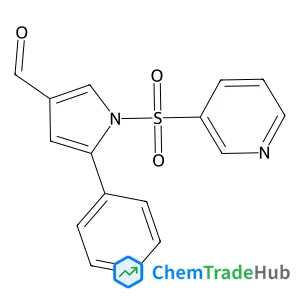
5-Phenyl-1-(pyridin-3-ylsulfonyl)-1H-pyrrole-3-carbaldehyde
CAS Number:
881676-90-0
Molecular Formula:
C16H12N2O3S

Recommended Suppliers






Disclaimer
This page provides academic journal information for reference and research purposes only. We are not affiliated with any journal publishers and do not handle publication submissions. For publication-related inquiries, please contact the respective journal publishers directly.
If you notice any inaccuracies in the information displayed, please contact us at support@chemtradehub.com. We will promptly review and address your concerns.