












Umbrella sampling molecular dynamics simulations reveal concerted ion movement through G-quadruplex DNA channels
Literature Information
Publication Date
2017-03-16
DOI
10.1039/C7CP01028A
Impact Factor
3.676
Authors
Parisa Akhshi, Gang Wu
View Original
Abstract
We have applied the umbrella sampling (US) method in all-atom molecular dynamics (MD) simulations to obtain potential of mean force (PMF) profiles for ion transport through three representative G-quadruplex DNA channels: [d(TG4T)]4, [d(G3T4G4)]2, and d[G4(T4G4)3]. The US MD results are in excellent agreement with those obtained previously with the adaptive biasing force (ABF) method. We then utilized the unique features in the US MD method to investigate multi-ion effects in [d(G3T4G4)]2 and discovered that the concerted ion movement is crucial for fully explaining the unusual experimental results on ion movement in this particular G-quadruplex system. We anticipate that these modern free-energy methods will be useful tools in evaluating ion transport properties of other G-quadruplex DNA channels.
Related Literature
A gene-activating skin substitute comprising PLLA/POSS nanofibers and plasmid DNA encoding ANG and bFGF promotes in vivo revascularization and epidermalization
Dongwei Wu, Jianwang Tan, Zhibin Liu
2018-09-28
Paper
DOI: 10.1039/C8TB02006J
Reversible encapsulations and stimuli-responsive biological delivery from a dynamically assembled cucurbit[7]uril host and nanoparticle guest scaffold
Santu Sinha, Ranjan Sasmal, Divyesh Joshi
2018-09-25
Paper
DOI: 10.1039/C8TB01596A
A biodegradable polyphosphoester-functionalized poly(disulfide) nanocarrier for reduction-triggered intracellular drug delivery
Pengfei Ju, Jian Hu, Fei Li, Youwen Cao, Lei Li, Dongjian Shi, Ying Hao, Mingzu Zhang, Jinlin He, Peihong Ni
2018-07-19
Paper
DOI: 10.1039/C8TB01566J
Encapsulating nanoscale zero-valent iron with a soluble Mg(OH)2 shell for improved mobility and controlled reactivity release
Yi-bo Hu, Xiao-yan Li
2017-11-30
Paper
DOI: 10.1039/C7TA08605A
Dual sulfonated poly(arylene ether ketone) membrane grafted with 15-crown-5-ether for enhanced proton conductivity and anti-oxidation stability
Dinh Cong Tinh Vo, Minh Dat Thinh Nguyen, Dukjoon Kim
2019-04-16
Paper
DOI: 10.1039/C9ME00009G
Enhanced gas separation through well-intergrown MOF membranes: seed morphology and crystal growth effects
Yiyin Mao, Wei Cao, Junwei Li, Yu Liu, Yulong Ying, Luwei Sun
2013-07-31
Paper
DOI: 10.1039/C3TA12402A
Porous nanoMoC@graphite shell derived from a MOFs-directed strategy: an efficient electrocatalyst for the hydrogen evolution reaction
Zhangping Shi, Yangxia Wang, Huanlei Lin, Hongbin Zhang, Meikun Shen, Songhai Xie, Yahong Zhang, Qingsheng Gao, Yi Tang
2016-03-17
Paper
DOI: 10.1039/C6TA01900E
Chirality-dependent balance between hydrogen bonding and London dispersion in isolated (±)-1-indanol clusters
Jonas Altnöder, Juhyon J. Lee, Katharina E. Otto, Martin A. Suhm
2013-05-13
Paper
DOI: 10.1039/C3CP50708D
Glyoxylamide-based self-assembly hydrogels for sustained ciprofloxacin delivery
Vina R. Aldilla, Shashidhar Nizalapur, Christopher E. Marjo, Anne M. Rich, Kitty K. K. Ho, David StC. Black
2018-08-28
Paper
DOI: 10.1039/C8TB01290C
You might also like
Compound Q&A
Are there alternatives to 1-(4-Chlorophenyl)-N-hydroxymethanimine (CAS: 3848-36-0) in synthesis?
When considering alternatives to 1-(4-Chlorophenyl)-N-hydroxymethanimine (CAS: 3...
3848-36-01-(4-Chlorophenyl)-N...
Compound Q&A
How should (1R,9S,10S,12S,14E,16S,19R,20R,21S,22R)-3,9,21-Trihydroxy-5,10,12,14,16,20,22-heptamethyl-23,24-dioxatetracyclo[17.3.1.1~6,9~.0~2,7~]tetracosa-2,5,7,14-tetraen-4-one (CAS: 183202-73-5) be stored?
This compound should be stored in a cool, dry place away from direct sunlight. I...
183202-73-5(1R,9S,10S,12S,14E,1...
Compound Q&A
How is 3-(4-Bromophenyl)-5-(2-fluorophenyl)-1,2,4-oxadiazole (CAS: 419553-16-5) typically synthesized?
3-(4-Bromophenyl)-5-(2-fluorophenyl)-1,2,4-oxadiazole is synthesized through a m...
419553-16-53-(4-Bromophenyl)-5-...
Compound Q&A
How is 5-Chloro-2-(4-chlorophenyl)-4-methyl-6-[3-(1-piperidinyl)propoxy]pyrimidine (CAS: 1639220-19-1) typically synthesized?
5-Chloro-2-(4-chlorophenyl)-4-methyl-6-[3-(1-piperidinyl)propoxy]pyrimidine (CAS...
1639220-19-15-Chloro-2-(4-chloro...
Compound Q&A
What industries use 2-Chloro-4-(difluoromethoxy)pyridine (CAS: 1206978-15-5)?
2-Chloro-4-(difluoromethoxy)pyridine is used in the pharmaceutical industry for ...
1206978-15-52-Chloro-4-(difluoro...
Compound Q&A
What regulatory guidelines apply to 3-Chloro-6-methylpyridazine (CAS: 1121-79-5)?
3-Chloro-6-methylpyridazine (CAS: 1121-79-5) is classified under the Globally Ha...
1121-79-53-Chloro-6-methylpyr...
Compound Q&A
Are there alternatives to Methyl 4,5-dimethyl-2-nitrobenzoate in synthesis?
Several alternatives can be used in the synthesis of Methyl 4,5-dimethyl-2-nitro...
90922-74-0Methyl 4,5-dimethyl-...
Compound Q&A
Are there alternatives to (2E,2'E)-3,3'-(1,4-Phenylene)bisacrylaldehyde in synthesis?
Alternatives to (2E,2'E)-3,3'-(1,4-Phenylene)bisacrylaldehyde include other acry...
63405-68-5(2E,2'E)-3,3'-(1,4-P...
Compound Q&A
What is 3-Amino-5-chloropyridin-2-ol hydrochloride (CAS: 1261906-29-9)?
3-Amino-5-chloropyridin-2-ol hydrochloride is an organic compound with the CAS n...
1261906-29-93-Amino-5-chloropyri...
Compound Q&A
What precautions should be taken when handling 6,7-Difluoro-2,3-dihydro-4H-chromen-4-one (CAS: 1092349-93-3)?
When handling 6,7-Difluoro-2,3-dihydro-4H-chromen-4-one, it is essential to wear...
1092349-93-36,7-Difluoro-2,3-dih...
Source Journal
Physical Chemistry Chemical Physics

CiteScore:
5.5
Self-citation Rate:
10.3%
Articles per Year:
3036
Physical Chemistry Chemical Physics (PCCP) is an international journal co-owned by 19 physical chemistry and physics societies from around the world. This journal publishes original, cutting-edge research in physical chemistry, chemical physics and biophysical chemistry. To be suitable for publication in PCCP, articles must include significant innovation and/or insight into physical chemistry; this is the most important criterion that reviewers and Editors will judge against when evaluating submissions. The journal has a broad scope and welcomes contributions spanning experiment, theory, computation and data science. Topical coverage includes spectroscopy, dynamics, kinetics, statistical mechanics, thermodynamics, electrochemistry, catalysis, surface science, quantum mechanics, quantum computing and machine learning. Interdisciplinary research areas such as polymers and soft matter, materials, nanoscience, energy, surfaces/interfaces, and biophysical chemistry are welcomed if they demonstrate significant innovation and/or insight into physical chemistry. Joined experimental/theoretical studies are particularly appreciated when complementary and based on up-to-date approaches.
Recommended Compounds
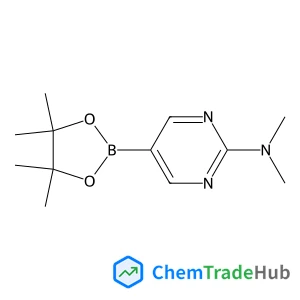
N,N-Dimethyl-5-(4,4,5,5-tetramethyl-1,3,2-dioxaborolan-2-yl)-2-pyrimidinamine
CAS Number:
1032759-30-0
Molecular Formula:
C12H20BN3O2
Recommended Suppliers






Disclaimer
This page provides academic journal information for reference and research purposes only. We are not affiliated with any journal publishers and do not handle publication submissions. For publication-related inquiries, please contact the respective journal publishers directly.
If you notice any inaccuracies in the information displayed, please contact us at support@chemtradehub.com. We will promptly review and address your concerns.