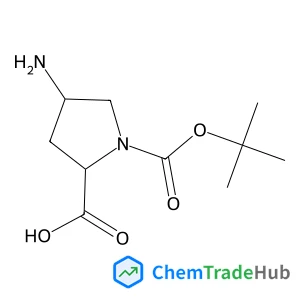
(2R,4R)-1-Boc-4-Aminopyrrolidine-2-carboxylic acid
CAS Number:
132622-98-1
Molecular Formula:
C10H18N2O4
Lisbeth Grøndahl, Edeline Wentrup-Byrne
We have demonstrated that the unacknowledged presence of almost 30% diene impurity in some commercial phosphate monomers had not only a significant effect on the molecular structure (topology) of a series of synthesized polymers but the instability of the ester functionalities during these polymerizations resulted in unexpectedly complex co-polymer chemistry.
Jongsik Kim, Jason C. Hicks
DOI: 10.1039/C7CP01322A
Julin Joseph, Aji A. Anappara
DOI: 10.1039/C7CP02731A
Long Van Duong
DOI: 10.1039/C7CP01740E
Chongshan Yin, Lingtao Wang, Jingjing Li, Yawei Zhou, Haining Zhang, Pengfei Fang, Chunqing He
DOI: 10.1039/C7CP03052E
Anindya Sundar Patra, Gaurangi Gogoi, Ranjan Kumar Sahu, Mohammad Qureshi
DOI: 10.1039/C7CP01444A
A. R. Cholach, A. A. Bryliakova
DOI: 10.1039/C7CP00900C
Anthony J. R. Rennie, Roberto M. Torresi, Peter J. Hall
DOI: 10.1039/C7CP03377J
Peng Liu, Jingxue Zhang, Dunyou Wang
DOI: 10.1039/C7CP02313H
When considering alternatives to 1-(4-Chlorophenyl)-N-hydroxymethanimine (CAS: 3...
This compound should be stored in a cool, dry place away from direct sunlight. I...
3-(4-Bromophenyl)-5-(2-fluorophenyl)-1,2,4-oxadiazole is synthesized through a m...
5-Chloro-2-(4-chlorophenyl)-4-methyl-6-[3-(1-piperidinyl)propoxy]pyrimidine (CAS...
2-Chloro-4-(difluoromethoxy)pyridine is used in the pharmaceutical industry for ...
3-Chloro-6-methylpyridazine (CAS: 1121-79-5) is classified under the Globally Ha...
Several alternatives can be used in the synthesis of Methyl 4,5-dimethyl-2-nitro...
Alternatives to (2E,2'E)-3,3'-(1,4-Phenylene)bisacrylaldehyde include other acry...
3-Amino-5-chloropyridin-2-ol hydrochloride is an organic compound with the CAS n...
When handling 6,7-Difluoro-2,3-dihydro-4H-chromen-4-one, it is essential to wear...

ChemComm publishes urgent research which is of outstanding significance and interest to experts in the field, while also appealing to the journal’s broad chemistry readership. Our communication format is ideally suited to short, urgent studies that are of such importance that they require accelerated publication. Our scope covers all topics in chemistry, and research at the interface of chemistry and other disciplines (such as materials science, nanoscience, physics, engineering and biology) where there is a significant novelty in the chemistry aspects. Major topic areas covered include: Analytical Chemistry Catalysis Chemical Biology and medicinal chemistry Computational Chemistry and Machine Learning Energy and sustainable chemistry Environmental Chemistry Green Chemistry Inorganic Chemistry Materials Chemistry Nanoscience Organic Chemistry Physical Chemistry Polymer Chemistry Supramolecular Chemistry