




Optogenetic modulation of real-time nanoscale dynamics of HCN channels using photoactivated adenylyl cyclases
Literature Information
Publication Date
2021-03-08
DOI
10.1039/D0CB00124D
Impact Factor
0
Authors
Meenakshi Tanwar, Suneel Kateriya, Deepak Nair, Mini Jose
View Original
Abstract
Adenosine 3′,5′-cyclic monophosphate (cAMP) is a key second messenger that activates several signal transduction pathways in eukaryotic cells. Alteration of basal levels of cAMP is known to activate protein kinases, regulate phosphodiesterases and modulate the activity of ion channels such as Hyper polarization-activated cyclic nucleotide gated channels (HCN). Recent advances in optogenetics have resulted in the availability of novel genetically encoded molecules with the capability to alter cytoplasmic profiles of cAMP with unprecedented spatial and temporal precision. Using single molecule based super-resolution microscopy and different optogenetic modulators of cellular cAMP in both live and fixed cells, we illustrate a novel paradigm to report alteration in nanoscale confinement of ectopically expressed HCN channels. We characterized the efficacy of cAMP generation using ensemble photoactivation of different optogenetic modulators. Then we demonstrate that local modulation of cAMP alters the exchange of membrane bound HCN channels with its nanoenvironment. Additionally, using high density single particle tracking in combination with both acute and chronic optogenetic elevation of cAMP in the cytoplasm, we show that HCN channels are confined to sub 100 nm sized functional domains on the plasma membrane. The nanoscale properties of these domains along with the exchange kinetics of HCN channels in and out of these molecular zones are altered upon temporal changes in the cytoplasmic cAMP. Using HCN2 point mutants and a truncated construct of HCN2 with altered sensitivity to cAMP, we confirmed these alterations in lateral organization of HCN2 to be specific to cAMP binding. Thus, combining these advanced non-invasive paradigms, we report a cAMP dependent ensemble and single particle behavior of HCN channels mediated by its cyclic nucleotide binding domain, opening innovative ways to dissect biochemical pathways at the nanoscale and real-time in living cells.
Recommended Journals

Science

Proceedings of the National Academy of Sciences of the United States of America

Journal of Organometallic Chemistry

Planta Medica

Pharmacological Reviews

Journal of Physics and Chemistry of Solids

Journal of Heterocyclic Chemistry

Israel Journal of Chemistry

Journal of Catalysis

European Journal of Wood and Wood Products
Related Literature
A theoretical study on hot charge-transfer states and dimensional effects of organic photocells based on an ideal diode model
2017-04-19
Paper
DOI: 10.1039/C7CP01455D
Unusual molecular mechanism behind the thermal response of polypeptoids in aqueous solutions
Jianbo Ma, Sunting Xuan, Abby C. Guerin, Tianyi Yu, Donghui Zhang, Daniel G. Kuroda
2017-04-04
Paper
DOI: 10.1039/C6CP08536A
Current–voltage characteristics influenced by the nanochannel diameter and surface charge density in a fluidic field-effect-transistor
Chunlei Guo
2017-05-19
Paper
DOI: 10.1039/C7CP02457F
Unexpected coordination number and phase diagram of niobium diselenide under compression
Zhong-Li Liu, Hong Jia, Rui Li, Xiu-Lu Zhang, Ling-Cang Cai
2017-05-03
Paper
DOI: 10.1039/C7CP00805H
Time-resolved measurements of product formation in the low-temperature (550–675 K) oxidation of neopentane: a probe to investigate chain-branching mechanism
Ivan O. Antonov, Leonid Sheps, John D. Savee, David L. Osborn, Craig A. Taatjes
2017-05-03
Paper
DOI: 10.1039/C7CP01366C
Local rotational symmetry in the packing of uniform spheres
Z. A. Tian, K. J. Dong, A. B. Yu
2017-05-10
Paper
DOI: 10.1039/C7CP01152K
Growth of low doped monolayer graphene on SiC(0001) via sublimation at low argon pressure
Périne Landois, Tianlin Wang, Abir Nachawaty, Maxime Bayle, Jean-Manuel Decams, Wilfried Desrat, Ahmed-Azmi Zahab, Benoît Jouault, Matthieu Paillet, Sylvie Contreras
2017-05-12
Paper
DOI: 10.1039/C7CP01012E
Structure and dynamics of water confined in a graphene nanochannel under gigapascal high pressure: dependence of friction on pressure and confinement
Lei Yang, Yanjie Guo, Dongfeng Diao
2017-05-05
Paper
DOI: 10.1039/C7CP01962A
pH-Dependent absorption spectrum of a protein: a minimal electrostatic model of Anabaena sensory rhodopsin
Michael Stenrup, Elisa Pieri, Vincent Ledentu, Nicolas Ferré
2017-05-03
Paper
DOI: 10.1039/C7CP00991G
On exo-cyclic aromaticity
Tamal Goswami, Manoswita Homray, Satadal Paul, Debojit Bhattacharya, Anirban Misra
2017-04-18
Communication
DOI: 10.1039/C7CP02031G
You might also like
Compound Q&A
How should waste containing N-Methoxy-N-methyl-1,3-thiazole-5-carboxamide (CAS: 898825-89-3) be handled?
Waste containing N-Methoxy-N-methyl-1,3-thiazole-5-carboxamide (CAS: 898825-89-3...
898825-89-3N-Methoxy-N-methyl-1...
Compound Q&A
How should N-(4-Biphenylyl)dibenzo[b,d]furan-4-amine (CAS: 1318338-47-4) be stored?
N-(4-Biphenylyl)dibenzo[b,d]furan-4-amine should be stored in a tightly sealed c...
1318338-47-4N-(4-Biphenylyl)dibe...
Compound Q&A
What is the market or research trend for 3-Acetamido-5-amino-2,4,6-triiodobenzoic acid (CAS: 1713-07-1)?
The market for 3-Acetamido-5-amino-2,4,6-triiodobenzoic acid (CAS: 1713-07-1) is...
1713-07-13-Acetamido-5-amino-...
Compound Q&A
How should Benzyl 2-O-acetyl-3,4,6-tri-O-benzyl-beta-D-galactopyranoside (CAS: 61820-03-9) be stored?
Benzyl 2-O-acetyl-3,4,6-tri-O-benzyl-beta-D-galactopyranoside (CAS: 61820-03-9) ...
61820-03-9Benzyl 2-O-acetyl-3,...
Compound Q&A
What regulatory guidelines apply to 2-Ethylpiperazine dihydrochloride (CAS: 438050-52-3)?
2-Ethylpiperazine dihydrochloride (CAS: 438050-52-3) is regulated under the Glob...
438050-52-32-Ethylpiperazine di...
Compound Q&A
What regulatory guidelines apply to 1,1'-[1,3-Phenylenebis(methylene)]bis(3-methyl-1H-pyrrole-2,5-dione) (CAS: 119462-56-5)?
1,1'-[1,3-Phenylenebis(methylene)]bis(3-methyl-1H-pyrrole-2,5-dione) (CAS: 11946...
119462-56-51,1'-[1,3-Phenyleneb...
Compound Q&A
Are there alternatives to 5-Fluoro-2-(1-pyrrolidinyl)pyridine (CAS: 1287217-79-1) in synthesis?
Several alternatives can be used in the synthesis of 5-Fluoro-2-(1-pyrrolidinyl)...
1287217-79-15-Fluoro-2-(1-pyrrol...
Compound Q&A
What precautions should be taken when handling 1-((2R,3R,4R,5R)-5-((bis(4-methoxyphenyl)(phenyl)methoxy)methyl)-4-hydroxy-3-methoxytetrahydrofuran-2-yl)-5-methylpyrimidine-2,4(1H,3H)-dione (CAS: 153631-19-7)?
Proper personal protective equipment (PPE) must be worn when handling this compo...
153631-19-71-((2R,3R,4R,5R)-5-(...
Compound Q&A
What precautions should be taken when handling 6-Bromoimidazo[1,2-a]pyridin-8-amine (CAS: 676371-00-9)?
When handling 6-Bromoimidazo[1,2-a]pyridin-8-amine, it is important to wear appr...
676371-00-96-Bromoimidazo[1,2-a...
Compound Q&A
Are there alternatives to (2S,4R)-4-(4-Nitrobenzyl)pyrrolidine-2-carboxylic acid hydrochloride (CAS: 1049740-22-8) in synthesis?
Alternatives to (2S,4R)-4-(4-Nitrobenzyl)pyrrolidine-2-carboxylic acid hydrochlo...
1049740-22-8(2S,4R)-4-(4-Nitrobe...
Source Journal
Recommended Compounds


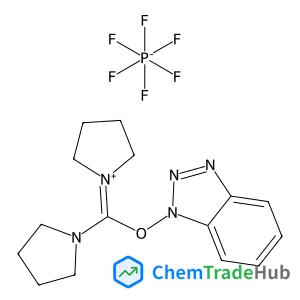
(1H-Benzotriazol-1-yloxy)(di-1-pyrrolidinyl)methylium hexafluorophosphate
CAS Number:
105379-24-6
Molecular Formula:
C15H21F6N5OP

Recommended Suppliers





Disclaimer
This page provides academic journal information for reference and research purposes only. We are not affiliated with any journal publishers and do not handle publication submissions. For publication-related inquiries, please contact the respective journal publishers directly.
If you notice any inaccuracies in the information displayed, please contact us at support@chemtradehub.com. We will promptly review and address your concerns.