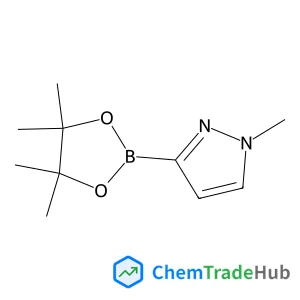
1-Methyl-3-(4,4,5,5-tetramethyl-1,3,2-dioxaborolan-2-yl)-1H-pyrazole
CAS Number:
1020174-04-2
Molecular Formula:
C10H17BN2O2
Z. A. Tian, K. J. Dong, A. B. Yu
Local rotational symmetry (LRS) of a particulate system is important for understanding its structure and phase transition. However, how to properly characterize LRS for this system is still a challenge as the system normally includes both ordered and disordered local structures. Herein, based on the so-called common neighbour subcluster (CNS), we proposed a method to characterize the LRS of uniform spheres packings with the packing fraction ρ ranging within 0.20 and 0.74. It was found that different fold LRSs coexist in most packings, and their maximum degree increases at ρ < 0.64, except for the 2-fold LRS held by 6-sphere CNS that continuously increases to form the fcc crystal at ρ = 0.74. The overall LRS involving all the CNSs monotonically increases with two critical changes at ρ = (0.35–0.40) and 0.64; the evolution of individual LRSs held by specific CNS groups critically changes at ρ ≈ (0.35–0.40), 0.50, 0.55–0.60, and 0.64. The physics corresponding to these critical changes has also been discussed. The findings will significantly enrich the understanding of the structural symmetry of materials including atoms and particles.
Makoto Uchida, Young-Chul Park, Katsuyoshi Kakinuma, Hiroshi Yano, Donald A. Tryk, Takeo Kamino, Hiroyuki Uchida, Masahiro Watanabe
DOI: 10.1039/C3CP51801A
Chia-Shing Wu, Szu-Wen Fang, Yun Chen
DOI: 10.1039/C3CP52087K
Pyosang Kim, Sujin Ham, Juwon Oh, Hiroki Uoyama, Hajime Watanabe, Kazunari Tagawa, Hidemitsu Uno, Dongho Kim
DOI: 10.1039/C3CP50166C
Imre Bakó, Ákos Bencsura, Kersti Hermannson, Szabolcs Bálint, Tamás Grósz, Julianna Oláh
DOI: 10.1039/C3CP52271G
Muruganathan Ramanathan, Lok Kumar Shrestha, Qingmin Ji
DOI: 10.1039/C3CP50620G
G. Ramos-Sanchez, P. B. Balbuena
DOI: 10.1039/C3CP51791H
DOI: 10.1039/C3CP50907A
Franziska Buchner, Hans-Hermann Ritze, Jan Lahl, Andrea Lübcke
DOI: 10.1039/C3CP51057C
Anita Gollmer, Johannes Regensburger, Tim Maisch, Wolfgang Bäumler
DOI: 10.1039/C3CP50841B
Waste containing N-Methoxy-N-methyl-1,3-thiazole-5-carboxamide (CAS: 898825-89-3...
N-(4-Biphenylyl)dibenzo[b,d]furan-4-amine should be stored in a tightly sealed c...
The market for 3-Acetamido-5-amino-2,4,6-triiodobenzoic acid (CAS: 1713-07-1) is...
Benzyl 2-O-acetyl-3,4,6-tri-O-benzyl-beta-D-galactopyranoside (CAS: 61820-03-9) ...
2-Ethylpiperazine dihydrochloride (CAS: 438050-52-3) is regulated under the Glob...
1,1'-[1,3-Phenylenebis(methylene)]bis(3-methyl-1H-pyrrole-2,5-dione) (CAS: 11946...
Several alternatives can be used in the synthesis of 5-Fluoro-2-(1-pyrrolidinyl)...
Proper personal protective equipment (PPE) must be worn when handling this compo...
When handling 6-Bromoimidazo[1,2-a]pyridin-8-amine, it is important to wear appr...
Alternatives to (2S,4R)-4-(4-Nitrobenzyl)pyrrolidine-2-carboxylic acid hydrochlo...

Physical Chemistry Chemical Physics (PCCP) is an international journal co-owned by 19 physical chemistry and physics societies from around the world. This journal publishes original, cutting-edge research in physical chemistry, chemical physics and biophysical chemistry. To be suitable for publication in PCCP, articles must include significant innovation and/or insight into physical chemistry; this is the most important criterion that reviewers and Editors will judge against when evaluating submissions. The journal has a broad scope and welcomes contributions spanning experiment, theory, computation and data science. Topical coverage includes spectroscopy, dynamics, kinetics, statistical mechanics, thermodynamics, electrochemistry, catalysis, surface science, quantum mechanics, quantum computing and machine learning. Interdisciplinary research areas such as polymers and soft matter, materials, nanoscience, energy, surfaces/interfaces, and biophysical chemistry are welcomed if they demonstrate significant innovation and/or insight into physical chemistry. Joined experimental/theoretical studies are particularly appreciated when complementary and based on up-to-date approaches.
![1-Naphthalenesulfonic acid, 2-[(2-hydroxy-1-naphthalenyl)azo]-, bariumsalt (2:1) structure](https://static.chemtradehub.com/structs/110/1103-38-4-0b33.webp "1-Naphthalenesulfonic acid, 2-[(2-hydroxy-1-naphthalenyl)azo]-, bariumsalt (2:1) structure")