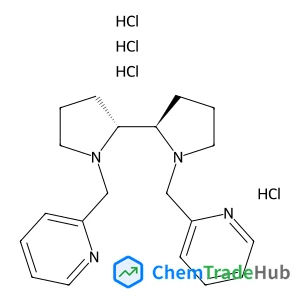
(2R,2'R)-1,1'-Bis(2-pyridinylmethyl)-2,2'-bipyrrolidine tetrahydrochloride
CAS Number:
1228077-88-0
Molecular Formula:
C20H30Cl4N4
The first page of this article is displayed as the abstract.
Inacrist Geronimo, Christina M. Payne, Mats Sandgren
DOI: 10.1039/C7OB02558K
Vladimir Maslivetc, Colby Barrett, Nicolai A. Aksenov
DOI: 10.1039/C7OB02068F
Jie-Hui Zhang, Cheng-Lin Pan, Huan-Huan Zhang
DOI: 10.1039/D1QO00228G
Animesh Mondal, Barnali Naskar, Sanchita Goswami, Chandraday Prodhan, Keya Chaudhuri, Chhanda Mukhopadhyay
DOI: 10.1039/C7OB02651J
Nikolai I. Sosnin, Olga A. Fedorova, Heiko Ihmels
DOI: 10.1039/C7OB02736B
S. Vergura, L. Pisani, P. Scafato, D. Casarini, S. Superchi
DOI: 10.1039/C7OB02730C
Bin-Hua Yuan, Wen-Jie Liu
DOI: 10.1039/C7OB02891A
Samuel R. Perry, Timothy A. Hill, Aline D. de Araujo, Huy N. Hoang, David P. Fairlie
DOI: 10.1039/C7OB02952G
Tao Yuan, Shenlin Huang, Chun Cai, Guo-ping Lu
DOI: 10.1039/C7OB02620J
Abith Vattekkatte, Stefan Garms, Wolfgang Brandt, Wilhelm Boland
DOI: 10.1039/C7OB02040F
(3.beta.)-3-Hydroxy-N,N-dimethyl-chol-5-en-24-amide (CAS: 79066-03-8) is primari...
5-(Aminomethyl)-2-methoxyphenol (CAS: 89702-89-6) is classified under GHS as a s...
Thieno[2,3-c]pyridin-7(6H)-one (CAS: 28981-13-7) is a heterocyclic organic compo...
1-[(6-Methoxy-3-pyridinyl)methyl]-4-piperidinamine dihydrochloride is generally ...
[(2E)-3-Phenyl-2-propen-1-yl]phosphonic acid (CAS: 146404-58-2) is regulated und...
6-Bromo-7-methoxyquinoline (CAS: 1620515-86-7) falls under the scope of the Glob...
This compound is primarily used in the pharmaceutical industry for the developme...
1-Ethyl-7-[2-methyl-6-(4H-1,2,4-triazol-3-yl)-3-pyridinyl]-3,5-dihydropyrazino[2...
Alternative reagents such as 2-[(dimethylamino)methyl]phenylboronic acid or rela...
3-(Piperidin-4-yloxy)pyridine (CAS: 310881-48-2) is an organic compound with the...

Chem Soc Rev publishes review articles covering important topics at the forefront of the chemical sciences. Reviews should be of the very highest quality and international impact. We particularly encourage international and multidisciplinary collaborations among our authors. Our scope covers the breadth of the chemical sciences, including interdisciplinary topics where the article has a basis in chemistry. Topics include: Analytical chemistry Biomaterials chemistry Bioorganic/medicinal chemistry Catalysis Chemical Biology Coordination Chemistry Crystal Engineering Energy Sustainable chemistry Green chemistry Inorganic chemistry Inorganic materials Main group chemistry Nanoscience Organic chemistry Organic materials Organometallics Physical chemistry Supramolecular chemistry Synthetic methodology Theoretical and computational chemistry
![N-[(6-Bromo-3-pyridinyl)methyl]ethanamine structure](https://static.chemtradehub.com/structs/120/120740-05-8-ca55.webp "N-[(6-Bromo-3-pyridinyl)methyl]ethanamine structure")