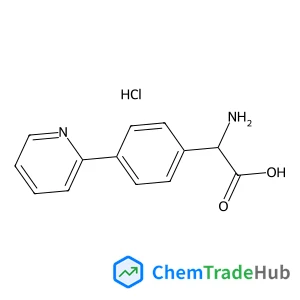
2-Amino-2-(4-(pyridin-2-YL)phenyl)acetic acid hydrochloride
CAS Number:
1135818-89-1
Molecular Formula:
C13H13ClN2O2
Inacrist Geronimo, Christina M. Payne, Mats Sandgren
β-Glucosidases (βgls) primarily catalyze the hydrolysis of the terminal glycosidic bond at the non-reducing end of β-glucosides, although glycosidic bond synthesis (called transglycosylation) can also occur in the presence of another acceptor. In the final reaction step, the glucose product or another substrate competes with water for transfer to the glycosyl-enzyme intermediate. The factors governing the balance between the two pathways are not fully known; however, the involvement of ionizable residues in binding and catalysis suggests that their pKa may play a role. Through constant pH molecular dynamics simulations of a glycoside hydrolase Family 3 (GH3) βgl, we showed that the pKa of the catalytic acid/base residue, E441, is low (∼2) during either reaction due to E441–R125–E128 and E441–R125–E166 hydrogen bond networks. The low basicity of E441 would reduce its ability to deprotonate the acceptor. This may be less critical for transglycosylation because sugars have a lower deprotonation enthalpy than water. Moreover, their acidity would be increased by hydrogen bonding with R169 at the acceptor binding site. In contrast, no such interaction was observed for catalytic water. The results are likely applicable to other GH3 βgls because R125, E128, E166, and R169 are conserved. As these enzymes are commonly used in biomass degradation, there is interest in developing variants with enhanced hydrolytic activity. This may be accomplished by elevating the acid/base residue pKa by disrupting its hydrogen bond networks and reducing the affinity and reactivity of a sugar acceptor by mutating R169.

New Journal of Chemistry

Current Opinion in Colloid & Interface Science

Acta Materialia

Journal of Natural Medicines

Journal of Saudi Chemical Society

Current Opinion in Solid State & Materials Science

Russian Journal of Coordination Chemistry

Russian Journal of Bioorganic Chemistry

Drug Discovery Today

Russian Chemical Bulletin
Dan Bai, Andrew C. Benniston, Jerry Hagon, Helge Lemmetyinen, Nikolai V. Tkachenko, William Clegg, Ross W. Harrington
DOI: 10.1039/C2CP23868C
Ronen Kreizman, Osip Schwartz, Zvicka Deutsch, Stella Itzhakov, Alla Zak, Sidney R. Cohen, Reshef Tenne, Dan Oron
DOI: 10.1039/C2CP24043B
Jialin Li, Qun Zhang, Yang Chen, Cunshun Huang, Xueming Yang
DOI: 10.1039/C2CP22385F
C. Callegari
DOI: 10.1039/C2CP22749E
Uttam Anand, Lisha Kurup, Saptarshi Mukherjee
DOI: 10.1039/C2CP00001F
Jens Petersen, Matthias Wohlgemuth, Bernhard Sellner, Roland Mitrić
DOI: 10.1039/C2CP24002E
Yasuhiro Inada, Yasuhiro Niwa, Masao Kimura, Kyoko K. Bando, Akira Yagishita, Yasuhiro Iwasawa, Masaharu Nomura
DOI: 10.1039/C1CP22466B
Yun Wang, Tao Sun, Dongjiang Yang, Hongwei Liu, Haimin Zhang, Xiangdong Yao, Huijun Zhao
DOI: 10.1039/C2CP23143C
Tim S. Totton, Alston J. Misquitta, Markus Kraft
DOI: 10.1039/C2CP23008A
(3.beta.)-3-Hydroxy-N,N-dimethyl-chol-5-en-24-amide (CAS: 79066-03-8) is primari...
5-(Aminomethyl)-2-methoxyphenol (CAS: 89702-89-6) is classified under GHS as a s...
Thieno[2,3-c]pyridin-7(6H)-one (CAS: 28981-13-7) is a heterocyclic organic compo...
1-[(6-Methoxy-3-pyridinyl)methyl]-4-piperidinamine dihydrochloride is generally ...
[(2E)-3-Phenyl-2-propen-1-yl]phosphonic acid (CAS: 146404-58-2) is regulated und...
6-Bromo-7-methoxyquinoline (CAS: 1620515-86-7) falls under the scope of the Glob...
This compound is primarily used in the pharmaceutical industry for the developme...
1-Ethyl-7-[2-methyl-6-(4H-1,2,4-triazol-3-yl)-3-pyridinyl]-3,5-dihydropyrazino[2...
Alternative reagents such as 2-[(dimethylamino)methyl]phenylboronic acid or rela...
3-(Piperidin-4-yloxy)pyridine (CAS: 310881-48-2) is an organic compound with the...

Organic & Biomolecular Chemistry (OBC) publishes original and high impact research and reviews in organic chemistry. We welcome research that shows new or significantly improved protocols or methodologies in total synthesis, synthetic methodology or physical and theoretical organic chemistry as well as research that shows a significant advance in the organic chemistry or molecular design aspects of chemical biology, catalysis, supramolecular and macromolecular chemistry, theoretical chemistry, mechanism-oriented physical organic chemistry, medicinal chemistry or natural products. Articles published in the journal should report new work which makes a highly-significant impact in the field. Routine and incremental work is generally not suitable for publication in the journal. More details about key areas of our scope are below. In all cases authors should include in their article clear rationale for why their research has been carried out.
![4-[(4-Bromophenyl)sulfonyl]thiomorpholine structure](https://static.chemtradehub.com/structs/223/223555-81-5-2d67.webp "4-[(4-Bromophenyl)sulfonyl]thiomorpholine structure")
![7-Bromo-5-chloro-1H-pyrazolo[4,3-b]pyridine structure](https://static.chemtradehub.com/structs/135/1351813-70-1-a716.webp "7-Bromo-5-chloro-1H-pyrazolo[4,3-b]pyridine structure")