












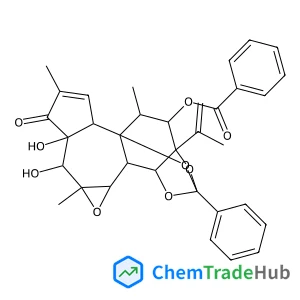
Highly efficient asymmetric construction of novel indolines and tetrahydroquinoline derivatives via aza-Barbier/C–N coupling reaction
Literature Information
Publication Date
2017-12-04
DOI
10.1039/C7OB02891A
Impact Factor
3.876
Authors
Bin-Hua Yuan, Wen-Jie Liu
View Original
Abstract
Highly stereoselective syntheses of chiral indolines and tetrahydroquinolines are achieved by combining the asymmetric Zn-mediated allylation of chiral N-tert-butanesulfinyl imines with efficient intramolecular C–N cross-coupling. Herein, the advantages of such a synthetic strategy are illustrated by the synthesis of indolines and tetrahydroquinolines with quaternary stereocenters and multi-substituted 1-oxo-1,2,3,4-tetrahydroisoquinolines.
Related Literature
Swelling properties of thermoresponsive/hydrophilic co-networks with functional crosslinked domain structures
Shohei Ida, Hironobu Kitanaka, Tatsuya Ishikawa, Shokyoku Kanaoka, Yoshitsugu Hirokawa
2018-01-03
Paper
DOI: 10.1039/C7PY01793F
Squalene/polyethylenimine based non-viral vectors: synthesis and use in systems for sustained gene release
Geta David, Lilia Clima, Manuela Calin, Cristina Ana Constantinescu, Mihaela Balan-Porcarasu
2018-01-25
Paper
DOI: 10.1039/C7PY01720K
Significantly improved energy density of BaTiO3 nanocomposites by accurate interfacial tailoring using a novel rigid-fluoro-polymer
Sheng Chen, Xuguang Lv, Xianghui Han, Hang Luo, Chris R. Bowen, Dou Zhang
2017-12-08
Paper
DOI: 10.1039/C7PY01914A
Simultaneous superior lubrication and high load bearing by the dynamic weak interaction of a lubricant with mechanically strong bilayer porous hydrogels
Meirong Cai, Bo Yu, Feng Zhou
2017-10-03
Communication
DOI: 10.1039/C7PY01532A
Temperature-responsive hydrogels via the electrostatic interaction of amphiphilic diblock copolymers with pendant-ion groups
Hye Yun Lee, Seung Hun Park, Jae Ho Kim, Moon Suk Kim
2017-10-17
Paper
DOI: 10.1039/C7PY01460K
Terpyridine-functionalized stimuli-responsive microgels and their assembly through metal–ligand interactions
Jookyeong Lee, Eun Jung Choi, Imre Varga, Sang-Ho Yun, Changsik Song
2018-01-30
Paper
DOI: 10.1039/C8PY00016F
Ferromagnetic iron oxide–cellulose nanocomposites prepared by ultrasonication
Razvan Rotaru, Marcela Savin, Nita Tudorachi, Cristian Peptu, Petrisor Samoila, Liviu Sacarescu, Valeria Harabagiu
2017-10-27
Paper
DOI: 10.1039/C7PY01587A
You might also like
Compound Q&A
What are the main uses of (3.beta.)-3-Hydroxy-N,N-dimethyl-chol-5-en-24-amide (CAS: 79066-03-8)?
(3.beta.)-3-Hydroxy-N,N-dimethyl-chol-5-en-24-amide (CAS: 79066-03-8) is primari...
79066-03-8(3.beta.)-3-Hydroxy-...
Compound Q&A
What regulatory guidelines apply to 5-(aminomethyl)-2-methoxyphenol (CAS: 89702-89-6)?
5-(Aminomethyl)-2-methoxyphenol (CAS: 89702-89-6) is classified under GHS as a s...
89702-89-65-(aminomethyl)-2-me...
Compound Q&A
What is Thieno[2,3-c]pyridin-7(6H)-one (CAS: 28981-13-7)?
Thieno[2,3-c]pyridin-7(6H)-one (CAS: 28981-13-7) is a heterocyclic organic compo...
28981-13-7Thieno[2,3-c]pyridin...
Compound Q&A
Is 1-[(6-Methoxy-3-pyridinyl)methyl]-4-piperidinamine dihydrochloride (CAS: 1185311-28-7) safe?
1-[(6-Methoxy-3-pyridinyl)methyl]-4-piperidinamine dihydrochloride is generally ...
1185311-28-71-[(6-Methoxy-3-pyri...
Compound Q&A
What regulatory guidelines apply to [(2E)-3-Phenyl-2-propen-1-yl]phosphonic acid (CAS: 146404-58-2)?
[(2E)-3-Phenyl-2-propen-1-yl]phosphonic acid (CAS: 146404-58-2) is regulated und...
146404-58-2[(2E)-3-Phenyl-2-pro...
Compound Q&A
What regulatory guidelines apply to 6-Bromo-7-methoxyquinoline (CAS: 1620515-86-7)?
6-Bromo-7-methoxyquinoline (CAS: 1620515-86-7) falls under the scope of the Glob...
1620515-86-76-Bromo-7-methoxyqui...
Compound Q&A
What industries use (2R)-1-(1-Benzofuran-2-yl)-N-propyl-2-pentanamine (CAS: 260550-89-8)?
This compound is primarily used in the pharmaceutical industry for the developme...
260550-89-8(2R)-1-(1-Benzofuran...
Compound Q&A
What are the main uses of 1-Ethyl-7-[2-methyl-6-(4H-1,2,4-triazol-3-yl)-3-pyridinyl]-3,5-dihydropyrazino[2,3-b]pyrazin-2(1H)-one (CAS: 1228013-15-7)?
1-Ethyl-7-[2-methyl-6-(4H-1,2,4-triazol-3-yl)-3-pyridinyl]-3,5-dihydropyrazino[2...
1228013-15-71-Ethyl-7-[2-methyl-...
Compound Q&A
Are there alternatives to {5-(Acryloylamino)-2-[(dimethylamino)methyl]phenyl}boronic acid (CAS: 1217500-78-1) in synthesis?
Alternative reagents such as 2-[(dimethylamino)methyl]phenylboronic acid or rela...
1217500-78-1{5-(Acryloylamino)-2...
Compound Q&A
What is 3-(Piperidin-4-yloxy)pyridine (CAS: 310881-48-2)?
3-(Piperidin-4-yloxy)pyridine (CAS: 310881-48-2) is an organic compound with the...
310881-48-23-(Piperidin-4-yloxy...
Source Journal
Organic & Biomolecular Chemistry

CiteScore:
3.4
Self-citation Rate:
10.3%
Articles per Year:
1041
Organic & Biomolecular Chemistry (OBC) publishes original and high impact research and reviews in organic chemistry. We welcome research that shows new or significantly improved protocols or methodologies in total synthesis, synthetic methodology or physical and theoretical organic chemistry as well as research that shows a significant advance in the organic chemistry or molecular design aspects of chemical biology, catalysis, supramolecular and macromolecular chemistry, theoretical chemistry, mechanism-oriented physical organic chemistry, medicinal chemistry or natural products. Articles published in the journal should report new work which makes a highly-significant impact in the field. Routine and incremental work is generally not suitable for publication in the journal. More details about key areas of our scope are below. In all cases authors should include in their article clear rationale for why their research has been carried out.
Recommended Compounds
Recommended Suppliers





Disclaimer
This page provides academic journal information for reference and research purposes only. We are not affiliated with any journal publishers and do not handle publication submissions. For publication-related inquiries, please contact the respective journal publishers directly.
If you notice any inaccuracies in the information displayed, please contact us at support@chemtradehub.com. We will promptly review and address your concerns.