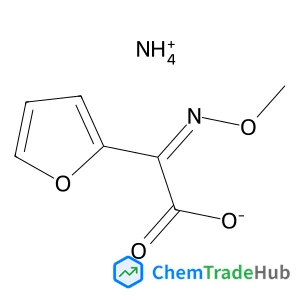
Ammonium (Z)-2-(furan-2-yl)-2-(methoxyimino)acetate
CAS Number:
97148-39-5
Molecular Formula:
C7H10N2O4
The first page of this article is displayed as the abstract.
William O. Oduro, Nick Cailuo, Kai Man K. Yu, Hongwei Yang, Shik Chi Tsang
DOI: 10.1039/C0CP01832E
Chun-Jiang Jia, Ferdi Schüth
DOI: 10.1039/C0CP02680H
Guoquan Zhang, Fenglin Yang
DOI: 10.1039/C0CP00608D
Darren Yang, Gaurav Arya
DOI: 10.1039/C0CP01487G
Dat Tien Hoang, Selim Alayoglu, Zhi Liu
DOI: 10.1039/C0CP01858A
Stefan Wellert, Matthias Karg, Olaf Holderer, André Richardt, Thomas Hellweg
DOI: 10.1039/C0CP02044C
Fu-Gen Wu, Jun-Jie Luo, Zhi-Wu Yu
DOI: 10.1039/C0CP01184C
Maria Hahlin, Michael Odelius, Martin Magnuson, Erik M. J. Johansson, Stefan Plogmaker, Daniel P. Hagberg, Licheng Sun, Hans Siegbahn, Håkan Rensmo
DOI: 10.1039/C0CP01491E
S. S. Sarangi, S. G. Raju, S. Balasubramanian
DOI: 10.1039/C0CP01272F
Lianqin Wang, Hui Meng, Pei Kang Shen, Claudio Bianchini, Francesco Vizza, Zidong Wei
DOI: 10.1039/C0CP01913E
1H-Indazole-6-carbonitrile finds applications in pharmaceuticals, where it serve...
Waste containing Dioctyl (2E)-2-butenedioate (CAS: 2997-85-5) should be collecte...
Sodium [(1,2-benzoxazol-3-ylmethyl)sulfonyl]azanide is primarily used in pharmac...
Dimethyl 4-(4,4,5,5-tetramethyl-1,3,2-dioxaborolan-2-yl)-2,6-pyridinedicarboxyla...
Waste containing 2-Fluoro-6-hydrazinopyridine (CAS: 80714-39-2) should be manage...
6-Formyl-2-pyridinecarboxylic acid is an organic compound with the molecular for...
Research trends for this compound indicate a focus on its potential applications...
9H-Tribenzo[b,d,f]azepine is typically synthesized via a multi-step process invo...
1-Cyclopropyl-7-ethoxy-6-fluoro-8-methoxy-4-oxo-1,4-dihydro-3-quinolinecarboxyli...
Waste containing Methyl 3-oxo-1,2,3,4-tetrahydro-6-quinoxalinecarboxylate (CAS: ...

Chem Soc Rev publishes review articles covering important topics at the forefront of the chemical sciences. Reviews should be of the very highest quality and international impact. We particularly encourage international and multidisciplinary collaborations among our authors. Our scope covers the breadth of the chemical sciences, including interdisciplinary topics where the article has a basis in chemistry. Topics include: Analytical chemistry Biomaterials chemistry Bioorganic/medicinal chemistry Catalysis Chemical Biology Coordination Chemistry Crystal Engineering Energy Sustainable chemistry Green chemistry Inorganic chemistry Inorganic materials Main group chemistry Nanoscience Organic chemistry Organic materials Organometallics Physical chemistry Supramolecular chemistry Synthetic methodology Theoretical and computational chemistry
![N-[(9H-Fluoren-9-ylmethoxy)carbonyl]serine structure](https://static.chemtradehub.com/structs/737/73724-45-5-b0dc.webp "N-[(9H-Fluoren-9-ylmethoxy)carbonyl]serine structure")