













3D-Printed electrodes for membraneless water electrolysis
Literature Information
Publication Date
2019-10-29
DOI
10.1039/C9SE00710E
Impact Factor
6.367
Authors
Justin C. Bui, Jonathan T. Davis, Daniel V. Esposito
View Original
Abstract
Additive manufacturing encompasses an emerging class of techniques that are increasingly finding applications in the field of electrochemistry. While most of these demonstrations have involved the use of 3D-printing to fabricate structural components of electrochemical devices, this manuscript describes the design, manufacture and performance of 3D-printed porous flow-through electrodes employed in an electrolyzer that is itself made almost entirely by 3D-printing. These electrodes were 3D-printed using fused deposition modeling (FDM) from a composite of conductive carbon and polylactic acid (PLA), followed by electrodeposition of nickel (Ni) electrocatalyst. The stability and performance of these Ni-PLA electrodes were evaluated for water electrolysis in 1.0 M sodium hydroxide (NaOH). After characterizing the performance of a single electrode pair for the hydrogen evolution reaction (HER) and oxygen evolution reaction (OER), three pairs of electrodes were incorporated into a simple and scalable 3D-printed membraneless electrolyzer by “clicking” them into a monolithic lid containing manifolding for collection of the O2 and H2 product gases. The device utilizes a membraneless architecture capable of operating in a stagnant electrolyte through buoyancy-driven separation of product gases, and allowing for easy regeneration of electrodes by electrodeposition. Device operation was evaluated through a combination of electroanalytical measurements, in situ high-speed video imaging, and finite element modeling. Although the efficiency and cross-over rates of these membraneless electrolyzers fall below what is required for commercial applications, additive manufacturing of electrodes offers an exciting new design space to improve performance and enable robust operation for applications where membrane-based electrolyzers are inherently unstable.
Related Literature
Carbon-based materials as heterogeneous antioxidants for biodiesel: efficiency and synergy with soluble antioxidants
Tais da C. Soares, Paulo R. M. Silva, Gilberto A. Romeiro, Mauricio G. Fonseca, Luciano N. Batista
2017-01-06
Communication
DOI: 10.1039/C6SE00017G
Asymmetric tin–vanadium redox electrolyte for hybrid energy storage with nanoporous carbon electrodes
Simon Fleischmann
2017-01-05
Paper
DOI: 10.1039/C6SE00062B
Suppressing intrinsic self-doping of CsPbIBr2 films for high-performance all-inorganic, carbon-based perovskite solar cells
Zeyang Zhang, Weidong Zhu, Dandan Chen, Wenming Chai, Dazheng Chen, He Xi, Jincheng Zhang, Chunfu Zhang, Yue Hao
2020-06-22
Paper
DOI: 10.1039/D0SE00774A
Sn dendrites for electrocatalytic N2 reduction to NH3 under ambient conditions
Xu Lv, Fengyi Wang, Juan Du, Qian Liu, Yongsong Luo, Siyu Lu, Guang Chen, Shuyan Gao, Baozhan Zheng, Xuping Sun
2020-06-30
Communication
DOI: 10.1039/D0SE00828A
Growth of three-dimensional flower-like SnS2 on g-C3N4 sheets as an efficient visible-light photocatalyst, photoelectrode, and electrochemical supercapacitance material
Sajid Ali Ansari, Moo Hwan Cho
2017-02-13
Paper
DOI: 10.1039/C6SE00049E
Cu3P/PAN derived N-doped carbon catalyst with non-toxic synthesis for alkaline hydrogen evolution reaction
HyoWon Kim, Yongju Lee, DongHoon Song, YongKeun Kwon, Eom-Ji Kim, EunAe Cho
2020-08-26
Paper
DOI: 10.1039/D0SE00923G
Hydrogen evolution with nanoengineered ZnO interfaces decorated using a beetroot extract and a hydrogenase mimic
M. V. Pavliuk, A. M. Cieślak, A. Budinská, S. Pullen, K. Sokołowski, D. L. A. Fernandes, J. Szlachetko, E. L. Bastos, S. Ott, L. Hammarström, T. Edvinsson
2017-01-09
Communication
DOI: 10.1039/C6SE00066E
Masking agent-free and channel-switch-mode simultaneous sensing of Fe3+ and Hg2+ using dual-excitation graphene quantum dots
Fengzhou Xu, Hui Shi, Xiaoxiao He, Kemin Wang, Dinggeng He, Lv'an Yan, Xiaosheng Ye, Jinlu Tang, Jingfang Shangguan, Lan Luo
2015-04-20
Communication
DOI: 10.1039/C5AN00468C
Chemical analysis of multicellular tumour spheroids
L. E. Jamieson, D. J. Harrison, C. J. Campbell
2015-04-23
Tutorial Review
DOI: 10.1039/C5AN00524H
You might also like
Compound Q&A
Is 2-(2-chloroacetamido)-3-phenylpropanoic acid (CAS: 7765-11-9) safe?
2-(2-Chloroacetamido)-3-phenylpropanoic acid (CAS: 7765-11-9) is generally consi...
7765-11-92-(2-chloroacetamido...
Compound Q&A
Is 2-(Benzyloxy)-5-bromobenzoic acid (CAS: 62176-31-2) safe?
2-(Benzyloxy)-5-bromobenzoic acid can be handled safely if appropriate precautio...
62176-31-22-(Benzyloxy)-5-brom...
Compound Q&A
What is (4-Methyl-1,2,5-oxadiazol-3-yl)methanamine hydrochloride (CAS: 1159825-48-5)?
(4-Methyl-1,2,5-oxadiazol-3-yl)methanamine hydrochloride is a chemical compound ...
1159825-48-5(4-Methyl-1,2,5-oxad...
Compound Q&A
What is 2-(5-Hexylthiophen-2-yl)-4,4,5,5-tetramethyl-1,3,2-dioxaborolane (CAS: 917985-54-7)?
2-(5-Hexylthiophen-2-yl)-4,4,5,5-tetramethyl-1,3,2-dioxaborolane (CAS: 917985-54...
917985-54-72-(5-Hexylthiophen-2...
Compound Q&A
Are there alternatives to 4-(8-Methyl-9H-1,3-dioxolo[4,5-h][2,3]benzodiazepin-5-yl)benzenamine (CAS: 102771-26-6) in synthesis?
While 4-(8-Methyl-9H-1,3-dioxolo[4,5-h][2,3]benzodiazepin-5-yl)benzenamine (CAS:...
102771-26-64-(8-Methyl-9H-1,3-d...
Compound Q&A
What is the market or research trend for tert-butyl 3-hydroxy-4,5,7,8-tetrahydro-2H-pyrazolo[3,4-d]azepine-6-carboxylate (CAS: 851376-80-2)?
The market for tert-butyl 3-hydroxy-4,5,7,8-tetrahydro-2H-pyrazolo[3,4-d]azepine...
851376-80-2tert-butyl 3-hydroxy...
Compound Q&A
How should waste containing 3,5-Diamino-1H-pyrazole-4-carbonitrile (CAS: 6844-58-2) be handled?
Waste containing 3,5-Diamino-1H-pyrazole-4-carbonitrile (CAS: 6844-58-2) should ...
6844-58-23,5-Diamino-1H-pyraz...
Compound Q&A
How is (6-Fluoro-3-pyridinyl)boronic acid (CAS: 351019-18-6) typically synthesized?
(6-Fluoro-3-pyridinyl)boronic acid can be synthesized through the reaction of 6-...
351019-18-6(6-Fluoro-3-pyridiny...
Compound Q&A
What industries use Dibenzyl carbonimidoylbiscarbamate (CAS: 10065-79-9)?
Dibenzyl carbonimidoylbiscarbamate (CAS: 10065-79-9) finds applications in vario...
10065-79-9Dibenzyl carbonimido...
Compound Q&A
What is the market or research trend for (beta,beta,2,3,4,5,6-~2~H_7_)Phenylalanine (CAS: 74228-83-4)?
The market for (beta,beta,2,3,4,5,6-~2~H_7_)Phenylalanine (CAS: 74228-83-4) is g...
74228-83-4(beta,beta,2,3,4,5,6...
Source Journal
Recommended Compounds
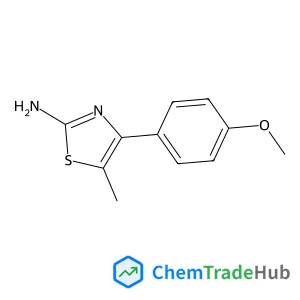
4-(4-Methoxyphenyl)-5-methyl-1,3-thiazol-2-amine
CAS Number:
105512-88-7
Molecular Formula:
C11H12N2OS
![2-(5-Bromo-1H-pyrrolo[2,3-B]pyridin-3-YL)acetic acid structure](https://static.chemtradehub.com/structs/106/1060795-03-0-0589.webp "2-(5-Bromo-1H-pyrrolo[2,3-B]pyridin-3-YL)acetic acid structure")
2-(5-Bromo-1H-pyrrolo[2,3-B]pyridin-3-YL)acetic acid
CAS Number:
1060795-03-0
Molecular Formula:
C9H7BrN2O2
![2-Azaspiro[4.5]decane-3,8-dione structure](https://static.chemtradehub.com/structs/914/914780-96-4-e94b.webp "2-Azaspiro[4.5]decane-3,8-dione structure")
Recommended Suppliers




Disclaimer
This page provides academic journal information for reference and research purposes only. We are not affiliated with any journal publishers and do not handle publication submissions. For publication-related inquiries, please contact the respective journal publishers directly.
If you notice any inaccuracies in the information displayed, please contact us at support@chemtradehub.com. We will promptly review and address your concerns.