













The preparation and mechanistic study of highly effective PtSnRu ternary nanorod catalysts toward the ethanol oxidation reaction
Literature Information
Publication Date
2019-09-25
DOI
10.1039/C9SE00474B
Impact Factor
6.367
Authors
Tzu-Hsi Huang, Hong-Sheng Zheng, Yih-Ming Cheng, Chen-Wei Liu, Sheng-Wei Lee, Jeng-Han Wang, Kuan-Wen Wang
View Original
Abstract
Although Pt-based anodes have shown promising electrochemical behaviors toward the ethanol oxidation reaction (EOR) in the direct ethanol fuel cell (DEFC) application, the rational design for optimizing the structures and compositions of catalysts is yet to be fully understood due largely to the lack of mechanistic insights into the catalytic reaction. Herein, we systematically investigated EOR on Pt-based binary (PtSn and PtRu) and ternary (PtSnRu) nanorods with varied atomic ratios to elucidate the effects of chemical composition and structure on the electrochemical behavior. The electrochemical results showed that Sn and Ru in the ternary PtSnRu NRs can effectively promote the EOR performance, both at 0.6 V (I06) and peak potential (Imax), as compared to binary PtSn and PtRu NRs. The enhanced activity at a low potential (I06) corresponded to the strengthened adsorption of water and ethanol on Ru site with a highly energetic d band structure; this at a high potential (Imax) was related to the oxygen-containing species on surface Sn, lowering the oxidation barriers through hydrogen-bond interactions, according to density functional theory-based calculations. The combination of electrochemical experiments on modeled binary and ternary electrodes and theoretical computation offers an effective approach to clarify the complex EOR mechanism and provides information vital to achieving the realistic design of better EOR anodes.
Related Literature
A sensitive strategy for the fluorescence detection of DNA methyltransferase activity based on the graphene oxide platform and T7 exonuclease-assisted cyclic signal amplification
Yefei Ma, Lini Chen, Liangliang Zhang, Suqi Liao
2015-04-07
Paper
DOI: 10.1039/C5AN00417A
An arginine-functionalized stationary phase for hydrophilic interaction liquid chromatography
Shengjie Wu, Feifang Zhang, Ge Jiang, Bingcheng Yang
2015-04-23
Communication
DOI: 10.1039/C5AN00570A
Nano-enabled bioanalytical approaches to ultrasensitive detection of low abundance single nucleotide polymorphisms
Yuan Guo, Dejian Zhou
2015-03-12
Minireview
DOI: 10.1039/C4AN02304H
Non-enzymatic glucose sensing by enhanced Raman spectroscopy on flexible ‘as-grown’ CVD graphene
Mau-Shiun Li, Pradip Kumar Roy, C. T. Wu
2015-04-24
Communication
DOI: 10.1039/C5AN00546A
A comparative study on methods of optimal sample preparation for the analysis of oligonucleotides by matrix-assisted laser desorption/ionization mass spectrometry
Jessica A. Ragas, Tracey A. Simmons, Patrick A. Limbach
2000-03-20
Paper
DOI: 10.1039/A909709K
Catalytic hydrodeoxygenation of biomass-derived oxygenates to bio-fuels over Co-based bimetallic catalysts
Zhen-Hong He, Chong-Shan Jiang, Zhong-Yu Wang, Kuan Wang, Yong-Chang Sun, Man-Qing Yao, Zhu-Hui Li
2020-06-11
Paper
DOI: 10.1039/D0SE00332H
Bifunctional catalytic activity of Ni–Co layered double hydroxide for the electro-oxidation of water and methanol
Komal Patil, Pravin Babar, Dong Min Lee, Vijay Karade, Eunae Jo, Jin Hyeok Kim
2020-08-15
Paper
DOI: 10.1039/D0SE00899K
Efficient production of lactic acid from biomass-derived carbohydrates under synergistic effects of indium and tin in In–Sn-Beta zeolites
Meng Xia, Wenjie Dong, Shaoze Xiao, Wenbo Chen, Minyan Gu, Yalei Zhang
2020-09-08
Paper
DOI: 10.1039/D0SE00798F
Atomic layer deposition for perovskite solar cells: research status, opportunities and challenges
V. Zardetto, B. L. Williams, A. Perrotta, F. Di Giacomo, R. Andriessen
2017-02-06
Perspective
DOI: 10.1039/C6SE00076B
You might also like
Compound Q&A
Is 2-(2-chloroacetamido)-3-phenylpropanoic acid (CAS: 7765-11-9) safe?
2-(2-Chloroacetamido)-3-phenylpropanoic acid (CAS: 7765-11-9) is generally consi...
7765-11-92-(2-chloroacetamido...
Compound Q&A
Is 2-(Benzyloxy)-5-bromobenzoic acid (CAS: 62176-31-2) safe?
2-(Benzyloxy)-5-bromobenzoic acid can be handled safely if appropriate precautio...
62176-31-22-(Benzyloxy)-5-brom...
Compound Q&A
What is (4-Methyl-1,2,5-oxadiazol-3-yl)methanamine hydrochloride (CAS: 1159825-48-5)?
(4-Methyl-1,2,5-oxadiazol-3-yl)methanamine hydrochloride is a chemical compound ...
1159825-48-5(4-Methyl-1,2,5-oxad...
Compound Q&A
What is 2-(5-Hexylthiophen-2-yl)-4,4,5,5-tetramethyl-1,3,2-dioxaborolane (CAS: 917985-54-7)?
2-(5-Hexylthiophen-2-yl)-4,4,5,5-tetramethyl-1,3,2-dioxaborolane (CAS: 917985-54...
917985-54-72-(5-Hexylthiophen-2...
Compound Q&A
Are there alternatives to 4-(8-Methyl-9H-1,3-dioxolo[4,5-h][2,3]benzodiazepin-5-yl)benzenamine (CAS: 102771-26-6) in synthesis?
While 4-(8-Methyl-9H-1,3-dioxolo[4,5-h][2,3]benzodiazepin-5-yl)benzenamine (CAS:...
102771-26-64-(8-Methyl-9H-1,3-d...
Compound Q&A
What is the market or research trend for tert-butyl 3-hydroxy-4,5,7,8-tetrahydro-2H-pyrazolo[3,4-d]azepine-6-carboxylate (CAS: 851376-80-2)?
The market for tert-butyl 3-hydroxy-4,5,7,8-tetrahydro-2H-pyrazolo[3,4-d]azepine...
851376-80-2tert-butyl 3-hydroxy...
Compound Q&A
How should waste containing 3,5-Diamino-1H-pyrazole-4-carbonitrile (CAS: 6844-58-2) be handled?
Waste containing 3,5-Diamino-1H-pyrazole-4-carbonitrile (CAS: 6844-58-2) should ...
6844-58-23,5-Diamino-1H-pyraz...
Compound Q&A
How is (6-Fluoro-3-pyridinyl)boronic acid (CAS: 351019-18-6) typically synthesized?
(6-Fluoro-3-pyridinyl)boronic acid can be synthesized through the reaction of 6-...
351019-18-6(6-Fluoro-3-pyridiny...
Compound Q&A
What industries use Dibenzyl carbonimidoylbiscarbamate (CAS: 10065-79-9)?
Dibenzyl carbonimidoylbiscarbamate (CAS: 10065-79-9) finds applications in vario...
10065-79-9Dibenzyl carbonimido...
Compound Q&A
What is the market or research trend for (beta,beta,2,3,4,5,6-~2~H_7_)Phenylalanine (CAS: 74228-83-4)?
The market for (beta,beta,2,3,4,5,6-~2~H_7_)Phenylalanine (CAS: 74228-83-4) is g...
74228-83-4(beta,beta,2,3,4,5,6...
Source Journal
Recommended Compounds
![[3-Fluoro-4-(1-pyrrolidinylcarbonyl)phenyl]boronic acid structure](https://static.chemtradehub.com/structs/874/874289-09-5-e3d4.webp "[3-Fluoro-4-(1-pyrrolidinylcarbonyl)phenyl]boronic acid structure")
[3-Fluoro-4-(1-pyrrolidinylcarbonyl)phenyl]boronic acid
CAS Number:
874289-09-5
Molecular Formula:
C11H13BFNO3
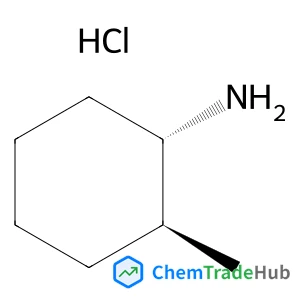
(1R,2R)-2-Methylcyclohexanamine hydrochloride (1:1)
CAS Number:
39558-31-1
Molecular Formula:
C7H16ClN
Recommended Suppliers





Disclaimer
This page provides academic journal information for reference and research purposes only. We are not affiliated with any journal publishers and do not handle publication submissions. For publication-related inquiries, please contact the respective journal publishers directly.
If you notice any inaccuracies in the information displayed, please contact us at support@chemtradehub.com. We will promptly review and address your concerns.