



Analysis of the effect of catalyst layer thickness on the performance and durability of platinum group metal-free catalysts for polymer electrolyte membrane fuel cells
Literature Information
Publication Date
2019-10-02
DOI
10.1039/C9SE00252A
Impact Factor
6.367
Authors
Andrea Baricci, Andrea Bisello, Alexey Serov, Madeleine Odgaard, Plamen Atanassov, Andrea Casalegno
View Original
Abstract
Development of platinum group metal-free catalysts for polymer electrolyte membrane fuel cells is a critical target to obtain a high market share of fuel cell electric vehicles in the long term. Recent studies have proved the feasibility of new materials with high catalytic activity towards the oxygen reduction reaction, which are based on Earth-abundant and low-cost elements. The stability of these materials is now the major concern at the current state of the art: in the initial hundreds of hours of operation, in fact, a significant loss of catalyst activity is observed. In the present work, the analysis of performance and degradation of cathode catalyst layers based on metal–nitrogen–carbon materials is carried out for 150 hours. The effects of catalyst loading and ionomer content are being analyzed. Electrochemical impedance spectroscopy is adopted to gain insight into the ageing and the results are interpreted by means of a 1D physics-based model. A regime is reported to occur, in which ion, electron and oxygen transport limitations interplay and the effect of each phenomenon is distinguished on the impedance spectra and polarization curves. Degradation is shown to mainly affect the catalyst activity or the density of active sites, but also a loss of electrical and ionic conductivity is observed.
Recommended Journals

Molecular Pharmacology

Proceedings of the National Academy of Sciences of the United States of America

Journal of Heterocyclic Chemistry

Israel Journal of Chemistry

Science Progress

Journal of Catalysis

Russian Chemical Reviews

European Journal of Wood and Wood Products

Kinetics and Catalysis

Journal of Organometallic Chemistry
Related Literature
Mechanistic insights into ozone-initiated oxidative degradation of saturated hydrocarbons and polymers
Richmond Lee, Michelle L. Coote
2016-08-16
Paper
DOI: 10.1039/C6CP05064F
Laser induced mechanisms controlling the size distribution of metallic nanoparticles
Zeming Liu, Guy Vitrant, Yaya Lefkir, Said Bakhti, Nathalie Destouches
2016-08-08
Paper
DOI: 10.1039/C6CP03415B
Effect of aromatic ring fluorination on CH⋯π interactions: microwave spectrum and structure of the 1,2-difluorobenzene⋯acetylene dimer
Anuradha G. Akmeemana, Justin M. Kang, Rachel E. Dorris, Rebecca D. Nelson, Ashley M. Anderton, Rebecca A. Peebles, Sean A. Peebles, Nathan A. Seifert, Brooks H. Pate
2016-08-17
Paper
DOI: 10.1039/C6CP04737H
Hydrogen bonds in methane–water clusters
Juan-Ramón Salazar-Cano, Alfredo Guevara-García, Rubicelia Vargas, Albeiro Restrepo, Jorge Garza
2016-07-29
Paper
DOI: 10.1039/C6CP04086A
From bulk to plasmonic nanoparticle surfaces: the behavior of two potent therapeutic peptides, octreotide and pasireotide
Belén Hernández, Eduardo López-Tobar, Santiago Sanchez-Cortes, Yves-Marie Coïc, Bruno Baron, Alexandre Chenal, Fernando Pflüger, Régis Cohen, Mahmoud Ghomi
2016-08-03
Paper
DOI: 10.1039/C6CP04421B
Understanding the curvature effect of silica nanoparticles on lysozyme adsorption orientation and conformation: a mesoscopic coarse-grained simulation study
Gaobo Yu, Jian Zhou
2016-07-19
Paper
DOI: 10.1039/C6CP01478J
Excitonic and vibrational coherence in artificial photosynthetic systems studied by negative-time ultrafast laser spectroscopy
Dongjia Han, Bing Xue, Juan Du, Tomohiro Miyatake, Hitoshi Tamiaki, Xin Xing, Wei Yuan, Yanyan Li
2016-08-02
Paper
DOI: 10.1039/C6CP03540J
A new class of N–H excited-state intramolecular proton transfer (ESIPT) molecules bearing localized zwitterionic tautomers
Anton J. Stasyuk, Yi-Ting Chen, Chi-Lin Chen, Pei-Jhen Wu, Pi-Tai Chou
2016-08-11
Paper
DOI: 10.1039/C6CP05236C
Role of the deposition temperature on the self-assembly of the non-planar molecule benzene-1,3,5-triphosphonic acid (BTP) at the liquid–solid interface
Doan Chau Yen Nguyen, Lars Smykalla, Thi Ngoc Ha Nguyen, Michael Mehring, Michael Hietschold
2016-08-05
Paper
DOI: 10.1039/C6CP04764E
You might also like
Compound Q&A
Is 2-(2-chloroacetamido)-3-phenylpropanoic acid (CAS: 7765-11-9) safe?
2-(2-Chloroacetamido)-3-phenylpropanoic acid (CAS: 7765-11-9) is generally consi...
7765-11-92-(2-chloroacetamido...
Compound Q&A
Is 2-(Benzyloxy)-5-bromobenzoic acid (CAS: 62176-31-2) safe?
2-(Benzyloxy)-5-bromobenzoic acid can be handled safely if appropriate precautio...
62176-31-22-(Benzyloxy)-5-brom...
Compound Q&A
What is (4-Methyl-1,2,5-oxadiazol-3-yl)methanamine hydrochloride (CAS: 1159825-48-5)?
(4-Methyl-1,2,5-oxadiazol-3-yl)methanamine hydrochloride is a chemical compound ...
1159825-48-5(4-Methyl-1,2,5-oxad...
Compound Q&A
What is 2-(5-Hexylthiophen-2-yl)-4,4,5,5-tetramethyl-1,3,2-dioxaborolane (CAS: 917985-54-7)?
2-(5-Hexylthiophen-2-yl)-4,4,5,5-tetramethyl-1,3,2-dioxaborolane (CAS: 917985-54...
917985-54-72-(5-Hexylthiophen-2...
Compound Q&A
Are there alternatives to 4-(8-Methyl-9H-1,3-dioxolo[4,5-h][2,3]benzodiazepin-5-yl)benzenamine (CAS: 102771-26-6) in synthesis?
While 4-(8-Methyl-9H-1,3-dioxolo[4,5-h][2,3]benzodiazepin-5-yl)benzenamine (CAS:...
102771-26-64-(8-Methyl-9H-1,3-d...
Compound Q&A
What is the market or research trend for tert-butyl 3-hydroxy-4,5,7,8-tetrahydro-2H-pyrazolo[3,4-d]azepine-6-carboxylate (CAS: 851376-80-2)?
The market for tert-butyl 3-hydroxy-4,5,7,8-tetrahydro-2H-pyrazolo[3,4-d]azepine...
851376-80-2tert-butyl 3-hydroxy...
Compound Q&A
How should waste containing 3,5-Diamino-1H-pyrazole-4-carbonitrile (CAS: 6844-58-2) be handled?
Waste containing 3,5-Diamino-1H-pyrazole-4-carbonitrile (CAS: 6844-58-2) should ...
6844-58-23,5-Diamino-1H-pyraz...
Compound Q&A
How is (6-Fluoro-3-pyridinyl)boronic acid (CAS: 351019-18-6) typically synthesized?
(6-Fluoro-3-pyridinyl)boronic acid can be synthesized through the reaction of 6-...
351019-18-6(6-Fluoro-3-pyridiny...
Compound Q&A
What industries use Dibenzyl carbonimidoylbiscarbamate (CAS: 10065-79-9)?
Dibenzyl carbonimidoylbiscarbamate (CAS: 10065-79-9) finds applications in vario...
10065-79-9Dibenzyl carbonimido...
Compound Q&A
What is the market or research trend for (beta,beta,2,3,4,5,6-~2~H_7_)Phenylalanine (CAS: 74228-83-4)?
The market for (beta,beta,2,3,4,5,6-~2~H_7_)Phenylalanine (CAS: 74228-83-4) is g...
74228-83-4(beta,beta,2,3,4,5,6...
Source Journal
Recommended Compounds
![Ethyl thieno[3,2-f]quinoline-2-carboxylate structure](https://static.chemtradehub.com/structs/299/29948-26-3-f62b.webp "Ethyl thieno[3,2-f]quinoline-2-carboxylate structure")
![(1S)-1,5-Anhydro-2-O-alpha-L-arabinopyranosyl-1-[5-hydroxy-7-({6-O-[3-(4-hydroxy-3-methoxyphenyl)propanoyl]-beta-D-glucopyranosyl}oxy)-2-(4-hydroxyphenyl)-4-oxo-4H-chromen-6-yl]-D-glucitol structure](https://static.chemtradehub.com/structs/225/2252345-81-4-bcff.webp "(1S)-1,5-Anhydro-2-O-alpha-L-arabinopyranosyl-1-[5-hydroxy-7-({6-O-[3-(4-hydroxy-3-methoxyphenyl)propanoyl]-beta-D-glucopyranosyl}oxy)-2-(4-hydroxyphenyl)-4-oxo-4H-chromen-6-yl]-D-glucitol structure")
![Heptadecanoic Acid 3-[2-[4-(6-Fluoro-1,2-benzisoxazol-3-yl)-1-piperidinyl]ethyl]-6,7,8,9-tetrahydro-2-methyl-4-oxo-4H-pyrido[1,2-a]pyrimidin-9-yl Ester structure](https://static.chemtradehub.com/structs/140/1404053-62-8-9da4.webp "Heptadecanoic Acid 3-[2-[4-(6-Fluoro-1,2-benzisoxazol-3-yl)-1-piperidinyl]ethyl]-6,7,8,9-tetrahydro-2-methyl-4-oxo-4H-pyrido[1,2-a]pyrimidin-9-yl Ester structure")
Heptadecanoic Acid 3-[2-[4-(6-Fluoro-1,2-benzisoxazol-3-yl)-1-piperidinyl]ethyl]-6,7,8,9-tetrahydro-2-methyl-4-oxo-4H-pyrido[1,2-a]pyrimidin-9-yl Ester
CAS Number:
1404053-62-8
Molecular Formula:
C40H59FN4O4
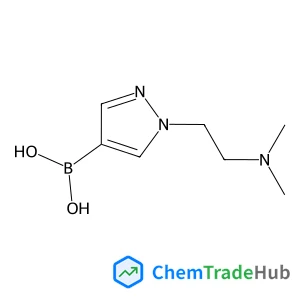
(1-(2-(Dimethylamino)ethyl)-1H-pyrazol-4-yl)boronic acid
CAS Number:
1086063-73-1
Molecular Formula:
C7H14BN3O2
Recommended Suppliers





Disclaimer
This page provides academic journal information for reference and research purposes only. We are not affiliated with any journal publishers and do not handle publication submissions. For publication-related inquiries, please contact the respective journal publishers directly.
If you notice any inaccuracies in the information displayed, please contact us at support@chemtradehub.com. We will promptly review and address your concerns.