












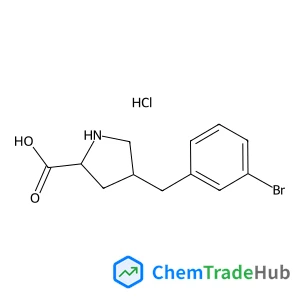
(2S,4R)-4-(3-Bromobenzyl)pyrrolidine-2-carboxylic acid hydrochloride
CAS Number:
1049734-10-2
Molecular Formula:
C12H15BrClNO2
Doan Chau Yen Nguyen, Lars Smykalla, Thi Ngoc Ha Nguyen, Michael Mehring, Michael Hietschold
Benzene-1,3,5-triphosphonic acid (BTP) contains three non-planar phosphonic acid groups which enable three-dimensional hydrogen bonding. Because of these versatile 3D functional groups, BTP is an interesting intermediate to design both 2D and 3D supramolecular hydrogen-bonded architectures and organic–inorganic hybrid frameworks. However, the adsorption of BTP has surprisingly not been the subject of scanning tunneling microscopy (STM) investigations so far. Here a STM study of the adsorption pattern of BTP as obtained from deposition out of a solution in undecanol on an interface to highly-oriented pyrolytic graphite (HOPG) is presented. Furthermore, the influence of the substrate temperature during the deposition from solution on the self-assembly is investigated. High-resolution STM images reveal that the BTB molecules usually form various structures by co-adsorption with undecanol and that the BTP molecules as parts of self-assembled aggregates adsorb with their benzene ring planes tilted with respect to the substrate plane. The specific supramolecular pattern and the 2D packing density of BTP can be precisely tuned by adjusting the initial substrate temperature during deposition. The experimental results are compared to corresponding model structures obtained from semi-empirical simulations and explained by the influence of temperature on the concentration at the solution–solid interface and the kinetics of the self-assembly process. Based on these results, the control of the deposition substrate temperature has been proven to be a versatile tool to control the polymorphism of molecular patterns deposited out of solutions.
Smriti Chaturvedi, Snehasis Chakraborty
DOI: 10.1039/D3FB00094J
Apoorv Balwani, Tridib Ambardar, Adarsh Kumar Pandey, Aravind Dasari, Sujay Chattopadhyay
DOI: 10.1039/D3SU00289F
DOI: 10.1039/D3SU90059B
Peiying Fan, Yuhan Zhang, Li Guan, Han Wang, George Zheng Chen
DOI: 10.1039/D3SU00197K
Filipa Macedo, Telma Guiu, Chris H. J. Franco, Vânia André, Alexander M. Kirillov
DOI: 10.1039/D3LF00123G
Teresa Cecchi, Zhaojing Gao, Christophe Clement, Yasser Matos Peralta, Olivier Girard, Clara Santato
DOI: 10.1039/D3SU00242J
Satish Bolloju, Eleni Fiamegkou, Nickil Shah, Mateusz Jan Zuba, Tien-Lin Lee, Pardeep K. Thakur, Melanie J. Loveridge
DOI: 10.1039/D3LF00093A
Kacper P. Krakowiak, Ruaraidh D. McIntosh, David Ellis
DOI: 10.1039/D3FB00088E
2-(2-Chloroacetamido)-3-phenylpropanoic acid (CAS: 7765-11-9) is generally consi...
2-(Benzyloxy)-5-bromobenzoic acid can be handled safely if appropriate precautio...
(4-Methyl-1,2,5-oxadiazol-3-yl)methanamine hydrochloride is a chemical compound ...
2-(5-Hexylthiophen-2-yl)-4,4,5,5-tetramethyl-1,3,2-dioxaborolane (CAS: 917985-54...
While 4-(8-Methyl-9H-1,3-dioxolo[4,5-h][2,3]benzodiazepin-5-yl)benzenamine (CAS:...
The market for tert-butyl 3-hydroxy-4,5,7,8-tetrahydro-2H-pyrazolo[3,4-d]azepine...
Waste containing 3,5-Diamino-1H-pyrazole-4-carbonitrile (CAS: 6844-58-2) should ...
(6-Fluoro-3-pyridinyl)boronic acid can be synthesized through the reaction of 6-...
Dibenzyl carbonimidoylbiscarbamate (CAS: 10065-79-9) finds applications in vario...
The market for (beta,beta,2,3,4,5,6-~2~H_7_)Phenylalanine (CAS: 74228-83-4) is g...

Physical Chemistry Chemical Physics (PCCP) is an international journal co-owned by 19 physical chemistry and physics societies from around the world. This journal publishes original, cutting-edge research in physical chemistry, chemical physics and biophysical chemistry. To be suitable for publication in PCCP, articles must include significant innovation and/or insight into physical chemistry; this is the most important criterion that reviewers and Editors will judge against when evaluating submissions. The journal has a broad scope and welcomes contributions spanning experiment, theory, computation and data science. Topical coverage includes spectroscopy, dynamics, kinetics, statistical mechanics, thermodynamics, electrochemistry, catalysis, surface science, quantum mechanics, quantum computing and machine learning. Interdisciplinary research areas such as polymers and soft matter, materials, nanoscience, energy, surfaces/interfaces, and biophysical chemistry are welcomed if they demonstrate significant innovation and/or insight into physical chemistry. Joined experimental/theoretical studies are particularly appreciated when complementary and based on up-to-date approaches.
![3,7-Di(1,1':3',1''-terphenyl-5'-yl)-10,11,12,13-tetrahydrodiindeno[7,1-de:1',7'-fg][1,3,2]dioxaphosphocin-5-ol 5-oxide structure](https://static.chemtradehub.com/structs/135/1352810-38-8-3f10.webp "3,7-Di(1,1':3',1''-terphenyl-5'-yl)-10,11,12,13-tetrahydrodiindeno[7,1-de:1',7'-fg][1,3,2]dioxaphosphocin-5-ol 5-oxide structure")
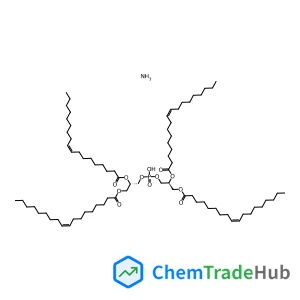
![Heptadecanoic Acid 3-[2-[4-(6-Fluoro-1,2-benzisoxazol-3-yl)-1-piperidinyl]ethyl]-6,7,8,9-tetrahydro-2-methyl-4-oxo-4H-pyrido[1,2-a]pyrimidin-9-yl Ester structure](https://static.chemtradehub.com/structs/140/1404053-62-8-9da4.webp "Heptadecanoic Acid 3-[2-[4-(6-Fluoro-1,2-benzisoxazol-3-yl)-1-piperidinyl]ethyl]-6,7,8,9-tetrahydro-2-methyl-4-oxo-4H-pyrido[1,2-a]pyrimidin-9-yl Ester structure")
![{3-[Bis(4-hydroxyphenyl)methyl]-1-[2-(dimethylamino)ethyl]-1H-indol-2-yl}[4-(2-chlorophenyl)-1-piperazinyl]methanone structure](https://static.chemtradehub.com/structs/170/170365-25-0-e4d7.webp "{3-[Bis(4-hydroxyphenyl)methyl]-1-[2-(dimethylamino)ethyl]-1H-indol-2-yl}[4-(2-chlorophenyl)-1-piperazinyl]methanone structure")





