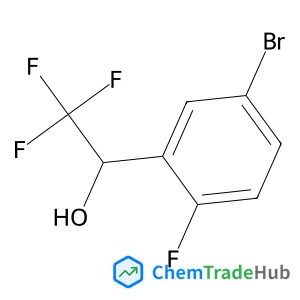
1-(5-Bromo-2-fluorophenyl)-2,2,2-trifluoroethanol
CAS Number:
1039827-16-1
Molecular Formula:
C8H5BrF4O
Juan-Ramón Salazar-Cano, Alfredo Guevara-García, Rubicelia Vargas, Albeiro Restrepo, Jorge Garza
Characterization of hydrogen bonds in CH4–(H2O)12 clusters was carried out by using several quantum chemistry tools. An initial stochastic search provided around 2 500 000 candidate structures, then, using a convex-hull polygon criterion followed by gradient based optimization under the Kohn–Sham scheme, a total of 54 well defined local minima were located in the Potential Energy Surface. These structures were further analyzed through second-order many-body perturbation theory with an extended basis set at the MP2/6-311++G(d,p) level. Our analysis of Gibbs energies at several temperatures clearly suggests a structural preference toward compact water clusters interacting with the external methane molecule, instead of the more commonly known clathrate-like structures. This study shows that CH4–(H2O)12 clusters may be detected at temperatures up to 179 K, this finding provides strong support to a recently postulated hypothesis that suggests that methane–water clusters could be present in Mars at these conditions. Interestingly, we found that water to water hydrogen bonding is strengthened in the mixed clusters when compared to the isolated water dimer, which in turn leads to a weakening of the methane to water hydrogen bonding when compared to the CH4–(H2O) dimer. Finally, our evidence places a stern warning about the abilities of popular geometrical criteria to determine the existence of hydrogen bonds.
Jiling Yue
DOI: 10.1039/D3LF00145H
Christoph Naderer, Heinrich Krobath, Dmitry Sivun, Georgii Gvindzhiliia, Thomas A. Klar, Jaroslaw Jacak
DOI: 10.1039/D3LF00125C
Jenni Tienaho, Hanna Brännström, Risto Korpinen, Juha-Matti Pihlava, Jarkko Hellström, Paula Jylhä, Jaana Liimatainen, Veikko Möttönen, Jyri Maunuksela, Petri Kilpeläinen
DOI: 10.1039/D3SU00255A
Tanongsak Yingnakorn, Jennifer Hartley, Jason S. Terreblanche, Chunhong Lei, Andrew P. Abbott
DOI: 10.1039/D3SU00237C
Ali Asad Yousaf, Kashif Sarfraz Abbasi, Muhammad Suhail Ibrahim, Asma Sohail, Mamoona Faiz, Mehwish Khadim
DOI: 10.1039/D3FB00113J
Bareera Siddiqui, Alisha Ahmad, Owais Yousuf, Kaiser Younis
DOI: 10.1039/D3FB00111C
Jiayin Zhou, Jihong Ni, Xiaofei Guan
DOI: 10.1039/D3SU00201B
Anna Hu, Yujie Zhang, Jinchuang Zhang, Tongqing Li, Zhaojun Wang, Qiang Wang
DOI: 10.1039/D3FB00171G
2-(2-Chloroacetamido)-3-phenylpropanoic acid (CAS: 7765-11-9) is generally consi...
2-(Benzyloxy)-5-bromobenzoic acid can be handled safely if appropriate precautio...
(4-Methyl-1,2,5-oxadiazol-3-yl)methanamine hydrochloride is a chemical compound ...
2-(5-Hexylthiophen-2-yl)-4,4,5,5-tetramethyl-1,3,2-dioxaborolane (CAS: 917985-54...
While 4-(8-Methyl-9H-1,3-dioxolo[4,5-h][2,3]benzodiazepin-5-yl)benzenamine (CAS:...
The market for tert-butyl 3-hydroxy-4,5,7,8-tetrahydro-2H-pyrazolo[3,4-d]azepine...
Waste containing 3,5-Diamino-1H-pyrazole-4-carbonitrile (CAS: 6844-58-2) should ...
(6-Fluoro-3-pyridinyl)boronic acid can be synthesized through the reaction of 6-...
Dibenzyl carbonimidoylbiscarbamate (CAS: 10065-79-9) finds applications in vario...
The market for (beta,beta,2,3,4,5,6-~2~H_7_)Phenylalanine (CAS: 74228-83-4) is g...

Physical Chemistry Chemical Physics (PCCP) is an international journal co-owned by 19 physical chemistry and physics societies from around the world. This journal publishes original, cutting-edge research in physical chemistry, chemical physics and biophysical chemistry. To be suitable for publication in PCCP, articles must include significant innovation and/or insight into physical chemistry; this is the most important criterion that reviewers and Editors will judge against when evaluating submissions. The journal has a broad scope and welcomes contributions spanning experiment, theory, computation and data science. Topical coverage includes spectroscopy, dynamics, kinetics, statistical mechanics, thermodynamics, electrochemistry, catalysis, surface science, quantum mechanics, quantum computing and machine learning. Interdisciplinary research areas such as polymers and soft matter, materials, nanoscience, energy, surfaces/interfaces, and biophysical chemistry are welcomed if they demonstrate significant innovation and/or insight into physical chemistry. Joined experimental/theoretical studies are particularly appreciated when complementary and based on up-to-date approaches.
![19-[Chloro(dideuterio)methyl]-19-deuterio-20,20-dideuteriooxyoctatriacontane-18,21-dione structure](https://static.chemtradehub.com/structs/124/1246818-85-8-6244.webp "19-[Chloro(dideuterio)methyl]-19-deuterio-20,20-dideuteriooxyoctatriacontane-18,21-dione structure")
![3-[4-(difluoromethoxy)phenyl]-2-({[(9H-fluoren-9-yl)methoxy]carbonyl}amino)propanoic acid structure](https://static.chemtradehub.com/structs/149/1496564-27-2-952e.webp "3-[4-(difluoromethoxy)phenyl]-2-({[(9H-fluoren-9-yl)methoxy]carbonyl}amino)propanoic acid structure")