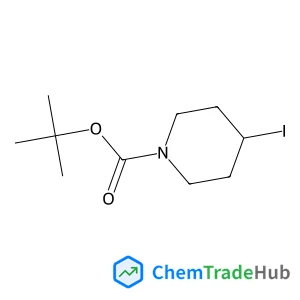
2-Methyl-2-propanyl 4-iodo-1-piperidinecarboxylate
CAS Number:
301673-14-3
Molecular Formula:
C10H18INO2
Jacobs H. Jordan, Anthony Wishard, Joel T. Mague, Bruce C. Gibb
Controlling the self-assembly of molecules in water is difficult because the small size, polarity, and hydrogen bond donating and accepting properties of water attenuate most non-covalent interactions. Here we describe how resorcinarene 1, with pyridinium pendent groups, assembles in water to form head-to-tail assemblies. These small supramolecular polymers form because they offer greater stabilization than any latent head-to-head assembly of resorcinarenes to form dimeric (or hexameric) containers. Instead, the resorcinarene bowl – particularly if negatively charged – is a good host for the pyridinium pendent groups of a second resorcinarene. Alternatively, resorcinarene 1 is also a good host for complexing anions and cations of any added salt. In combination therefore, host 1 possesses a rich repertoire of supramolecular properties that is dependent on the ionic strength and the nature of salts, pH, and the concentration of the host. These findings provide new information about controlling the self-assembly of resorcinarenes in water.
D. A. Ivanov, J. Winkelmann
DOI: 10.1039/B402165G
Sergey Vasenkov, Jörg Kärger
DOI: 10.1039/B316174A
DOI: 10.1039/B316170F
Quirino Balzano
DOI: 10.1039/B406111J
DOI: 10.1039/B402156H
Alexander Panchenko, Herbert Dilger, Jochen Kerres, Martin Hein, Andreas Ullrich, Till Kaz, Emil Roduner
DOI: 10.1039/B404253K
Timur V. Tscherbul, Alexei A. Buchachenko, Mikhail E. Akopyan, Sergey A. Poretsky, Anatoly M. Pravilov, Thomas A. Stephenson
DOI: 10.1039/B402655A
Waste containing (6-Bromo-2-naphthyl)oxy](dimethyl)(2-methyl-2-propanyl)silane (...
7-Fluoro-4-isoquinolinecarboxylic acid can be synthesized via a multi-step proce...
2,3,5,6-Tetrabromothieno[3,2-b]thiophene is a crystalline compound with a high m...
1-[4-(Benzylamino)-7,8-dihydro-5H-pyrano[4,3-d]pyrimidin-2-yl]-2-methyl-1H-indol...
The market for imidazo[5,1-d]-1,2,3,5-tetrazine-8-carboxylic acid, 3,4-dihydro-3...
3-(Triisopropylsilyl)propiolaldehyde is a synthetic organic compound with the CA...
6-Nitro-2H-1,4-benzoxazin-3(4H)-one (CAS: 81721-87-1) is subject to various regu...
Waste containing (3-Fluorophenyl)(4-{[(2-methyl-2-propanyl)oxy]carbonyl}-1-piper...
N,N'-4,4'-Biphenyldiyldiisonicotinamide is a white crystalline solid with a mole...
6-Bromo-8-fluoro-2-quinazolinol is primarily used in the pharmaceutical industry...

Organic Chemistry Frontiers publishes high-quality research from across organic chemistry. Emphases are placed on studies that make significant contributions to the field of organic chemistry by reporting either new or significantly improved protocols or methodologies. Topics include, but are not limited to the following: Organic synthesis Development of synthetic methodologies Catalysis Natural products Functional organic materials Supramolecular and macromolecular chemistry Physical and computational organic chemistry
![2,9-Dichloro-5,12-dihydroquinolino[2,3-b]acridine-7,14-dione structure](https://static.chemtradehub.com/structs/308/3089-17-6-750b.webp "2,9-Dichloro-5,12-dihydroquinolino[2,3-b]acridine-7,14-dione structure")