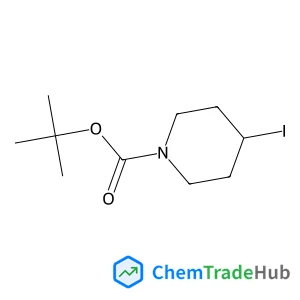
2-Methyl-2-propanyl 4-iodo-1-piperidinecarboxylate
CAS Number:
301673-14-3
Molecular Formula:
C10H18INO2
Toru Amaya, Shun Katoh, Toshiyuki Moriuchi, Toshikazu Hirao
A convex-bound sumanenyl hafnocene complex Cp*(sumanenyl)HfCl2 (Cp* = C5Me5) was selectively synthesized. The catalytic activity of the sumanenyl hafnocene and zirconocene was also demonstrated in the hydroethylation reaction of allylbenzene via carboalumination. This is the first example demonstrating the catalytic activity of sumanenyl metallocenes. Furthermore, the sumanenyl ligand was found to exhibit higher reactivity compared to fluorenyl and Cp* ligands.
Sergey Vasenkov, Jörg Kärger
DOI: 10.1039/B316174A
R. M. Moision, P. B. Armentrout
DOI: 10.1039/B315642G
Annika Lenz, Lars Ojamäe
DOI: 10.1039/B502109J
James B. Burkholder, R. W. Portmann, A. R. Ravishankara
DOI: 10.1039/B503332B
C. Crépin, V. Dubois, F. Goldfarb, F. Chaput, J. P. Boilot
DOI: 10.1039/B500578G
Stephen A. Cooke, Michael C. L. Gerry
DOI: 10.1039/B503421C
John D. Hearn, Geoffrey D. Smith
DOI: 10.1039/B506424D
Nissim Garti, Idit Amar-Yuli, Aviram Spernath, Roy E. Hoffman
DOI: 10.1039/B404315B
Brendan F. Hayward, Hans Riesen
DOI: 10.1039/B502079D
Waste containing (6-Bromo-2-naphthyl)oxy](dimethyl)(2-methyl-2-propanyl)silane (...
7-Fluoro-4-isoquinolinecarboxylic acid can be synthesized via a multi-step proce...
2,3,5,6-Tetrabromothieno[3,2-b]thiophene is a crystalline compound with a high m...
1-[4-(Benzylamino)-7,8-dihydro-5H-pyrano[4,3-d]pyrimidin-2-yl]-2-methyl-1H-indol...
The market for imidazo[5,1-d]-1,2,3,5-tetrazine-8-carboxylic acid, 3,4-dihydro-3...
3-(Triisopropylsilyl)propiolaldehyde is a synthetic organic compound with the CA...
6-Nitro-2H-1,4-benzoxazin-3(4H)-one (CAS: 81721-87-1) is subject to various regu...
Waste containing (3-Fluorophenyl)(4-{[(2-methyl-2-propanyl)oxy]carbonyl}-1-piper...
N,N'-4,4'-Biphenyldiyldiisonicotinamide is a white crystalline solid with a mole...
6-Bromo-8-fluoro-2-quinazolinol is primarily used in the pharmaceutical industry...

Organic Chemistry Frontiers publishes high-quality research from across organic chemistry. Emphases are placed on studies that make significant contributions to the field of organic chemistry by reporting either new or significantly improved protocols or methodologies. Topics include, but are not limited to the following: Organic synthesis Development of synthetic methodologies Catalysis Natural products Functional organic materials Supramolecular and macromolecular chemistry Physical and computational organic chemistry