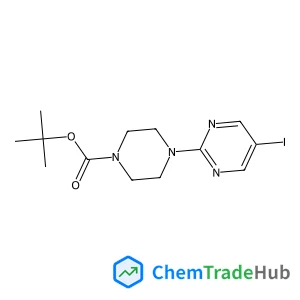
2-Methyl-2-propanyl 4-(5-iodo-2-pyrimidinyl)-1-piperazinecarboxylate
CAS Number:
1027616-32-5
Molecular Formula:
C13H19IN4O2
Wen Jing Yang, Wenya Xu, Xi Tao, Wen Wang, Yaqin Hu, Xue Li, En-Tang Kang, Lianhui Wang
The fabrication of adhesive hydrogel systems is quite important for biological applications. Herein, two-stage thiol-based click reactions have been employed for the preparation and adhesion of hydrogels. In the first stage, two self-adhesive hydrogels (HG-1 and HG-2) were constructed via the thiol-based click reactions and thiol–thiol coupling reaction under different stimuli, employing the same functional copolymer poly(propargyl methacrylate-co-N-(3,4-dihydroxyphenethyl) methacrylamide-co-poly(ethylene glycol) methyl ether methacrylate) (poly(PMA-co-DMA-co-PEGMA), polyPDP) and a 4-arm thiol-PEG cross-linker. Subsequently, the two prepared hydrogels achieved responsive self-adhesion properties via the second stage of thiol-based click reactions between the preserved functional groups under different stimuli. Moreover, the self-adhered hydrogels exhibited increased mechanical strength after adhesion. The present strategy thus provides a facile approach for the fabrication of hydrogel systems with on-demand self-adhesive properties.

Critical Reviews in Solid State and Materials Sciences

Bioorganic & Medicinal Chemistry Letters

Acta Metallurgica Sinica-English Letters

Electroanalysis

Herald of the Russian Academy of Sciences

Colloid Journal

Topics in Catalysis

Medicinal Chemistry Research

Chinese Journal of Chemistry

Biocatalysis and Biotransformation
Giselle de Andrade Ramos, Andressa Souza de Oliveira, Manuela Bartolini, Marina Naldi, Irene Liparulo, Christian Bergamini, Elisa Uliassi, Ling Wu, Paul E. Fraser, Monica Abreu, Alessandra Sofia Kiametis, Ricardo Gargano, Edilberto Rocha Silveira, Guilherme D. Brand, Lukas Prchal, Maria Laura Bolognesi, Luiz Antonio Soares Romeiro
DOI: 10.1039/D1MD00046B
Kaitlind C. Howard, Octavio A. Gonzalez, Sylvie Garneau-Tsodikova
DOI: 10.1039/D0MD00424C
Jennifer R. Baker, Cecilia C. Russell, Jayne Gilbert, Adam McCluskey, Jennette A. Sakoff
DOI: 10.1039/D1MD00021G
Lisa Barbaro, Gayathri Nagalingam, James A. Triccas, Jonathan B. Baell, Daniel L. Priebbenow
DOI: 10.1039/D1MD00063B
Rachael Zigweid, Bart L. Staker
DOI: 10.1039/D0MD00303D
Ali Nakhi, Henry L. Wong, Peter I. Dosa
DOI: 10.1039/D0MD00425A
DOI: 10.1039/D1MD00015B
Nattawadee Panyain, Aurélien Godinat, Aditya Raymond Thawani, Sofía Lachiondo-Ortega, Katie Mason, Sarah Elkhalifa, Lisa M. Smith, Jeanine A. Harrigan
DOI: 10.1039/D1MD00218J
Waste containing 6-Chloro-5-(2'-hydroxy-3'-methoxy-4-biphenylyl)-3-(3-methoxyphe...
(3alpha,5alpha)-3-Hydroxypregnane-11,20-dione is primarily used in the pharmaceu...
The market for 4-Amino-6-chloro-2-pyridinecarboxylic acid (CAS: 546141-56-4) is ...
Alternatives to (2-Benzoylethyl)trimethylammonium chloride (CAS: 24472-88-6) in ...
N-[4-Nitro-3-(trifluoromethyl)phenyl]acetamide (CAS: 393-12-4) is generally safe...
Alternative reagents such as other phosphates or similar functional groups can b...
There are alternatives to N,N'-Bis(3-aminopropyl)-1,3-propanediamine (CAS: 4605-...
When handling Aluminium trihexadecanoate, it is important to use appropriate per...
(1,1-Dioxido-3-oxo-1,2-benzothiazol-2(3H)-yl)acetic acid is a chemical compound ...
Several alternatives to 5,5-dimethyloxolan-2-one (CAS: 3123-97-5) can be used in...

Polymer Chemistry welcomes submissions in all areas of polymer science that have a strong focus on macromolecular chemistry. Manuscripts may cover a broad range of fields, yet no direct application focus is required.
![2-Methyl-2-propanyl (2E)-5-chloro-2-[3-methoxy-4-(4-methyl-1H-imidazol-1-yl)benzylidene]pentanoate structure](https://static.chemtradehub.com/structs/122/1225232-42-7-ee03.webp "2-Methyl-2-propanyl (2E)-5-chloro-2-[3-methoxy-4-(4-methyl-1H-imidazol-1-yl)benzylidene]pentanoate structure")