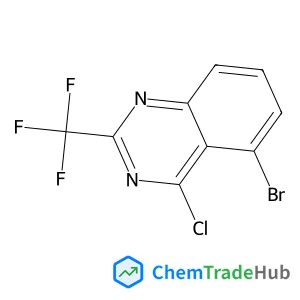
5-Bromo-4-chloro-2-(trifluoromethyl)quinazoline
CAS Number:
2089311-03-3
Molecular Formula:
C9H3BrClF3N2
Ali Nakhi, Henry L. Wong, Peter I. Dosa
Bile acid derivatives have been investigated as possible therapeutics for a wide array of conditions, including several for which gut-restricted analogs would likely be preferred. These include the prevention of Clostridioides difficile infection (CDI) and the treatment of inflammatory bowel disease (IBD). The design of gut-restricted bile acid analogs, however, is complicated by the highly efficient enterohepatic circulation system that typically reabsorbs these compounds from the digestive tract for subsequent return to the liver. Herein, we report that incorporation of a sulfate group at the 7-position of the bile acid scaffold reduces oral bioavailability and increases fecal recovery in two pairs of compounds designed to inhibit the germination of C. difficile spores. A different approach was necessary for designing gut-restricted bile acid-based TGR5 agonists for the treatment of IBD, as the incorporation of a 7-sulfate group reduces activity at this receptor. Instead, building on our previous discovery that incorporation of a 7-methoxy group into chenodeoxycholic acid derivatives greatly increases their TGR5 receptor potency, we determined that an N-methyl-D-glucamine group could be conjugated to the scaffold to obtain a compound with an excellent mix of potency at the TGR5 receptor, low oral exposure, and good fecal recovery.
Sebastian Tassoti, Martin Walenta, Alexander Pöcheim, Kathrin Buchberger, Olaf Kunert, Klaus Zangger
DOI: 10.1039/C9AN01364D
Tripti Ahuja, Atanu Ghosh, Sandip Mondal, Pallab Basuri, Shantha Kumar Jenifer, Pillalamarri Srikrishnarka, Jyoti Sarita Mohanty, Sandeep Bose, Thalappil Pradeep
DOI: 10.1039/C9AN01700C
Alain Wuethrich, Aswin Raj Rajkumar, Karthik Balaji Shanmugasundaram, Kamil K. Reza, Shuvashis Dey, Christopher B. Howard
DOI: 10.1039/C9AN01450K
Xifeng Chen, Bidou Wang, Guangxing Liu, Yuguo Tang, Peng Miao
DOI: 10.1039/C6AN00762G
Luca Guerrini
DOI: 10.1039/C9AN02040C
DOI: 10.1039/C9AN01162E
Wanyu Zhang, Lihua Jia, Rui Yang, Yu Zhang, Zhenlong Zhao
DOI: 10.1039/C9AN01953G
Chun Mei Li, Lei Zhan, Lin Ling Zheng, Yuan Fang Li
DOI: 10.1039/C6AN00489J
Waste containing 6-Chloro-5-(2'-hydroxy-3'-methoxy-4-biphenylyl)-3-(3-methoxyphe...
(3alpha,5alpha)-3-Hydroxypregnane-11,20-dione is primarily used in the pharmaceu...
The market for 4-Amino-6-chloro-2-pyridinecarboxylic acid (CAS: 546141-56-4) is ...
Alternatives to (2-Benzoylethyl)trimethylammonium chloride (CAS: 24472-88-6) in ...
N-[4-Nitro-3-(trifluoromethyl)phenyl]acetamide (CAS: 393-12-4) is generally safe...
Alternative reagents such as other phosphates or similar functional groups can b...
There are alternatives to N,N'-Bis(3-aminopropyl)-1,3-propanediamine (CAS: 4605-...
When handling Aluminium trihexadecanoate, it is important to use appropriate per...
(1,1-Dioxido-3-oxo-1,2-benzothiazol-2(3H)-yl)acetic acid is a chemical compound ...
Several alternatives to 5,5-dimethyloxolan-2-one (CAS: 3123-97-5) can be used in...