












Pulse radiolysis study on the reactivity of NO3˙ radical toward uranous(iv), hydrazinium nitrate and hydroxyl ammonium nitrate at room temperature and at 45 °C
Literature Information
Publication Date
2020-02-13
DOI
10.1039/C9CP07034F
Impact Factor
3.676
Authors
R. Musat, J. L. Marignier, C. Le Naour, S. Denisov, L. Venault, Ph. Moisy, M. Mostafavi
View Original
Abstract
Concentrated nitric acid solutions subjected to radiation produce radicals of extreme importance in the reprocessing of spent nuclear fuel. Knowledge of the different rate constants of the reactions involved in this chemistry is needed to improve the efficiency of the process and to define safe operating practices. Pulse radiolysis measurements are performed to find the rate constant of the reaction between NO3˙ radicals and U(IV) in highly concentrated nitrate solution. The optimal stabilization conditions toward thermal oxidation are defined for the considered solutions at room temperature and at 45 °C by adding anti-nitrous agents such as hydrazinium nitrate (HN) and hydroxyl ammonium nitrate (HAN). The decay of the NO3˙ radical is monitored and its reaction rates with HN, HAN and U(IV) are found to be 1.3 × 10⁵, 1.5 × 10⁷ and 1.6 × 10⁶ M−1 s−1 at room temperature. The latter value is more than 10 times lower than the one currently used in numerical codes for simulation of the long-term radiolytic degradation associated with the reprocessing and storage of spent nuclear waste. At 45 °C, conditions similar to the reprocessing of spent fuel, the values of the rate constants of NO3˙ radical toward HN, HAN and U(IV) increase and are found to be 2.6 × 10⁵, 2.9 × 10⁷ and 9.3 × 10⁶ M−1 s−1.
Recommended Journals
Related Literature
Proton transport mechanism of imidazole, triazole and phosphoric acid mixtures from ab initio molecular dynamics simulations
Swagata Pahari, Sudip Roy
2015-10-22
Paper
DOI: 10.1039/C5CP05735C
Long term puzzles of the CH and CD energetics and related phenomena revisited; solutions sought through REMPI-photofragmentations of bromomethanes
Arnar Hafliðason, Huasheng Wang, Ágúst Kvaran
2015-12-09
Paper
DOI: 10.1039/C5CP06097D
An EPR study of ampullosporin A, a medium-length peptaibiotic, in bicelles and vesicles
Annalisa Dalzini, Fernando Formaggio, Claudio Toniolo, Marina Gobbo, Anna Lisa Maniero
2015-11-19
Paper
DOI: 10.1039/C5CP04136H
Electrochemo-dynamical characterization of polypyrrole actuators coated on gold electrodes
T. F. Otero, E. W. H. Jager
2015-11-18
Paper
DOI: 10.1039/C5CP05841D
Reactive symbol sequences for a model of hydrogen combustion
Mohammad Alaghemandi
2015-11-26
Paper
DOI: 10.1039/C5CP05125H
Photoinduced charge separation in an oligophenylenevinylene-based Hamilton-type receptor supramolecularly associating two C60-barbiturate guests
G. Pagona, A. Stergiou, H. B. Gobeze, G. Rotas, F. D'Souza, N. Tagmatarchis
2015-11-17
Paper
DOI: 10.1039/C5CP05657H
The pH dependence of OH radical formation in photo-electrochemical water oxidation with rutile TiO2 single crystals
Yukihiro Nakabayashi, Yoshio Nosaka
2015-10-23
Paper
DOI: 10.1039/C5CP04531B
Pressure-dependent formation of i-motif and G-quadruplex DNA structures
S. Takahashi
2015-09-03
Paper
DOI: 10.1039/C5CP04727G
Probing the dynamics of highly excited toluene on the fs timescale
C. C. Papadopoulou, S. Kaziannis, C. Kosmidis
2015-11-12
Paper
DOI: 10.1039/C5CP04346H
You might also like
Compound Q&A
Is 6-(3-Fluorophenyl)picolinic acid (CAS: 887982-40-3) safe?
6-(3-Fluorophenyl)picolinic acid is generally considered safe for laboratory use...
887982-40-36-(3-Fluorophenyl)pi...
Compound Q&A
What industries use (3R)-3-Pyrrolidinol (CAS: 2799-21-5)?
(3R)-3-Pyrrolidinol is used in the pharmaceutical industry as a precursor for dr...
2799-21-5(3R)-3-Pyrrolidinol
Compound Q&A
What precautions should be taken when handling (4R,5R)-4,5-Diethoxycarbonyl-2,2-dimethyldioxolane (CAS: 59779-75-8)?
When handling (4R,5R)-4,5-Diethoxycarbonyl-2,2-dimethyldioxolane (CAS: 59779-75-...
59779-75-8(4R,5R)-4,5-Diethoxy...
Compound Q&A
How is 1-(6-Chloroimidazo[1,2-b]pyridazin-3-yl)ethanone (CAS: 90734-71-7) typically synthesized?
1-(6-Chloroimidazo[1,2-b]pyridazin-3-yl)ethanone is often synthesized via a mult...
90734-71-71-(6-Chloroimidazo[1...
Compound Q&A
What is the market or research trend for N-Ethyl-3,4-dimethylbenzylamine (CAS: 39180-83-1)?
The market for N-Ethyl-3,4-dimethylbenzylamine (CAS: 39180-83-1) remains steady,...
39180-83-1N-Ethyl-3,4-dimethyl...
Compound Q&A
What is Tert-butyl 3-(pyrrolidin-1-yl)azetidine-1-carboxylate (CAS: 1019008-21-9)?
Tert-butyl 3-(pyrrolidin-1-yl)azetidine-1-carboxylate is a chemical compound wit...
1019008-21-9Tert-butyl 3-(pyrrol...
Compound Q&A
What regulatory guidelines apply to 1-Bromo-3-chloro-2,4-dimethoxybenzene (CAS: 1228956-93-1)?
1-Bromo-3-chloro-2,4-dimethoxybenzene (CAS: 1228956-93-1) falls under the classi...
1228956-93-11-Bromo-3-chloro-2,4...
Compound Q&A
Is 8-Bromo-2-methyl-3,4-dihydroisoquinolin-1(2H)-one (CAS: 1368622-07-4) safe?
The safety of 8-Bromo-2-methyl-3,4-dihydroisoquinolin-1(2H)-one (CAS: 1368622-07...
1368622-07-48-Bromo-2-methyl-3,4...
Compound Q&A
Is Benzyl [(3S)-2,6-dioxo-3-piperidinyl]carbamate (CAS: 22785-43-9) safe?
Benzyl [(3S)-2,6-dioxo-3-piperidinyl]carbamate is generally safe when handled wi...
22785-43-9Benzyl [(3S)-2,6-dio...
Compound Q&A
How should 1-{[4-(4,4,5,5-Tetramethyl-1,3,2-dioxaborolan-2-yl)phenyl]sulfonyl}pyrrolidine (CAS: 928657-21-0) be stored?
1-{[4-(4,4,5,5-Tetramethyl-1,3,2-dioxaborolan-2-yl)phenyl]sulfonyl}pyrrolidine s...
928657-21-01-{[4-(4,4,5,5-Tetra...
Source Journal
Physical Chemistry Chemical Physics

CiteScore:
5.5
Self-citation Rate:
10.3%
Articles per Year:
3036
Physical Chemistry Chemical Physics (PCCP) is an international journal co-owned by 19 physical chemistry and physics societies from around the world. This journal publishes original, cutting-edge research in physical chemistry, chemical physics and biophysical chemistry. To be suitable for publication in PCCP, articles must include significant innovation and/or insight into physical chemistry; this is the most important criterion that reviewers and Editors will judge against when evaluating submissions. The journal has a broad scope and welcomes contributions spanning experiment, theory, computation and data science. Topical coverage includes spectroscopy, dynamics, kinetics, statistical mechanics, thermodynamics, electrochemistry, catalysis, surface science, quantum mechanics, quantum computing and machine learning. Interdisciplinary research areas such as polymers and soft matter, materials, nanoscience, energy, surfaces/interfaces, and biophysical chemistry are welcomed if they demonstrate significant innovation and/or insight into physical chemistry. Joined experimental/theoretical studies are particularly appreciated when complementary and based on up-to-date approaches.
Recommended Compounds
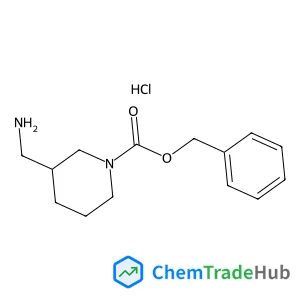
Benzyl 3-(aminomethyl)piperidine-1-carboxylate hydrochloride
CAS Number:
1186663-23-9
Molecular Formula:
C14H21ClN2O2
Recommended Suppliers



Disclaimer
This page provides academic journal information for reference and research purposes only. We are not affiliated with any journal publishers and do not handle publication submissions. For publication-related inquiries, please contact the respective journal publishers directly.
If you notice any inaccuracies in the information displayed, please contact us at support@chemtradehub.com. We will promptly review and address your concerns.