












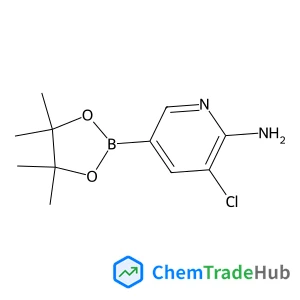
3-Chloro-5-(4,4,5,5-tetramethyl-1,3,2-dioxaborolan-2-yl)-2-pyridinamine
CAS Number:
1032758-99-8
Molecular Formula:
C11H16BClN2O2
Maria Wächtler
Polyoxometalate (POM)-associated charge-separated states, formed by the photoinduced oxidation of a covalently attached photosensitizer and reduction of the POM, have attracted much attention due to the remarkable catalytic properties of the reduced POMs. However, short lifetimes of the POM-associated charge-separated state, which in some cases lead to the backward electron transfer being more rapid than the formation of the charge-separated state itself, are generally observed. Recently, we reported on the first example of a relative long-lived (τ = 470 ns) charge-separated state in a Ru(II) bis(terpyridine)-POM molecular dyad. In this manuscript, further studies on extended molecular structures – two molecular triads – which contain an additional electron donor, phenothiazine (PTZ) or π-extended tetrathiafulvalene (exTTF), are discussed. We show that the excitation of the photosensitizer leads to the population of two distinct MLCT states, which differ in the distribution of excess electron density on the two distinct tpy ligands. These two MLCT states decay separately and, thus, constitute the starting points for distinct intramolecular electron-transfer pathways leading to the simultaneous population of two partially charge-separated states, i.e. PTZ˙+-Ru(tpy)2˙−-POM and PTZ-RuIII(tpy)2-POM˙−. These independent decay pathways are unaffected by the choice of the electron donor. Thus, the initial charge distribution within the coordination environment of the photocenter determines the nature of the subsequent (partially) charge separated state that is formed in the triads. These results might open new avenues to design molecular interfaces, in which the directionality of electron transfer can be tuned by the choice of initial excitation.
Yu Wang, Wei Wang, Ruyun Tang, Zhenhua Liu, Weihua Tao, Zhongxue Fang
DOI: 10.1039/C8OB02151A
Xianghua Zeng, Lu Chen
DOI: 10.1039/C8OB02216J
Xinying Zhang, Xuesen Fan
DOI: 10.1039/C8OB01846D
Philip C. Bulman Page, Francesca S. Kinsey, Yohan Chan, Ian R. Strutt, Alexandra M. Z. Slawin, Garth A. Jones
DOI: 10.1039/C8OB01795F
Andrew W. Phillips, Matthew J. Anketell, Tudor Balan, Nelson Y. S. Lam, Simon Williams, Ian Paterson
DOI: 10.1039/C8OB01621F
Weihua Li, Yifeng Wang, Danqian Xu
DOI: 10.1039/C8OB02484G
Alagesan Muthukumar, Subramani Sangeetha, Govindasamy Sekar
DOI: 10.1039/C8OB01423J
Saúl Silva, Osvaldo S. Ascenso, Eva C. Lourenço, Margarida Archer, M. Rita Ventura
DOI: 10.1039/C8OB02096E
This compound is mainly used as an intermediate in the synthesis of antipsychoti...
Waste containing 1-(D-Ribofuranosyl)-1,4-dihydro-3-pyridinecarboxamide (CAS: 191...
2-Methyl-2-propanyl 3-bromo-3-(hydroxymethyl)-1-azetidinecarboxylate (CAS: 20079...
N-(4-Chloro-2-pyridinyl)acetamide (CAS: 245056-66-0) is a chemical compound with...
5-Chloro-2-hydroxybenzoic acid, also known as 5-chlorosalicylic acid, is an arom...
When handling 1,1-Dichloro-1-fluoroethane (CAS: 1717-00-6), it is important to u...
Fmoc-(2S,3R)-3-phenylpyrrolidine-2-carboxylic acid is a white crystalline solid ...
4-Amino-5-bromo-2-pyridinecarboxylic acid is primarily used as a precursor in th...
Handling this compound should be done with personal protective equipment (PPE) i...
When handling 8-bromo-2,2-dimethyl-3,4-dihydro-2H-1,4-benzoxazin-3-one, use prop...

Physical Chemistry Chemical Physics (PCCP) is an international journal co-owned by 19 physical chemistry and physics societies from around the world. This journal publishes original, cutting-edge research in physical chemistry, chemical physics and biophysical chemistry. To be suitable for publication in PCCP, articles must include significant innovation and/or insight into physical chemistry; this is the most important criterion that reviewers and Editors will judge against when evaluating submissions. The journal has a broad scope and welcomes contributions spanning experiment, theory, computation and data science. Topical coverage includes spectroscopy, dynamics, kinetics, statistical mechanics, thermodynamics, electrochemistry, catalysis, surface science, quantum mechanics, quantum computing and machine learning. Interdisciplinary research areas such as polymers and soft matter, materials, nanoscience, energy, surfaces/interfaces, and biophysical chemistry are welcomed if they demonstrate significant innovation and/or insight into physical chemistry. Joined experimental/theoretical studies are particularly appreciated when complementary and based on up-to-date approaches.
![2,6-Di(thiophen-2-yl)dithieno[3,2-b:2',3'-d]thiophene structure](https://static.chemtradehub.com/structs/910/910788-24-8-5b70.webp "2,6-Di(thiophen-2-yl)dithieno[3,2-b:2',3'-d]thiophene structure")



