












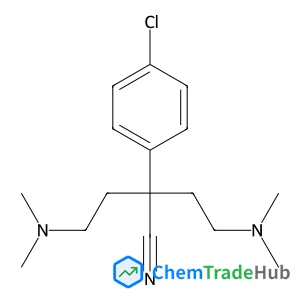
2-(4-Chlorophenyl)-4-(dimethylamino)-2-(2-(dimethylamino)ethyl)butanenitrile
CAS Number:
1246816-57-8
Molecular Formula:
C16H24ClN3
Nadia Ben Amor, Mathias Rapacioli, Jennifer A. Noble, Joëlle Mascetti, Céline Toubin, Aude Simon
In dense interstellar environments, Polycyclic Aromatic Hydrocarbons (PAHs) are likely to condense onto or integrate into water ice mantles covering dust grains. Understanding the role of ice in the photo-induced processes involving adsorbed PAHs is therefore a key issue in astrochemistry. This requires (i) the knowledge of PAH–ice interactions, i.e. PAH–ice adsorption energies and local structures at the PAH–ice interface, as well as (ii) the understanding of the fate of electrons in the PAH–ice system upon excitation. Regarding (i), in this work, we determined the lowest energy structures of PAH–ice systems for a variety of PAHs ranging from naphthalene to ovalene on three types of ice – crystalline (Ih and Ic) and amorphous (low density) – using an explicit description of the electrons and a finite-sized system. The electronic structure was determined using the Self Consistent Charge Density Functional based Tight Binding (SCC-DFTB) scheme with modified Mulliken charges in order to ensure a good description of the studied systems. Regarding (ii), the influence of the interaction with ice on the Vertical Ionisation Potentials (VIPs) of the series of PAHs was determined using the constrained SCC-DFTB scheme benchmarked against correlated wavefunction results for PAH–(H2O)n (n = 1–6, 13) clusters. The results show a deviation equal, at most, to ∼1.4 eV of the VIPs of PAHs adsorbed on ice with respect to the gas phase values. Our results are discussed in the light of experimental data and previous theoretical studies.
M. Oldenburg, A. Turshatov, D. Busko, M. Jakoby, R. Haldar, K. Chen, G. Emandi, M. O. Senge, C. Wöll, J. M. Hodgkiss
DOI: 10.1039/C7CP08452H
Ericmoore Jossou, Ubong Eduok, Nelson Y. Dzade, Barbara Szpunar, Jerzy A. Szpunar
DOI: 10.1039/C7CP07154J
Haiming Lv, Yi Wang, Lei Pan, Leipeng Zhang, Hangchuan Zhang, Lei Shang, Huiying Qu, Na Li, Jiupeng Zhao, Yao Li
DOI: 10.1039/C7CP07617G
Chantal Sleiman, Gisèle El Dib, Marzio Rosi, Dimitrios Skouteris, Nadia Balucani, André Canosa
DOI: 10.1039/C7CP05746F
Michèle Chevalier, Justinas Ceponkus, Germán A. Rojas-Lorenzo, Claudine Crépin
DOI: 10.1039/C7CP06481K
DOI: 10.1039/C7CP06431D
Xiangtai Liu, Qinglong Fang, Tingwei Hu, Dayan Ma, Xiaohe Zhang, Shuai Liu, Fei Ma
DOI: 10.1039/C7CP07338K
Takumi Tokuda, Takahiro Uchida, Kazuya Sonoda, Bogdan A. Marekha, Abdenacer Idrissi, Takashi Tokushima, Hiroyuki Sakurai, Masahiro Kawano, Koichiro Sadakane, Hiroki Iwase
DOI: 10.1039/C8CP00963E
Xuduo Bai
DOI: 10.1039/C7CP07887K
This compound is mainly used as an intermediate in the synthesis of antipsychoti...
Waste containing 1-(D-Ribofuranosyl)-1,4-dihydro-3-pyridinecarboxamide (CAS: 191...
2-Methyl-2-propanyl 3-bromo-3-(hydroxymethyl)-1-azetidinecarboxylate (CAS: 20079...
N-(4-Chloro-2-pyridinyl)acetamide (CAS: 245056-66-0) is a chemical compound with...
5-Chloro-2-hydroxybenzoic acid, also known as 5-chlorosalicylic acid, is an arom...
When handling 1,1-Dichloro-1-fluoroethane (CAS: 1717-00-6), it is important to u...
Fmoc-(2S,3R)-3-phenylpyrrolidine-2-carboxylic acid is a white crystalline solid ...
4-Amino-5-bromo-2-pyridinecarboxylic acid is primarily used as a precursor in th...
Handling this compound should be done with personal protective equipment (PPE) i...
When handling 8-bromo-2,2-dimethyl-3,4-dihydro-2H-1,4-benzoxazin-3-one, use prop...

Physical Chemistry Chemical Physics (PCCP) is an international journal co-owned by 19 physical chemistry and physics societies from around the world. This journal publishes original, cutting-edge research in physical chemistry, chemical physics and biophysical chemistry. To be suitable for publication in PCCP, articles must include significant innovation and/or insight into physical chemistry; this is the most important criterion that reviewers and Editors will judge against when evaluating submissions. The journal has a broad scope and welcomes contributions spanning experiment, theory, computation and data science. Topical coverage includes spectroscopy, dynamics, kinetics, statistical mechanics, thermodynamics, electrochemistry, catalysis, surface science, quantum mechanics, quantum computing and machine learning. Interdisciplinary research areas such as polymers and soft matter, materials, nanoscience, energy, surfaces/interfaces, and biophysical chemistry are welcomed if they demonstrate significant innovation and/or insight into physical chemistry. Joined experimental/theoretical studies are particularly appreciated when complementary and based on up-to-date approaches.
![Methyl 4-({[(2-methyl-2-propanyl)oxy]carbonyl}amino)bicyclo[2.2.2]octane-1-carboxylate structure](https://static.chemtradehub.com/structs/943/943845-74-7-b7e5.webp "Methyl 4-({[(2-methyl-2-propanyl)oxy]carbonyl}amino)bicyclo[2.2.2]octane-1-carboxylate structure")
![6-Benzyl-4,5,6,7-tetrahydro-1H-pyrazolo[3,4-c]pyridin-3(2H)-one structure](https://static.chemtradehub.com/structs/909/909187-64-0-f54f.webp "6-Benzyl-4,5,6,7-tetrahydro-1H-pyrazolo[3,4-c]pyridin-3(2H)-one structure")
![tert-Butyl N-[(2-chloropyridin-4-yl)methyl]carbamate structure](https://static.chemtradehub.com/structs/916/916210-27-0-9f95.webp "tert-Butyl N-[(2-chloropyridin-4-yl)methyl]carbamate structure")




