


Nitrogen doping in coexposed (001)–(101) anatase TiO2 surfaces: a DFT study
Literature Information
Publication Date
2019-09-10
DOI
10.1039/C9CP03930A
Impact Factor
3.676
Authors
Giovanni Di Liberto, Sergio Tosoni, Gianfranco Pacchioni
View Original
Abstract
In this work we study the effect of nitrogen (N)-doping on the structural and electronic properties of coexposed anatase (001)–(101) surfaces by means of Density Functional Theory (DFT). This work is motivated by recent experiments, showing that these materials are highly active for photocatalysis. The introduction of doping species such as N further improves their activity under visible light. Our results indicate a tendency toward dopant segregation at the interface at low N concentrations, while at larger concentrations also doping sites in the bulk regions are populated. N-Doping does not affect the reciprocal band alignment of TiO2(101) and (001), where the former stabilizes photogenerated electrons and the latter hosts the holes. However, N-doping enhances the visible light absorption of the composite material, due to the introduction of gap states. Moreover, N-doping strongly stabilizes oxygen vacancies, which in turn enhance the light absorption properties.
Recommended Journals

Drug Discovery Today

Russian Journal of Coordination Chemistry

Russian Journal of General Chemistry

Nature Medicine

Current Opinion in Colloid & Interface Science

New Journal of Chemistry

Russian Journal of Bioorganic Chemistry

Current Opinion in Solid State & Materials Science

Chemical Communications

Organic Process Research & Development
Related Literature
An EPR study of ampullosporin A, a medium-length peptaibiotic, in bicelles and vesicles
Annalisa Dalzini, Fernando Formaggio, Claudio Toniolo, Marina Gobbo, Anna Lisa Maniero
2015-11-19
Paper
DOI: 10.1039/C5CP04136H
Spectroscopic evidence of ‘jumping and pecking’ of cholinium and H-bond enhanced cation–cation interaction in ionic liquids
Anne Knorr, Koichi Fumino, Anne-Marie Bonsa
2015-08-11
Communication
DOI: 10.1039/C5CP03412D
Hierarchical NiMoO4 nanowire arrays supported on macroporous graphene foam as binder-free 3D anodes for high-performance lithium storage
Bo Wang, Songmei Li, Xiaoyu Wu, Jianhua Liu, Wenming Tian
2015-11-17
Paper
DOI: 10.1039/C5CP04820F
Spontaneous transition of a water droplet from the Wenzel state to the Cassie state: a molecular dynamics simulation study
Jiadao Wang, Shuai Chen, Darong Chen
2015-10-22
Paper
DOI: 10.1039/C5CP05045F
The pH dependence of OH radical formation in photo-electrochemical water oxidation with rutile TiO2 single crystals
Yukihiro Nakabayashi, Yoshio Nosaka
2015-10-23
Paper
DOI: 10.1039/C5CP04531B
The impact of doping rates on the morphologies of silver and gold nanowires grown in helium nanodroplets
Alexander Volk, Philipp Thaler, Daniel Knez, Andreas W. Hauser, Johannes Steurer, Werner Grogger, Ferdinand Hofer, Wolfgang E. Ernst
2015-11-12
Paper
DOI: 10.1039/C5CP06248A
Chemical and photochemical properties of chloroharmine derivatives in aqueous solutions
Federico A. O. Rasse-Suriani, M. Paula Denofrio, Juan G. Yañuk, M. Micaela Gonzalez, Ezequiel Wolcan, Marco Seifermann, Rosa Erra-Balsells, Franco M. Cabrerizo
2015-11-23
Paper
DOI: 10.1039/C5CP05866J
Spatial frequency heterodyne imaging of aqueous phase transitions inside multi-walled carbon nanotubes
F. M. Schunk, D. Rand, C. Rose-Petruck
2015-10-26
Paper
DOI: 10.1039/C5CP04508H
Delayed luminescence induced by complex domains in water and in TEOS aqueous solutions
C. Colleoni, S. Esposito, R. Grasso, D. Romeli, G. Rosace
2015-11-19
Paper
DOI: 10.1039/C5CP03420E
You might also like
Compound Q&A
Is 6-(3-Fluorophenyl)picolinic acid (CAS: 887982-40-3) safe?
6-(3-Fluorophenyl)picolinic acid is generally considered safe for laboratory use...
887982-40-36-(3-Fluorophenyl)pi...
Compound Q&A
What industries use (3R)-3-Pyrrolidinol (CAS: 2799-21-5)?
(3R)-3-Pyrrolidinol is used in the pharmaceutical industry as a precursor for dr...
2799-21-5(3R)-3-Pyrrolidinol
Compound Q&A
What precautions should be taken when handling (4R,5R)-4,5-Diethoxycarbonyl-2,2-dimethyldioxolane (CAS: 59779-75-8)?
When handling (4R,5R)-4,5-Diethoxycarbonyl-2,2-dimethyldioxolane (CAS: 59779-75-...
59779-75-8(4R,5R)-4,5-Diethoxy...
Compound Q&A
How is 1-(6-Chloroimidazo[1,2-b]pyridazin-3-yl)ethanone (CAS: 90734-71-7) typically synthesized?
1-(6-Chloroimidazo[1,2-b]pyridazin-3-yl)ethanone is often synthesized via a mult...
90734-71-71-(6-Chloroimidazo[1...
Compound Q&A
What is the market or research trend for N-Ethyl-3,4-dimethylbenzylamine (CAS: 39180-83-1)?
The market for N-Ethyl-3,4-dimethylbenzylamine (CAS: 39180-83-1) remains steady,...
39180-83-1N-Ethyl-3,4-dimethyl...
Compound Q&A
What is Tert-butyl 3-(pyrrolidin-1-yl)azetidine-1-carboxylate (CAS: 1019008-21-9)?
Tert-butyl 3-(pyrrolidin-1-yl)azetidine-1-carboxylate is a chemical compound wit...
1019008-21-9Tert-butyl 3-(pyrrol...
Compound Q&A
What regulatory guidelines apply to 1-Bromo-3-chloro-2,4-dimethoxybenzene (CAS: 1228956-93-1)?
1-Bromo-3-chloro-2,4-dimethoxybenzene (CAS: 1228956-93-1) falls under the classi...
1228956-93-11-Bromo-3-chloro-2,4...
Compound Q&A
Is 8-Bromo-2-methyl-3,4-dihydroisoquinolin-1(2H)-one (CAS: 1368622-07-4) safe?
The safety of 8-Bromo-2-methyl-3,4-dihydroisoquinolin-1(2H)-one (CAS: 1368622-07...
1368622-07-48-Bromo-2-methyl-3,4...
Compound Q&A
Is Benzyl [(3S)-2,6-dioxo-3-piperidinyl]carbamate (CAS: 22785-43-9) safe?
Benzyl [(3S)-2,6-dioxo-3-piperidinyl]carbamate is generally safe when handled wi...
22785-43-9Benzyl [(3S)-2,6-dio...
Compound Q&A
How should 1-{[4-(4,4,5,5-Tetramethyl-1,3,2-dioxaborolan-2-yl)phenyl]sulfonyl}pyrrolidine (CAS: 928657-21-0) be stored?
1-{[4-(4,4,5,5-Tetramethyl-1,3,2-dioxaborolan-2-yl)phenyl]sulfonyl}pyrrolidine s...
928657-21-01-{[4-(4,4,5,5-Tetra...
Source Journal
Physical Chemistry Chemical Physics

CiteScore:
5.5
Self-citation Rate:
10.3%
Articles per Year:
3036
Physical Chemistry Chemical Physics (PCCP) is an international journal co-owned by 19 physical chemistry and physics societies from around the world. This journal publishes original, cutting-edge research in physical chemistry, chemical physics and biophysical chemistry. To be suitable for publication in PCCP, articles must include significant innovation and/or insight into physical chemistry; this is the most important criterion that reviewers and Editors will judge against when evaluating submissions. The journal has a broad scope and welcomes contributions spanning experiment, theory, computation and data science. Topical coverage includes spectroscopy, dynamics, kinetics, statistical mechanics, thermodynamics, electrochemistry, catalysis, surface science, quantum mechanics, quantum computing and machine learning. Interdisciplinary research areas such as polymers and soft matter, materials, nanoscience, energy, surfaces/interfaces, and biophysical chemistry are welcomed if they demonstrate significant innovation and/or insight into physical chemistry. Joined experimental/theoretical studies are particularly appreciated when complementary and based on up-to-date approaches.
Recommended Compounds
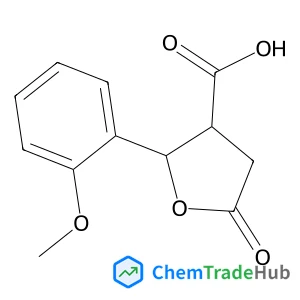
trans-2-(2-Methoxyphenyl)-5-oxotetrahydrofuran-3-carboxylic acid
CAS Number:
99226-02-5
Molecular Formula:
C12H12O5
Recommended Suppliers






Disclaimer
This page provides academic journal information for reference and research purposes only. We are not affiliated with any journal publishers and do not handle publication submissions. For publication-related inquiries, please contact the respective journal publishers directly.
If you notice any inaccuracies in the information displayed, please contact us at support@chemtradehub.com. We will promptly review and address your concerns.