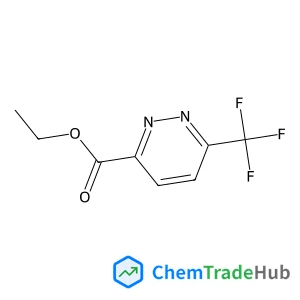
Ethyl 6-(trifluoromethyl)pyridazine-3-carboxylate
CAS Number:
1192155-06-8
Molecular Formula:
C8H7F3N2O2
F. M. Schunk, D. Rand, C. Rose-Petruck
The evaporation and condensation of water on multi-walled carbon nanotube (MWCNT) surfaces was studied as a function of temperature and time using X-ray spatial frequency heterodyne imaging (SFHI). SFHI is an imaging modality that produces an absorption and scatter image in a single exposure, and has increased sensitivity to variations in electron density relative to more common place X-ray imaging techniques. Differing features exhibited in the temporal scatter intensity profiles recorded during evaporation and condensation revealed the existence of an absorption–desorption hysteresis. Effects on the aforementioned phenomena due to chemical functionalization of the carbon nanotube surfaces were also monitored. The increased interaction potential between the functionalized MWCNT walls and water molecules altered the evaporation event time scale and increased the temperature at which condensation could take place. Theoretical calculations were used to correlate the shape of the observed scatter profiles during condensation to changes in the MWCNT cross section geometry and configuration of the contained water volume. Changes in evaporation time scales with temperature coincided with the boiling point for confined water predicted by the Kelvin equation, indicating that a thermodynamic description of mesoscopic confined water is permissible in some instances.
Xianwei Li, Tianzhang Wang, Yu-Jing Lu, Shaomin Ji, Yanping Huo, Bifu Liu
DOI: 10.1039/C8OB01532E
Paola Baiocco, Anna Maria Barreca, Maura Fabbrini, Carlo Galli, Patrizia Gentili
DOI: 10.1039/B208951C
Madhu Ramesh, Pandeeswar Makam, Chandrashekhar Voshavar, Harshavardhan Khare, Kolla Rajasekhar, Suryanarayanarao Ramakumar, Thimmaiah Govindaraju
DOI: 10.1039/C8OB01691G
Feng Li, Ziyan Wu, Jingjing Wang, Siyuan Zhang, Jiaxin Yu, Zhen Yuan, Jingya Liu, Renzeng Shen, Yao Zhou
DOI: 10.1039/D1QO01665B
R. Schettini, C. Costabile, G. Della Sala, J. Buirey, M. Tosolini, P. Tecilla, M. C. Vaccaro, I. Bruno, F. De Riccardis, I. Izzo
DOI: 10.1039/C8OB01522H
Gennaro Pescitelli, Nina Berova, Tom L. Xiao, Roman V. Rozhkov, Richard C. Larock, Daniel W. Armstrong
DOI: 10.1039/B207652G
Han Xu, Feng Sha, Qiong Li, Xin-Yan Wu
DOI: 10.1039/C8OB01970C
Leilei Cao, Liliang Huang, Xianjun Xu
DOI: 10.1039/D1QO01358K
Derek Johnston, Emmanuel Couché, David J. Edmonds, Kenneth W. Muir, David J. Procter
DOI: 10.1039/B209066J
6-(3-Fluorophenyl)picolinic acid is generally considered safe for laboratory use...
(3R)-3-Pyrrolidinol is used in the pharmaceutical industry as a precursor for dr...
When handling (4R,5R)-4,5-Diethoxycarbonyl-2,2-dimethyldioxolane (CAS: 59779-75-...
1-(6-Chloroimidazo[1,2-b]pyridazin-3-yl)ethanone is often synthesized via a mult...
The market for N-Ethyl-3,4-dimethylbenzylamine (CAS: 39180-83-1) remains steady,...
Tert-butyl 3-(pyrrolidin-1-yl)azetidine-1-carboxylate is a chemical compound wit...
1-Bromo-3-chloro-2,4-dimethoxybenzene (CAS: 1228956-93-1) falls under the classi...
The safety of 8-Bromo-2-methyl-3,4-dihydroisoquinolin-1(2H)-one (CAS: 1368622-07...
Benzyl [(3S)-2,6-dioxo-3-piperidinyl]carbamate is generally safe when handled wi...
1-{[4-(4,4,5,5-Tetramethyl-1,3,2-dioxaborolan-2-yl)phenyl]sulfonyl}pyrrolidine s...

Physical Chemistry Chemical Physics (PCCP) is an international journal co-owned by 19 physical chemistry and physics societies from around the world. This journal publishes original, cutting-edge research in physical chemistry, chemical physics and biophysical chemistry. To be suitable for publication in PCCP, articles must include significant innovation and/or insight into physical chemistry; this is the most important criterion that reviewers and Editors will judge against when evaluating submissions. The journal has a broad scope and welcomes contributions spanning experiment, theory, computation and data science. Topical coverage includes spectroscopy, dynamics, kinetics, statistical mechanics, thermodynamics, electrochemistry, catalysis, surface science, quantum mechanics, quantum computing and machine learning. Interdisciplinary research areas such as polymers and soft matter, materials, nanoscience, energy, surfaces/interfaces, and biophysical chemistry are welcomed if they demonstrate significant innovation and/or insight into physical chemistry. Joined experimental/theoretical studies are particularly appreciated when complementary and based on up-to-date approaches.