












Mechanistic insight into E22Q-mutation-induced antiparallel-to-parallel β-sheet transition of Aβ16−22 fibrils: an all-atom simulation study
Literature Information
Publication Date
2019-06-25
DOI
10.1039/C9CP02561H
Impact Factor
3.676
Authors
Xuhua Li, Jiangtao Lei, Ruxi Qi, Luogang Xie, Guanghong Wei
View Original
Abstract
Alzheimer's disease is associated with the abnormal self-assembly of amyloid-β (Aβ) peptide into toxic oligomers and fibrils. Recent experiments reported that Aβ16−22, containing the central hydrophobic core (CHC) of Aβ, formed antiparallel β-sheet fibrils, while its E22Q mutant self-assembled into parallel β-sheet fibrils. However, the molecular mechanisms underlying E22Q-mutation-induced parallel β-sheet fibril formation are not well understood. Herein, we performed molecular dynamics (MD) simulations to study the dimerization processes of Aβ16−22 and Aβ16−22E22Q peptides. β-Sheet dimers with diverse hydrogen bond arrangements were observed and they exhibited highly dynamic and interconverting properties. An antiparallel-to-parallel β-sheet transition occurred in the assembly process of the E22Q mutant, but not in that of Aβ16−22. During this conformational transformation process, the inter-molecular Q22–Q22 hydrogen bonds were first formed and acted as a binder to facilitate the two chains forming a parallel orientation, then the hydrophobic interactions between residues in the CHC region consolidated this arrangement and drove the main-chain H-bond formation, hence resulting in parallel β-sheet formation. However, parallel β-sheets were less populated than antiparallel β-sheets of Aβ16−22E22Q dimers. In order to explore whether parallel β-sheets became dominant in larger size oligomers, we investigated the conformational ensembles of Aβ16−22 and Aβ16−22E22Q octamers by conducting replica exchange molecular dynamics (REMD) simulations. The REMD simulations revealed that the population of parallel β-strand alignment increased with an increase of the size of ordered Aβ16−22E22Q β-sheet oligomers, implying that the formation of full parallel β-sheets requires larger sized oligomers. Our findings provide a mechanistic explanation for the E22Q-mutation-induced formation of parallel β-sheet fibrils observed experimentally.
Related Literature
Visible light-induced palladium–carbon bond weakening in catalytically relevant T-shaped complexes
Peter M. Waddell, Lei Tian, Anthony R. Scavuzzo, Lalu Venigalla, Gregory D. Scholes, Brad P. Carrow
2023-11-28
Edge Article
DOI: 10.1039/D3SC02588H
Hydrogen spillover enhances alkaline hydrogen electrocatalysis on interface-rich metallic Pt-supported MoO3
2023-12-08
Edge Article
DOI: 10.1039/D3SC04126C
Dimethyl carbonate synthesis from CO2 and methanol over CeO2: elucidating the surface intermediates and oxygen vacancy-assisted reaction mechanism
Toshiyuki Sugiyama, Francisco Medina, Wouter van Beek, Jun-ya Hasegawa
2023-11-21
Edge Article
DOI: 10.1039/D3SC04466A
EnzymeMap: curation, validation and data-driven prediction of enzymatic reactions
Daniel Probst, William H. Green, Georg K. H. Madsen
2023-11-22
Edge Article
DOI: 10.1039/D3SC02048G
Engineered aptamers for molecular imaging
Bingqian Lin, Feng Xiao, Jinting Jiang, Zhengjia Zhao, Xiang Zhou
2023-11-21
Review Article
DOI: 10.1039/D3SC03989G
Towards routine organic structure determination using Raman microscopy
Jason Malenfant, Lucille Kuster, Yohann Gagné, Kouassi Signo, Maxime Denis, Sylvain Canesi, Mathieu Frenette
2023-11-14
Edge Article
DOI: 10.1039/D3SC02954A
1,2-Disubstituted bicyclo[2.1.1]hexanes as saturated bioisosteres of ortho-substituted benzene
Aleksandr Denisenko, Pavel Garbuz, Yelyzaveta Makovetska, Dmytro Lesyk, Rodion Korzh, Iryna V. Sadkova, Pavel K. Mykhailiuk
2023-10-27
Edge Article
DOI: 10.1039/D3SC05121H
Recent advances in the utilization of covalent organic frameworks (COFs) as electrode materials for supercapacitors
Shen Xu, Jinghang Wu, Xiang Wang
2023-11-07
Review Article
DOI: 10.1039/D3SC04571D
Cobalt-catalyzed decarboxylative difluoroalkylation of nitrophenylacetic acid salts
Ebbin Joseph, Ian Smith, Jon A. Tunge
2023-11-16
Edge Article
DOI: 10.1039/D3SC05583C
You might also like
Compound Q&A
How is 3-(2-Bromoimidazo[2,1-b]thiazol-6-yl)propanoic acid hydrochloride (CAS: 1187830-80-3) typically synthesized?
3-(2-Bromoimidazo[2,1-b]thiazol-6-yl)propanoic acid hydrochloride is typically s...
1187830-80-33-(2-Bromoimidazo[2,...
Compound Q&A
How is 2-Isopropyl-1,3-dioxane-5-carboxylic acid (CAS: 116193-72-7) typically synthesized?
2-Isopropyl-1,3-dioxane-5-carboxylic acid is typically synthesized by the carbox...
116193-72-72-Isopropyl-1,3-diox...
Compound Q&A
What is Alisporivir (CAS: 254435-95-5)?
Alisporivir (CAS: 254435-95-5) is an antiviral medication used in the treatment ...
254435-95-5Alisporivir
Compound Q&A
What are the physical and chemical properties of [1,2,4]triazolo[3,4-a]phthalazine (CAS: 234-80-0)?
[1,2,4]triazolo[3,4-a]phthalazine (CAS: 234-80-0) is a crystalline compound with...
234-80-0[1,2,4]triazolo[3,4-...
Compound Q&A
What regulatory guidelines apply to (2S)-5-Hydroxy-2-(4-hydroxyphenyl)-4-oxo-3,4-dihydro-2H-chromen-7-yl methyl beta-D-glucopyranosiduronate (CAS: 1985597-72-5)?
Regulatory guidelines for (2S)-5-Hydroxy-2-(4-hydroxyphenyl)-4-oxo-3,4-dihydro-2...
1985597-72-5(2S)-5-Hydroxy-2-(4-...
Compound Q&A
Is 2,2-Difluorocyclohexanamine hydrochloride (CAS: 921602-83-7) safe?
2,2-Difluorocyclohexanamine hydrochloride is generally safe when handled under p...
921602-83-72,2-Difluorocyclohex...
Compound Q&A
What are the main uses of 3-Nitro-2-phenylthiophene (CAS: 18150-94-2)?
3-Nitro-2-phenylthiophene is primarily used in the synthesis of other organic co...
18150-94-23-Nitro-2-phenylthio...
Compound Q&A
What is 1-(Trifluoroacetyl)-4-piperidinecarbonitrile (CAS: 77940-79-5)?
1-(Trifluoroacetyl)-4-piperidinecarbonitrile (CAS: 77940-79-5) is a colorless to...
77940-79-51-(Trifluoroacetyl)-...
Compound Q&A
What is the market or research trend for 1,3,6,8-Tetranitro-9H-carbazole (CAS: 4543-33-3)?
Research and market trends for 1,3,6,8-Tetranitro-9H-carbazole (CAS: 4543-33-3) ...
4543-33-31,3,6,8-Tetranitro-9...
Compound Q&A
How should waste containing Dibenzo[b,d]thiophen-1-ylboronic acid (CAS: 1245943-60-5) be handled?
Waste containing Dibenzo[b,d]thiophen-1-ylboronic acid (CAS: 1245943-60-5) shoul...
1245943-60-5Dibenzo[b,d]thiophen...
Source Journal
Physical Chemistry Chemical Physics

CiteScore:
5.5
Self-citation Rate:
10.3%
Articles per Year:
3036
Physical Chemistry Chemical Physics (PCCP) is an international journal co-owned by 19 physical chemistry and physics societies from around the world. This journal publishes original, cutting-edge research in physical chemistry, chemical physics and biophysical chemistry. To be suitable for publication in PCCP, articles must include significant innovation and/or insight into physical chemistry; this is the most important criterion that reviewers and Editors will judge against when evaluating submissions. The journal has a broad scope and welcomes contributions spanning experiment, theory, computation and data science. Topical coverage includes spectroscopy, dynamics, kinetics, statistical mechanics, thermodynamics, electrochemistry, catalysis, surface science, quantum mechanics, quantum computing and machine learning. Interdisciplinary research areas such as polymers and soft matter, materials, nanoscience, energy, surfaces/interfaces, and biophysical chemistry are welcomed if they demonstrate significant innovation and/or insight into physical chemistry. Joined experimental/theoretical studies are particularly appreciated when complementary and based on up-to-date approaches.
Recommended Compounds


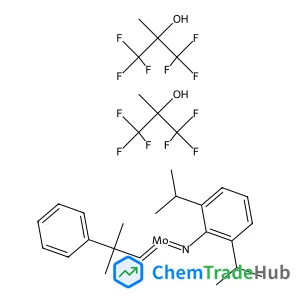
2,6-Diisopropylphenylimidoneophylidene molybdenum(VI) bis(hexafluoro-t-butoxide)
CAS Number:
139220-25-0
Molecular Formula:
C30H37F12MoNO2

Recommended Suppliers



Disclaimer
This page provides academic journal information for reference and research purposes only. We are not affiliated with any journal publishers and do not handle publication submissions. For publication-related inquiries, please contact the respective journal publishers directly.
If you notice any inaccuracies in the information displayed, please contact us at support@chemtradehub.com. We will promptly review and address your concerns.