













Towards routine organic structure determination using Raman microscopy
Literature Information
Publication Date
2023-11-14
DOI
10.1039/D3SC02954A
Impact Factor
9.825
Authors
Jason Malenfant, Lucille Kuster, Yohann Gagné, Kouassi Signo, Maxime Denis, Sylvain Canesi, Mathieu Frenette
View Original
Abstract
Raman microscopy can reveal a compound-specific vibrational “fingerprint” from micrograms of material with no sample preparation. We expect this increasingly available instrumentation to routinely assist synthetic chemists in structure determination; however, interpreting the information-dense spectra can be challenging for unreported compounds. Appropriate theoretical calculations using the highly efficient r2SCAN-3c method can accurately predict peak positions but are less precise in matching peak heights. To limit incorrect biases while comparing experimental and theoretical spectra, we introduce a user-friendly software that gives a match score to assist with structure determination. The capabilities and limitations of this approach are demonstrated for several proof-of-concept examples including the characterization of intermediates in the total synthesis of deoxyaspidodispermine.
Related Literature
Controlled formation of porous magnetic nanorodsvia a liquid/liquid solvothermal method
Oscar Bomati-Miguel, Aldo F. Rebolledo, Pedro Tartaj
2008-07-07
Communication
DOI: 10.1039/B805239E
Controlled generation of acentric and homochiral coordination compounds from a versatile asymmetric ligand 4-(1H-1,2,4-triazol-3-yl)-4H-1,2,4-triazole
Jian Zhang, Zhao-Ji Li, Ye-Yan Qin, Jian-Kai Cheng, Yuan-Gen Yao
2008-07-15
Communication
DOI: 10.1039/B807320A
BiPh3—A convenient synthon for heavy alkaline-earth metal amides
Jonathan G. MacLellan, Craig M. Forsyth, Philip C. Andrews, Glen B. Deacon, Karin Ruhlandt-Senge
2008-07-31
Communication
DOI: 10.1039/B806948D
Open cellular reactive porous membranes from high internal phase emulsions
Peter Krajnc
2008-07-30
Communication
DOI: 10.1039/B807095D
Ni(ii)-catalyzed enantioselective Nazarov cyclizations
Irene Walz, Antonio Togni
2008-07-17
Communication
DOI: 10.1039/B806870D
Directing single-walled carbon nanotubes to self-assemble at water/oil interfaces and facilitate electron transfer
Yuanjian Zhang, Yanfei Shen, Daniel Kuehner, Shuixing Wu, Zhongmin Su, Shen Ye, Li Niu
2008-07-17
Communication
DOI: 10.1039/B805789C
Cyanurate-guided self-assembly of a melamine-capped oligo(p-phenylenevinylene)
Shun Kubota, Kanako Unoike, Takashi Karatsu, Akihide Kitamura
2008-07-29
Communication
DOI: 10.1039/B808684B
Hydrogen adsorption in microporous organic framework polymer
Saad Makhseed, Jacob Samuel
2008-07-18
Communication
DOI: 10.1039/B805656K
You might also like
Compound Q&A
What precautions should be taken when handling 4-(2-Furylmethyl)thiomorpholine 1,1-dioxide (CAS: 79206-94-3)?
When handling 4-(2-Furylmethyl)thiomorpholine 1,1-dioxide (CAS: 79206-94-3), it ...
79206-94-34-(2-Furylmethyl)thi...
Compound Q&A
What precautions should be taken when handling 4-Chloro-N-[2-(4-morpholinyl)ethyl]benzamide (CAS: 71320-77-9)?
When handling 4-Chloro-N-[2-(4-morpholinyl)ethyl]benzamide (CAS: 71320-77-9), it...
71320-77-94-Chloro-N-[2-(4-mor...
Compound Q&A
How should waste containing 2-[2-(2-Methoxyethoxy)ethoxy]ethyl 4-methylbenzenesulfonate (CAS: 62921-74-8) be handled?
Waste containing this compound (CAS: 62921-74-8) should be handled according to ...
62921-74-82-[2-(2-Methoxyethox...
Compound Q&A
How should waste containing (S)-Methyl 2-amino-3-cyclohexylpropanoate be handled?
Waste containing (S)-Methyl 2-amino-3-cyclohexylpropanoate should be collected i...
40056-18-6(S)-Methyl 2-amino-3...
Compound Q&A
How is 5-({4-[(2S,4R)-4-Hydroxy-2-methyltetrahydro-2H-pyran-4-yl]-2-thienyl}sulfanyl)-1-methyl-1,3-dihydro-2H-indol-2-one (CAS: 166882-70-8) typically synthesized?
This compound can be synthesized using a multi-step process involving the conjug...
166882-70-85-({4-[(2S,4R)-4-Hyd...
Compound Q&A
Are there alternatives to (2E)-3-(3,4-Dichlorophenyl)acrylic acid (CAS: 7312-27-8) in synthesis?
There are several alternatives to (2E)-3-(3,4-Dichlorophenyl)acrylic acid in syn...
7312-27-8(2E)-3-(3,4-Dichloro...
Compound Q&A
How should Ethyl 6-(2-nitrophenyl)imidazo[2,1-b][1,3]thiazole-3-carboxylate (CAS: 925437-84-9) be stored?
Ethyl 6-(2-nitrophenyl)imidazo[2,1-b][1,3]thiazole-3-carboxylate (CAS: 925437-84...
925437-84-9Ethyl 6-(2-nitrophen...
Compound Q&A
How should waste containing 2-(1,3-Thiazol-2-yl)ethanamine (CAS: 18453-07-1) be handled?
Waste containing 2-(1,3-Thiazol-2-yl)ethanamine (CAS: 18453-07-1) should be coll...
18453-07-12-(1,3-Thiazol-2-yl)...
Compound Q&A
How is Methyl 5-iodo-2-methylbenzoate (CAS: 103440-54-6) typically synthesized?
Methyl 5-iodo-2-methylbenzoate can be synthesized through the iodination of meth...
103440-54-6Methyl 5-iodo-2-meth...
Compound Q&A
How is 5-Chloro[1,2,4]triazolo[1,5-a]pyridine (CAS: 1427399-34-5) typically synthesized?
5-Chloro[1,2,4]triazolo[1,5-a]pyridine is commonly synthesized via the condensat...
1427399-34-55-Chloro[1,2,4]triaz...
Source Journal
Chemical Science

CiteScore:
14.4
Self-citation Rate:
3.9%
Articles per Year:
1413
Our journal has a wide-ranging scope which covers the full breadth of the chemical sciences. The research we publish contains the sorts of novel ideas, challenging questions and progressive thinking that bring undiscovered breakthroughs within reach. Your paper could focus on a single area, or cross many. It could be beyond the accepted bounds of the chemical sciences. It might address an immediate challenge, contribute to a future breakthrough or be wholly conceptual. We’re a team from every field of the chemical sciences, and know from experience that breakthroughs that drive the solutions to global challenges can come from anywhere, at any time. You could even start an entirely new area of research. Too bold? Too progressive? No such thing
Recommended Compounds
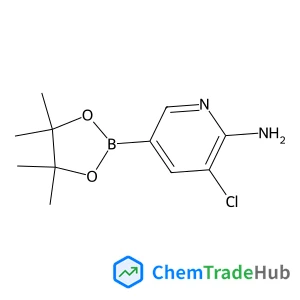
3-Chloro-5-(4,4,5,5-tetramethyl-1,3,2-dioxaborolan-2-yl)-2-pyridinamine
CAS Number:
1032758-99-8
Molecular Formula:
C11H16BClN2O2
![5-Methyl-4,5,6,7-tetrahydropyrazolo[1,5-a]pyrazin-2-amine structure](https://static.chemtradehub.com/structs/122/1227210-33-4-8d64.webp "5-Methyl-4,5,6,7-tetrahydropyrazolo[1,5-a]pyrazin-2-amine structure")
5-Methyl-4,5,6,7-tetrahydropyrazolo[1,5-a]pyrazin-2-amine
CAS Number:
1227210-33-4
Molecular Formula:
C7H12N4

Recommended Suppliers






Disclaimer
This page provides academic journal information for reference and research purposes only. We are not affiliated with any journal publishers and do not handle publication submissions. For publication-related inquiries, please contact the respective journal publishers directly.
If you notice any inaccuracies in the information displayed, please contact us at support@chemtradehub.com. We will promptly review and address your concerns.