












Hydrogen bond dynamics and conformational flexibility in antipsychotics
Literature Information
Publication Date
2019-06-20
DOI
10.1039/C9CP02456E
Impact Factor
3.676
Authors
Jose E. M. Pereira, Svemir Rudic, Dehong Yu, Richard Mole
View Original
Abstract
Effective treatment of disorders of the central nervous system can often be achieved using bioactive molecules of similar moieties to those known to be tolerable. A better understanding of the solid-state characteristics of such molecules could thereby create new opportunities for research on pharmaceutical preparations and drug prescriptions, while information about their rich intramolecular dynamics may well add an important aspect in the field of in silico drug discovery. We have therefore investigated three different antipsychotic drugs: haloperidol (C21H23ClFNO2, HAL), aripiprazole (C23H27Cl2N3O2, APZ) and quetiapine hemifumarate (C21H25N3O2S·0.5C4H4O4, QTP) based on similarities either in their structures, hydrophobic and hydrophilic moieties, or in their modes of action, typical or atypical. Our aim was to test the structural and molecular stability of these three different antipsychotics. To this end, we compared the molecular vibrations observed by inelastic neutron spectroscopy of these systems with those from theoretical periodic calculations of the crystalline antipsychotics using the Vienna ab initio simulation package (VASP). While most of the observed features in the lattice region were reasonably well represented by the calculations, the overall spectra were relatively complex, and hence traditional assignment procedures for the approximately 600 normal modes in the unit cell were not possible. These results indicate that in the search for new drug candidates, not only analysis of the flexibility of the receptor, but also the dynamics of the active molecules play a role in improving the prediction of binding affinities.
Related Literature
Selective chiral dimerization and folding driven by arene–perfluoroarene force
Qiuhong Cheng, Aiyou Hao, Pengyao Xing
2023-11-29
Edge Article
DOI: 10.1039/D3SC05212E
Inserting an “atomic trap” for directional dopant migration in core/multi-shell quantum dots
Chun Chu, Elan Hofman, Chengpeng Gao, Shuya Li, Hanjie Lin, Walker MacSwain, John M. Franck, Robert W. Meulenberg, Arindam Chakraborty, Weiwei Zheng
2023-11-20
Edge Article
DOI: 10.1039/D3SC04165D
Thermally activated delayed fluorescence in a deep red dinuclear iridium(iii) complex: a hidden mechanism for short luminescence lifetimes
Andrey V. Zaytsev, Amit Sil, Glib V. Baryshnikov, J. A. Gareth Williams, Fernando B. Dias, Valery N. Kozhevnikov
2023-11-14
Edge Article
DOI: 10.1039/D3SC04450E
Rapid, iterative syntheses of unsymmetrical di- and triarylboranes from crystalline aryldifluoroboranes
Douglas Turnbull, Marc-André Légaré
2023-11-17
Edge Article
DOI: 10.1039/D3SC05071H
Supramolecular “baking powder”: a hexameric halogen-bonded phosphonium salt cage encapsulates and functionalises small-molecule carbonyl compounds
Hatem M. Titi, Yong Teoh
2023-11-28
Edge Article
DOI: 10.1039/D2SC04615F
Using waste to treat waste: facile synthesis of hollow carbon nanospheres from lignin for water decontamination
Xiang Liu, Zixuan Hao, Chen Fang, Kun Pang, Jiaying Yan, Yingping Huang, Di Huang
2023-11-27
Edge Article
DOI: 10.1039/D3SC05275C
Thermally activated delayed fluorescence in a mechanically soft charge-transfer complex: role of the locally excited state
Kalyan Jyoti Kalita, Saikat Mondal, C. Malla Reddy, Ratheesh K. Vijayaraghavan
2023-11-10
Edge Article
DOI: 10.1039/D3SC03267A
Engineering TADF, mechanochromism, and second harmonic up-conversion properties in regioisomeric substitution space
Abhijit Chatterjee, Joy Chatterjee, Subrahmanyam Sappati, Riteeka Tanwar, Madan D. Ambhore, Habibul Arfin, Rintu M. Umesh, Mayurika Lahiri, Pankaj Mandal, Partha Hazra
2023-11-08
Edge Article
DOI: 10.1039/D3SC04280D
O–H bond activation of β,γ-unsaturated oximes via hydrogen atom transfer (HAT) and photoredox dual catalysis
Chen Zhu, Xiangyu Chen, Huifeng Yue, Tengfei Ji, Yiqiao Ma, Yuanyuan Cao, Rajesh Kancherla, Magnus Rueping
2023-11-30
Edge Article
DOI: 10.1039/D3SC04410F
Hydrogen spillover and substrate–support hydrogen bonding mediate hydrogenation of phenol catalyzed by palladium on reducible metal oxides
Yeongseo An, Sayak Banerjee
2023-11-24
Edge Article
DOI: 10.1039/D3SC02913A
You might also like
Compound Q&A
How is 3-(2-Bromoimidazo[2,1-b]thiazol-6-yl)propanoic acid hydrochloride (CAS: 1187830-80-3) typically synthesized?
3-(2-Bromoimidazo[2,1-b]thiazol-6-yl)propanoic acid hydrochloride is typically s...
1187830-80-33-(2-Bromoimidazo[2,...
Compound Q&A
How is 2-Isopropyl-1,3-dioxane-5-carboxylic acid (CAS: 116193-72-7) typically synthesized?
2-Isopropyl-1,3-dioxane-5-carboxylic acid is typically synthesized by the carbox...
116193-72-72-Isopropyl-1,3-diox...
Compound Q&A
What is Alisporivir (CAS: 254435-95-5)?
Alisporivir (CAS: 254435-95-5) is an antiviral medication used in the treatment ...
254435-95-5Alisporivir
Compound Q&A
What are the physical and chemical properties of [1,2,4]triazolo[3,4-a]phthalazine (CAS: 234-80-0)?
[1,2,4]triazolo[3,4-a]phthalazine (CAS: 234-80-0) is a crystalline compound with...
234-80-0[1,2,4]triazolo[3,4-...
Compound Q&A
What regulatory guidelines apply to (2S)-5-Hydroxy-2-(4-hydroxyphenyl)-4-oxo-3,4-dihydro-2H-chromen-7-yl methyl beta-D-glucopyranosiduronate (CAS: 1985597-72-5)?
Regulatory guidelines for (2S)-5-Hydroxy-2-(4-hydroxyphenyl)-4-oxo-3,4-dihydro-2...
1985597-72-5(2S)-5-Hydroxy-2-(4-...
Compound Q&A
Is 2,2-Difluorocyclohexanamine hydrochloride (CAS: 921602-83-7) safe?
2,2-Difluorocyclohexanamine hydrochloride is generally safe when handled under p...
921602-83-72,2-Difluorocyclohex...
Compound Q&A
What are the main uses of 3-Nitro-2-phenylthiophene (CAS: 18150-94-2)?
3-Nitro-2-phenylthiophene is primarily used in the synthesis of other organic co...
18150-94-23-Nitro-2-phenylthio...
Compound Q&A
What is 1-(Trifluoroacetyl)-4-piperidinecarbonitrile (CAS: 77940-79-5)?
1-(Trifluoroacetyl)-4-piperidinecarbonitrile (CAS: 77940-79-5) is a colorless to...
77940-79-51-(Trifluoroacetyl)-...
Compound Q&A
What is the market or research trend for 1,3,6,8-Tetranitro-9H-carbazole (CAS: 4543-33-3)?
Research and market trends for 1,3,6,8-Tetranitro-9H-carbazole (CAS: 4543-33-3) ...
4543-33-31,3,6,8-Tetranitro-9...
Compound Q&A
How should waste containing Dibenzo[b,d]thiophen-1-ylboronic acid (CAS: 1245943-60-5) be handled?
Waste containing Dibenzo[b,d]thiophen-1-ylboronic acid (CAS: 1245943-60-5) shoul...
1245943-60-5Dibenzo[b,d]thiophen...
Source Journal
Physical Chemistry Chemical Physics

CiteScore:
5.5
Self-citation Rate:
10.3%
Articles per Year:
3036
Physical Chemistry Chemical Physics (PCCP) is an international journal co-owned by 19 physical chemistry and physics societies from around the world. This journal publishes original, cutting-edge research in physical chemistry, chemical physics and biophysical chemistry. To be suitable for publication in PCCP, articles must include significant innovation and/or insight into physical chemistry; this is the most important criterion that reviewers and Editors will judge against when evaluating submissions. The journal has a broad scope and welcomes contributions spanning experiment, theory, computation and data science. Topical coverage includes spectroscopy, dynamics, kinetics, statistical mechanics, thermodynamics, electrochemistry, catalysis, surface science, quantum mechanics, quantum computing and machine learning. Interdisciplinary research areas such as polymers and soft matter, materials, nanoscience, energy, surfaces/interfaces, and biophysical chemistry are welcomed if they demonstrate significant innovation and/or insight into physical chemistry. Joined experimental/theoretical studies are particularly appreciated when complementary and based on up-to-date approaches.
Recommended Compounds
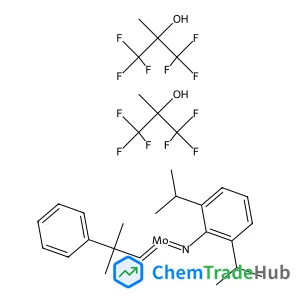
2,6-Diisopropylphenylimidoneophylidene molybdenum(VI) bis(hexafluoro-t-butoxide)
CAS Number:
139220-25-0
Molecular Formula:
C30H37F12MoNO2
Recommended Suppliers




Disclaimer
This page provides academic journal information for reference and research purposes only. We are not affiliated with any journal publishers and do not handle publication submissions. For publication-related inquiries, please contact the respective journal publishers directly.
If you notice any inaccuracies in the information displayed, please contact us at support@chemtradehub.com. We will promptly review and address your concerns.