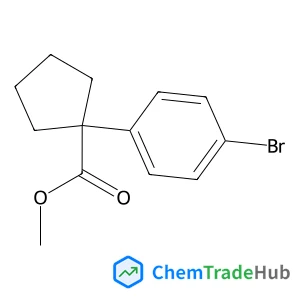
Methyl 1-(4-bromophenyl)cyclopentanecarboxylate
CAS Number:
1236357-64-4
Molecular Formula:
C13H15BrO2
Alexander V. Thoeny, Tobias M. Gasser, Thomas Loerting
The nature of the hydrogen sublattice of an HCl-doped ice VI sample after cooling at 1.8 GPa has been a topic of recent interest. The samples are interpreted either as the new H-ordered ice phase ice β-XV with a thermodynamic stability region in the phase diagram [T. M. Gasser et al., Chem. Sci., 2018, 9, 4224], or alternatively as H-disordered, deep glassy ice VI [A. Rosu-Finsen and C. G. Salzmann, Chem. Sci., 2019, 10, 515]. Here we provide a comprehensive Raman spectroscopic study on ice β-XV, ice XV and ice VI, with the following key findings: (i) the Raman spectra of ice β-XV differ fundamentally from those of ice VI and ice XV, where the degree of H-order is even higher than in ice XV. (ii) Upon cooling ice VI there is competition between formation of ice XV and ice β-XV domains, where ice XV forms at 0.0 GPa, but ice β-XV at 1.8 GPa. Domains of ice β-XV are present in literature “ice XV” at 1.0 GPa. This result clarifies the puzzling earlier observation that the degree of H-order in ice XV apparently improves upon heating and recooling at ambient pressure. In reality, this procedure leaves the H-order in ice XV unaffected, but removes ice β-XV domains by transforming them to ice XV. (iii) Upon heating, the samples experience the transition sequence ice β-XV → ice XV → ice VI, i.e., an order–order transition at 103 K followed by an order–disorder transition at 129 K. The former progresses via a disordered transient state. (iv) D2O ice β-XV forms upon cooling DCl-doped D2O-ice VI, albeit at a much lower pace than in the hydrogenated case so that untransformed D2O ice VI domains are present even after slow cooling. The librational band at 380 cm−1 is identified to be the characteristic spectroscopic feature of deuterated ice β-XV. Taken together these findings clarify open questions in previous work on H-ordering in the ice VI lattice, rule out a glassy nature of ice β-XV and pave the way for a future neutron diffraction study to refine the crystal structure of D2O ice β-XV.
Bingqian Lin, Feng Xiao, Jinting Jiang, Zhengjia Zhao, Xiang Zhou
DOI: 10.1039/D3SC03989G
Clement G. Collins Rice, Louis J. Morris, Jean-Charles Buffet, Zoë R. Turner, Dermot O'Hare
DOI: 10.1039/D3SC04861F
Daniele Mazzarella, Tommaso Bortolato, Giorgio Pelosi, Luca Dell'Amico
DOI: 10.1039/D3SC05997A
Jian Zhuang, Hua Zhang
DOI: 10.1039/D3SC03504B
Leo W. T. Parsons, James C. Fettinger, Louise A. Berben
DOI: 10.1039/D3SC03806H
Alister S. Goodfellow, Kevin Kasten, Zhuan Duan, Tengfei Kang, David B. Cordes, Aidan P. McKay, Michael Bühl, Andrew D. Smith
DOI: 10.1039/D3SC05470E
3-(2-Bromoimidazo[2,1-b]thiazol-6-yl)propanoic acid hydrochloride is typically s...
2-Isopropyl-1,3-dioxane-5-carboxylic acid is typically synthesized by the carbox...
Alisporivir (CAS: 254435-95-5) is an antiviral medication used in the treatment ...
[1,2,4]triazolo[3,4-a]phthalazine (CAS: 234-80-0) is a crystalline compound with...
Regulatory guidelines for (2S)-5-Hydroxy-2-(4-hydroxyphenyl)-4-oxo-3,4-dihydro-2...
2,2-Difluorocyclohexanamine hydrochloride is generally safe when handled under p...
3-Nitro-2-phenylthiophene is primarily used in the synthesis of other organic co...
1-(Trifluoroacetyl)-4-piperidinecarbonitrile (CAS: 77940-79-5) is a colorless to...
Research and market trends for 1,3,6,8-Tetranitro-9H-carbazole (CAS: 4543-33-3) ...
Waste containing Dibenzo[b,d]thiophen-1-ylboronic acid (CAS: 1245943-60-5) shoul...

Physical Chemistry Chemical Physics (PCCP) is an international journal co-owned by 19 physical chemistry and physics societies from around the world. This journal publishes original, cutting-edge research in physical chemistry, chemical physics and biophysical chemistry. To be suitable for publication in PCCP, articles must include significant innovation and/or insight into physical chemistry; this is the most important criterion that reviewers and Editors will judge against when evaluating submissions. The journal has a broad scope and welcomes contributions spanning experiment, theory, computation and data science. Topical coverage includes spectroscopy, dynamics, kinetics, statistical mechanics, thermodynamics, electrochemistry, catalysis, surface science, quantum mechanics, quantum computing and machine learning. Interdisciplinary research areas such as polymers and soft matter, materials, nanoscience, energy, surfaces/interfaces, and biophysical chemistry are welcomed if they demonstrate significant innovation and/or insight into physical chemistry. Joined experimental/theoretical studies are particularly appreciated when complementary and based on up-to-date approaches.