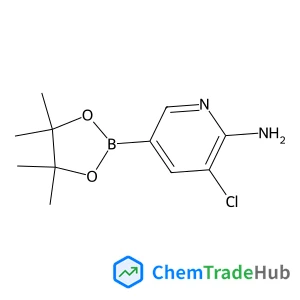
3-Chloro-5-(4,4,5,5-tetramethyl-1,3,2-dioxaborolan-2-yl)-2-pyridinamine
CAS Number:
1032758-99-8
Molecular Formula:
C11H16BClN2O2
Daniele Mazzarella, Tommaso Bortolato, Giorgio Pelosi, Luca Dell'Amico
Herein, we document the design and development of a novel (3 + 2) cycloaddition reaction aided by the activity of an organic photocatalyst and visible light. The process is extremely fast, taking place in a few minutes, with virtually complete atom economy. A large variety of structurally diverse aziridines were used as masked ylides in the presence of different types of dipolarophiles (28 examples with up to 94% yield and >95 : 5 dr). Mechanistic insights obtained from photophysical, electrochemical and experimental studies highlight that the chemistry is driven by the in situ generation of the reactive ylide through two consecutive electron-transfer processes. We also report an aerobic cascade process, where an additional oxidation step grants access to a vast array of pyrrole derivatives (19 examples with up to 95% yield). Interestingly, the extended aromatic core exhibits a distinctive absorption and emission profile, which can be easily used to tag the effectiveness of this covalent linkage.
Oscar Bomati-Miguel, Aldo F. Rebolledo, Pedro Tartaj
DOI: 10.1039/B805239E
Tom F. A. de Greef, Marko M. L. Nieuwenhuizen, Patrick J. M. Stals, Carel F. C. Fitié, Anja R. A. Palmans, Rint P. Sijbesma, E. W. Meijer
DOI: 10.1039/B806506C
Junichi Tsuzuki, Futoshi Sakai, Masatsugu Kajitani, Nick Serpone
DOI: 10.1039/B808188C
Magali Bonne, Nicolas Bion, Frédéric Pailloux, Sabine Valange, Sébastien Royer, Jean-Michel Tatibouët, Daniel Duprez
DOI: 10.1039/B808699K
Yuanjian Zhang, Yanfei Shen, Daniel Kuehner, Shuixing Wu, Zhongmin Su, Shen Ye, Li Niu
DOI: 10.1039/B805789C
Shigehisa Akine, Takashi Matsumoto, Tatsuya Nabeshima
DOI: 10.1039/B810426C
Azusa Takai, Yusuke Yamauchi, Kazuyuki Kuroda
DOI: 10.1039/B804072A
Laura Pérez, Julie Lenoble, Joaquín Barberá, Pilar de la Cruz, Robert Deschenaux, Fernando Langa
DOI: 10.1039/B808730J
Todd W. Hudnall, François P. Gabbaï
DOI: 10.1039/B808740G
When handling 4-(2-Furylmethyl)thiomorpholine 1,1-dioxide (CAS: 79206-94-3), it ...
When handling 4-Chloro-N-[2-(4-morpholinyl)ethyl]benzamide (CAS: 71320-77-9), it...
Waste containing this compound (CAS: 62921-74-8) should be handled according to ...
Waste containing (S)-Methyl 2-amino-3-cyclohexylpropanoate should be collected i...
This compound can be synthesized using a multi-step process involving the conjug...
There are several alternatives to (2E)-3-(3,4-Dichlorophenyl)acrylic acid in syn...
Ethyl 6-(2-nitrophenyl)imidazo[2,1-b][1,3]thiazole-3-carboxylate (CAS: 925437-84...
Waste containing 2-(1,3-Thiazol-2-yl)ethanamine (CAS: 18453-07-1) should be coll...
Methyl 5-iodo-2-methylbenzoate can be synthesized through the iodination of meth...
5-Chloro[1,2,4]triazolo[1,5-a]pyridine is commonly synthesized via the condensat...
Our journal has a wide-ranging scope which covers the full breadth of the chemical sciences. The research we publish contains the sorts of novel ideas, challenging questions and progressive thinking that bring undiscovered breakthroughs within reach. Your paper could focus on a single area, or cross many. It could be beyond the accepted bounds of the chemical sciences. It might address an immediate challenge, contribute to a future breakthrough or be wholly conceptual. We’re a team from every field of the chemical sciences, and know from experience that breakthroughs that drive the solutions to global challenges can come from anywhere, at any time. You could even start an entirely new area of research. Too bold? Too progressive? No such thing