












Effective electron–hole separation over a controllably constructed WP/UiO-66/CdS heterojunction to achieve efficiently improved visible-light-driven photocatalytic hydrogen evolution
Literature Information
Publication Date
2019-03-25
DOI
10.1039/C9CP01180C
Impact Factor
3.676
Authors
View Original
Abstract
The photocatalytic decomposition of water to produce hydrogen is an important strategy to effectively utilize solar energy and solve the energy crisis. In this study, a highly efficient WP-nanoparticle-modified composite catalyst was successfully prepared. WP nanoparticles have been used as an efficient and acid-stable co-catalyst for the HER owing to their specific electronic structure, metalloid characteristics and catalytic activity. On the one hand, the octahedral spatial structure of UiO-66 not only provides attachment space for CdS and WP nanoparticles, but also effectively reduces the particle size and increases the dispersion of CdS and WP nanoparticles. On the other hand, the potential difference and the matching energy band positions of UiO-66 and CdS provide a feasible thermodynamic path for the transmission of photogenerated electrons. The intimate contact between the abovementioned three compounds resulted in a strong synergistic effect, which improved the efficiency of the photocatalytic H2 production. Under visible-light irradiation, the maximum H2 production in 5 h over the [UiO-66@CdS/WP (10 wt%)] photocatalyst was 395 μmol, which was 26.33 times that of pure CdS. The physical and chemical information of the samples could be obtained through XRD, SEM, TEM, XPS, BET and UV-vis DRS characterizations. Furthermore, based on the photoluminescence spectra, photoelectrochemical experiments and Mott–Schottky curves, we could reasonably explain the separation and transfer mechanisms of the photogenerated electrons and holes. The lower recombination rate of charge, enhanced intensity of light absorption, a short fluorescence lifetime (2.11 ns), a faster electron injection rate (KET = 2.32 × 10⁸ s−1), a larger efficiency of electron injection (ηinj = 49.1%), high photocurrent response, and smaller charge transfer resistance accelerate the efficient separation and transfer of spatial charges, finally enhancing the photocatalytic performance.
Related Literature
Structure and magnetism of a new pyrazolate bridged iron(II) spin crossover complex displaying a single HS–HS to LS–LS transition
Ben A. Leita, Boujemaa Moubaraki, Keith S. Murray, Jonathan P. Smith, John D. Cashion
2003-11-20
Communication
DOI: 10.1039/B311818E
Large macroscopic size changes in chemomechanical polymers with binding sites for metal ions
Hans-Jörg Schneider, Tianjun Liu
2003-11-13
Communication
DOI: 10.1039/B310939A
Peroxides in ordered nanoporous silicas: clean alternatives to transition metal oxidants for the removal of toxic gases
Michael J. Hudson, Dominic B. Jackson, Jessica L. Ward, Matt J. Chinn
2003-11-07
Communication
DOI: 10.1039/B310872D
The synthesis of a di-N-heterocyclic carbene-amido complex of palladium(ii)
Richard E. Douthwaite, Jennifer Houghton, Benson M. Kariuki
2004-02-13
Communication
DOI: 10.1039/B314814A
First three examples of taxane-derived di-propellanes in Taxus canadensis needles
Qing Wen Shi, Françoise Sauriol, Alain Lesimple, Lolita O. Zamir
2004-02-04
Communication
DOI: 10.1039/B316051C
Amine elimination synthesis of a titanium(IV) N-heterocyclic carbene complex with short intramolecular Cl⋯Ccarbene contacts
Colin D. Abernethy
2004-01-15
Communication
DOI: 10.1039/B314558A
Metal organic chemical vapour deposition (MOCVD) of bone mineral like carbonated hydroxyapatite coatings
J. A. Darr, Z. X. Guo, V. Raman, M. Bououdina, I. U. Rehman
2004-02-13
Communication
DOI: 10.1039/B312855P
Hydrogen adsorption in the nanoporous metal-benzenedicarboxylate M(OH)(O2C–C6H4–CO2) (M = Al3+, Cr3+), MIL-53
Gérard Férey, Michel Latroche, Christian Serre, Franck Millange, Thierry Loiseau, Annick Percheron-Guégan
2003-11-04
Communication
DOI: 10.1039/B308903G
Dichloro(dodeca-2,6,10-triene-1,12-diyl)ruthenium(iv): a highly efficient catalyst for the isomerization of allylic alcohols into carbonyl compounds in organic and aqueous media
Victorio Cadierno, Sergio E. García-Garrido, José Gimeno
2003-12-05
Communication
DOI: 10.1039/B313069J
The first general method for α-trifluoromethylation of carboxylic acids using BrF3
Aviv Hagooly, Shlomo Rozen
2004-02-09
Communication
DOI: 10.1039/B315705A
You might also like
Compound Q&A
What are the main uses of 1H-Indazole-6-carbonitrile (CAS: 141290-59-7)?
1H-Indazole-6-carbonitrile finds applications in pharmaceuticals, where it serve...
141290-59-71H-Indazole-6-carbon...
Compound Q&A
How should waste containing Dioctyl (2E)-2-butenedioate (CAS: 2997-85-5) be handled?
Waste containing Dioctyl (2E)-2-butenedioate (CAS: 2997-85-5) should be collecte...
2997-85-5Dioctyl (2E)-2-buten...
Compound Q&A
What industries use Sodium [(1,2-benzoxazol-3-ylmethyl)sulfonyl]azanide (CAS: 68291-98-5)?
Sodium [(1,2-benzoxazol-3-ylmethyl)sulfonyl]azanide is primarily used in pharmac...
68291-98-5Sodium [(1,2-benzoxa...
Compound Q&A
Are there alternatives to Dimethyl 4-(4,4,5,5-tetramethyl-1,3,2-dioxaborolan-2-yl)-2,6-pyridinedicarboxylate (CAS: 741709-66-0) in synthesis?
Dimethyl 4-(4,4,5,5-tetramethyl-1,3,2-dioxaborolan-2-yl)-2,6-pyridinedicarboxyla...
741709-66-0Dimethyl 4-(4,4,5,5-...
Compound Q&A
How should waste containing 2-Fluoro-6-hydrazinopyridine (CAS: 80714-39-2) be handled?
Waste containing 2-Fluoro-6-hydrazinopyridine (CAS: 80714-39-2) should be manage...
80714-39-22-Fluoro-6-hydrazino...
Compound Q&A
What is 6-Formyl-2-pyridinecarboxylic acid (CAS: 499214-11-8)?
6-Formyl-2-pyridinecarboxylic acid is an organic compound with the molecular for...
499214-11-86-Formyl-2-pyridinec...
Compound Q&A
What is the market or research trend for 3-(3,4-dimethoxyphenyl)-2,5-dimethyl-N-(2-morpholin-4-ylethyl)pyrazolo[1,5-a]pyrimidin-7-amine (CAS: 900874-91-1)?
Research trends for this compound indicate a focus on its potential applications...
900874-91-13-(3,4-dimethoxyphen...
Compound Q&A
How is 9H-Tribenzo[b,d,f]azepine (CAS: 29875-73-8) typically synthesized?
9H-Tribenzo[b,d,f]azepine is typically synthesized via a multi-step process invo...
29875-73-89H-Tribenzo[b,d,f]az...
Compound Q&A
How is 1-Cyclopropyl-7-ethoxy-6-fluoro-8-methoxy-4-oxo-1,4-dihydro-3-quinolinecarboxylic acid (CAS: 1797982-51-4) typically synthesized?
1-Cyclopropyl-7-ethoxy-6-fluoro-8-methoxy-4-oxo-1,4-dihydro-3-quinolinecarboxyli...
1797982-51-41-Cyclopropyl-7-etho...
Compound Q&A
How should waste containing Methyl 3-oxo-1,2,3,4-tetrahydro-6-quinoxalinecarboxylate (CAS: 671820-52-3) be handled?
Waste containing Methyl 3-oxo-1,2,3,4-tetrahydro-6-quinoxalinecarboxylate (CAS: ...
671820-52-3Methyl 3-oxo-1,2,3,4...
Source Journal
Physical Chemistry Chemical Physics

CiteScore:
5.5
Self-citation Rate:
10.3%
Articles per Year:
3036
Physical Chemistry Chemical Physics (PCCP) is an international journal co-owned by 19 physical chemistry and physics societies from around the world. This journal publishes original, cutting-edge research in physical chemistry, chemical physics and biophysical chemistry. To be suitable for publication in PCCP, articles must include significant innovation and/or insight into physical chemistry; this is the most important criterion that reviewers and Editors will judge against when evaluating submissions. The journal has a broad scope and welcomes contributions spanning experiment, theory, computation and data science. Topical coverage includes spectroscopy, dynamics, kinetics, statistical mechanics, thermodynamics, electrochemistry, catalysis, surface science, quantum mechanics, quantum computing and machine learning. Interdisciplinary research areas such as polymers and soft matter, materials, nanoscience, energy, surfaces/interfaces, and biophysical chemistry are welcomed if they demonstrate significant innovation and/or insight into physical chemistry. Joined experimental/theoretical studies are particularly appreciated when complementary and based on up-to-date approaches.
Recommended Compounds
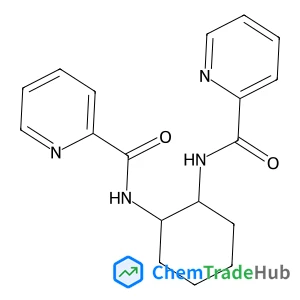
N,N'-(1R,2R)-1,2-Cyclohexanediyldi(2-pyridinecarboxamide)
CAS Number:
218290-24-5
Molecular Formula:
C18H20N4O2
Recommended Suppliers






Disclaimer
This page provides academic journal information for reference and research purposes only. We are not affiliated with any journal publishers and do not handle publication submissions. For publication-related inquiries, please contact the respective journal publishers directly.
If you notice any inaccuracies in the information displayed, please contact us at support@chemtradehub.com. We will promptly review and address your concerns.