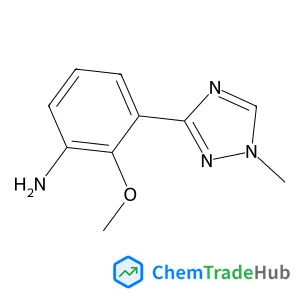
2-Methoxy-3-(1-methyl-1H-1,2,4-triazol-3-yl)aniline
CAS Number:
1609394-10-6
Molecular Formula:
C10H12N4O
Hans-Jörg Schneider, Tianjun Liu
A flexible polymer based on the reaction of polyacrylate with diethylenetriamine shows, under the control of transition metal ions in the external aqueous medium, size expansion or contraction by up to 200% (corresponding to 400% volume change); the macroscopic movements, which are fully reversible, show a distinct maximum at a certain metal salt concentration, and vary significantly with the addition of second effector compounds such as sodium chloride or benzoate.
Orion Archer Cohen, Samuel M. Blau, Jason M. Munro, Ruoxi Yang, Rishabh D. Guha, Sudarshan Vijay, Patrick Huck, Ryan Kingsbury, Matthew K. Horton
DOI: 10.1039/D3DD00153A
Benjamin Weiser, Jérôme Genzling, Mihai Burai-Patrascu, Ophélie Rostaing
DOI: 10.1039/D3DD00110E
Dapeng Luo, Jinping Zou, Zhaohui Wei, Xiaoyun Ye, Qianting Wang, Li-An Ma
DOI: 10.1039/D3CE00900A
Krishanu Dey, Dibyajyoti Ghosh, Matthew Pilot, Samuel R. Pering, Bart Roose, Priyanka Deswal, Satyaprasad P. Senanayak, Petra J. Cameron, M. Saiful Islam
DOI: 10.1039/D3EE03772J
Zongjin Yi, Rui He, Jingwei Zhu, Wenbo Jiao, Yi Luo, Yuliang Xu, Yunfan Wang, Zixin Zeng, Kun Wei, Jinbao Zhang, Sai-Wing Tsang, Cong Chen, Dewei Zhao
DOI: 10.1039/D3EE02839A
Kaixian Li, Chuncai Shan, Shaoke Fu, Huiyuan Wu, Wencong He, Jian Wang, Gui Li, Qianjin Mu, Shihe Du, Qionghua Zhao, Chenguo Hu, Hengyu Guo
DOI: 10.1039/D3EE03216G
Shu Huang
DOI: 10.1039/D3DD00159H
Oskar G. Wood, Leanne Jones, Chris S. Hawes
DOI: 10.1039/D3CE00985H
Yangjun Luo, Yanwei Wang, Youyuan Wang, Jin Wan, Chuanzhen Feng, Lingmei Liu, Zaiping Guo, Jian Li
DOI: 10.1039/D3EE03274D
1H-Indazole-6-carbonitrile finds applications in pharmaceuticals, where it serve...
Waste containing Dioctyl (2E)-2-butenedioate (CAS: 2997-85-5) should be collecte...
Sodium [(1,2-benzoxazol-3-ylmethyl)sulfonyl]azanide is primarily used in pharmac...
Dimethyl 4-(4,4,5,5-tetramethyl-1,3,2-dioxaborolan-2-yl)-2,6-pyridinedicarboxyla...
Waste containing 2-Fluoro-6-hydrazinopyridine (CAS: 80714-39-2) should be manage...
6-Formyl-2-pyridinecarboxylic acid is an organic compound with the molecular for...
Research trends for this compound indicate a focus on its potential applications...
9H-Tribenzo[b,d,f]azepine is typically synthesized via a multi-step process invo...
1-Cyclopropyl-7-ethoxy-6-fluoro-8-methoxy-4-oxo-1,4-dihydro-3-quinolinecarboxyli...
Waste containing Methyl 3-oxo-1,2,3,4-tetrahydro-6-quinoxalinecarboxylate (CAS: ...

ChemComm publishes urgent research which is of outstanding significance and interest to experts in the field, while also appealing to the journal’s broad chemistry readership. Our communication format is ideally suited to short, urgent studies that are of such importance that they require accelerated publication. Our scope covers all topics in chemistry, and research at the interface of chemistry and other disciplines (such as materials science, nanoscience, physics, engineering and biology) where there is a significant novelty in the chemistry aspects. Major topic areas covered include: Analytical Chemistry Catalysis Chemical Biology and medicinal chemistry Computational Chemistry and Machine Learning Energy and sustainable chemistry Environmental Chemistry Green Chemistry Inorganic Chemistry Materials Chemistry Nanoscience Organic Chemistry Physical Chemistry Polymer Chemistry Supramolecular Chemistry