












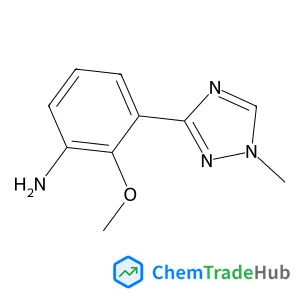
2-Methoxy-3-(1-methyl-1H-1,2,4-triazol-3-yl)aniline
CAS Number:
1609394-10-6
Molecular Formula:
C10H12N4O
Swen Schuster, Matthias Füser, Andika Asyuda, Piotr Cyganik, Andreas Terfort, Michael Zharnikov
Photoisomerization of a series of custom-designed, azobenzene-substituted alkanethiolate (AT) self-assembled monolayers (SAMs) on Au(111) substrates was studied in the context of work function variation, using Kelvin probe measurements as a transduction technique. These SAMs featured variable packing density (by ∼14%; due to the odd–even effects) and, as an option, were additionally decorated with the electron donating/withdrawing –CH3 and –CF3 tail group, respectively, which induce additional dipole moments. The efficiency of photoisomerization and the respective extent of work function variation (ΔΦ) were found to be quite low and independent of the packing density in the SAMs, within the given odd–even packing density variation. They could only be increased, up to ca. 40 meV for ΔΦ, by mixing the azobenzene-substituted ATs with shorter “matrix” molecules, which were introduced for a partial release of the sterical constraints. The ΔΦ values for the SAMs decorated with the –CH3 and –CF3 tail groups were found to be lower than those for the monolayers without such a decoration, which correlated well with the theoretical estimates for the change of the dipole moment of the relevant molecules upon the photoisomerization.
Chenyi Liao, Pengcheng Xu, Chenguang Yuan, Fengtao Fan, Guohui Li, Zhizhang Yuan, Xianfeng Li
DOI: 10.1039/D3EE02693K
Liang Zhao, Zheng Lv, Yue Shi, Shuanglong Zhou, Yan Liu, Jiani Han, Qi Zhang, Jianping Lai
DOI: 10.1039/D3EE03761D
Rafael Vescovi, Tobias Ginsburg, Kyle Hippe, Doga Ozgulbas, Casey Stone, Abraham Stroka, Rory Butler, Tom Brettin, Arvind Ramanathan, Aikaterini Vriza, Qingteng Zhang
DOI: 10.1039/D3DD00142C
Xiaohong Zou, Mingcong Tang, Ying Wang, Zongping Shao
DOI: 10.1039/D3EE03059H
Mireia Benito Montaner, Matthew R. Penny, Stephen T. Hilton
DOI: 10.1039/D3DD00128H
Nickolas Gantzler, Aryan Deshwal, Janardhan Rao Doppa, Cory M. Simon
DOI: 10.1039/D3DD00117B
Phillip Donnelly, Helge S. Stein
DOI: 10.1039/D3DD00166K
Xiaolong Guo, Petru Apostol, Xuan Zhou, Jiande Wang, Xiaodong Lin, Darsi Rambabu, Mengyuan Du, Süleyman Er, Alexandru Vlad
DOI: 10.1039/D3EE02897F
Haoxiang Lin, Xi Zhu
DOI: 10.1039/D3DD00130J
Ian C. Dingle, Nathan C. Stumme, Scott K. Shaw, David Eaton, Asmund Vego
DOI: 10.1039/D3DD00156C
1H-Indazole-6-carbonitrile finds applications in pharmaceuticals, where it serve...
Waste containing Dioctyl (2E)-2-butenedioate (CAS: 2997-85-5) should be collecte...
Sodium [(1,2-benzoxazol-3-ylmethyl)sulfonyl]azanide is primarily used in pharmac...
Dimethyl 4-(4,4,5,5-tetramethyl-1,3,2-dioxaborolan-2-yl)-2,6-pyridinedicarboxyla...
Waste containing 2-Fluoro-6-hydrazinopyridine (CAS: 80714-39-2) should be manage...
6-Formyl-2-pyridinecarboxylic acid is an organic compound with the molecular for...
Research trends for this compound indicate a focus on its potential applications...
9H-Tribenzo[b,d,f]azepine is typically synthesized via a multi-step process invo...
1-Cyclopropyl-7-ethoxy-6-fluoro-8-methoxy-4-oxo-1,4-dihydro-3-quinolinecarboxyli...
Waste containing Methyl 3-oxo-1,2,3,4-tetrahydro-6-quinoxalinecarboxylate (CAS: ...

Physical Chemistry Chemical Physics (PCCP) is an international journal co-owned by 19 physical chemistry and physics societies from around the world. This journal publishes original, cutting-edge research in physical chemistry, chemical physics and biophysical chemistry. To be suitable for publication in PCCP, articles must include significant innovation and/or insight into physical chemistry; this is the most important criterion that reviewers and Editors will judge against when evaluating submissions. The journal has a broad scope and welcomes contributions spanning experiment, theory, computation and data science. Topical coverage includes spectroscopy, dynamics, kinetics, statistical mechanics, thermodynamics, electrochemistry, catalysis, surface science, quantum mechanics, quantum computing and machine learning. Interdisciplinary research areas such as polymers and soft matter, materials, nanoscience, energy, surfaces/interfaces, and biophysical chemistry are welcomed if they demonstrate significant innovation and/or insight into physical chemistry. Joined experimental/theoretical studies are particularly appreciated when complementary and based on up-to-date approaches.

![4-Penten-1-yl 2-[(2-furylmethyl)(1H-imidazol-1-ylcarbonyl)amino]butanoate structure](https://static.chemtradehub.com/structs/101/101903-30-4-ac34.webp "4-Penten-1-yl 2-[(2-furylmethyl)(1H-imidazol-1-ylcarbonyl)amino]butanoate structure")





