













Multi-fidelity Bayesian optimization of covalent organic frameworks for xenon/krypton separations
Literature Information
Publication Date
2023-10-16
DOI
10.1039/D3DD00117B
Impact Factor
0
Authors
Nickolas Gantzler, Aryan Deshwal, Janardhan Rao Doppa, Cory M. Simon
View Original
Abstract
Our objective is to search a large candidate set of covalent organic frameworks (COFs) for the one with the largest equilibrium adsorptive selectivity for xenon (Xe) over krypton (Kr) at room temperature. To predict the Xe/Kr selectivity of a COF structure, we have access to two molecular simulation techniques: (1) a high-fidelity, binary grand canonical Monte Carlo simulation and (2) a low-fidelity Henry coefficient calculation that (a) approximates the adsorbed phase as dilute and, consequently, (b) incurs a smaller computational runtime than the higher-fidelity simulation. To efficiently search for the COF with the largest high-fidelity Xe/Kr selectivity, we employ a multi-fidelity Bayesian optimization (MFBO) approach. MFBO constitutes a sequential, automated feedback loop of (1) conduct a low- or high-fidelity molecular simulation of Xe/Kr adsorption in a COF, (2) use the simulation data gathered thus far to train a surrogate model that cheaply predicts, with quantified uncertainty, the low- and high-fidelity simulated Xe/Kr selectivity of COFs from their structural/chemical features, then (3) plan the next simulation (i.e., choose the next COF and fidelity) in consideration of balancing exploration, exploitation, and cost. We find that MFBO acquires the optimal COF among the candidate set of 609 structures using only 30 low-fidelity and seven high-fidelity simulations, incurring only 2%, 4% on average, and 20% on average of the computational runtime of a single-[high-]fidelity exhaustive, random, and BO search, respectively.
Related Literature
Ultrafast photoinduced charge transport in Pt(ii) donor–acceptor assembly bearing naphthalimide electron acceptor and phenothiazine electron donor
Jonathan Best, Paul A. Scattergood, Michael Towrie, Sergei A. Tikhomirov, Oleg V. Bouganov, Anthony J. H. M. Meijer, Julia A. Weinstein
2014-10-24
Paper
DOI: 10.1039/C4CP03995E
Interaction of gold nanoparticles mediated by captopril and S-nitrosocaptopril: the effect of manganese ions in mild acid medium
Emilia Iglesias, Rafael Prado-Gotor
2014-11-07
Paper
DOI: 10.1039/C4CP03969F
Beyond the molecular orbital conception of electronically excited states through the quantum theory of atoms in molecules
David Ferro-Costas, Ángel Martín Pendás, Leticia González, Ricardo A. Mosquera
2014-03-17
Paper
DOI: 10.1039/C4CP00431K
Timescales of water transport in viscous aerosol: measurements on sub-micron particles and dependence on conditioning history
Jessica W. Lu, Andrew M. J. Rickards, Jim S. Walker, Kerry J. Knox, Rachael E. H. Miles, Jonathan P. Reid
2013-11-29
Paper
DOI: 10.1039/C3CP54233E
Ab initio and metadynamics studies on the role of essential functional groups in biomineralization of calcium carbonate and environmental situations
Moumita Saharay, R. James Kirkpatrick
2014-10-22
Paper
DOI: 10.1039/C4CP03904A
Conformational changes of globular proteins upon adsorption on a hydrophobic surface
Yevgeny Moskovitz, Simcha Srebnik
2014-04-16
Paper
DOI: 10.1039/C4CP00354C
Bonding and spectroscopic properties of complexes of SO2–O2 and SO2–N2 and its atmospheric consequences
Samiyara Begum, Ranga Subramanian
2014-06-26
Paper
DOI: 10.1039/C4CP01084A
Lithium conductivity in glasses of the Li2O–Al2O3–SiO2 system
Sebastian Ross
2014-11-03
Paper
DOI: 10.1039/C4CP03609C
Thermal boundary conductance between Al films and GaN nanowires investigated with molecular dynamics
Xiao-wang Zhou, Reese E. Jones, Patrick E. Hopkins, Thomas E. Beechem
2014-03-26
Paper
DOI: 10.1039/C4CP00261J
Propene epoxidation with O2 or H2–O2 mixtures over silver catalysts: theoretical insights into the role of the particle size
M. Boronat, A. Pulido, P. Concepción, A. Corma
2014-08-14
Paper
DOI: 10.1039/C4CP02198C
You might also like
Compound Q&A
What are the main uses of 1H-Indazole-6-carbonitrile (CAS: 141290-59-7)?
1H-Indazole-6-carbonitrile finds applications in pharmaceuticals, where it serve...
141290-59-71H-Indazole-6-carbon...
Compound Q&A
How should waste containing Dioctyl (2E)-2-butenedioate (CAS: 2997-85-5) be handled?
Waste containing Dioctyl (2E)-2-butenedioate (CAS: 2997-85-5) should be collecte...
2997-85-5Dioctyl (2E)-2-buten...
Compound Q&A
What industries use Sodium [(1,2-benzoxazol-3-ylmethyl)sulfonyl]azanide (CAS: 68291-98-5)?
Sodium [(1,2-benzoxazol-3-ylmethyl)sulfonyl]azanide is primarily used in pharmac...
68291-98-5Sodium [(1,2-benzoxa...
Compound Q&A
Are there alternatives to Dimethyl 4-(4,4,5,5-tetramethyl-1,3,2-dioxaborolan-2-yl)-2,6-pyridinedicarboxylate (CAS: 741709-66-0) in synthesis?
Dimethyl 4-(4,4,5,5-tetramethyl-1,3,2-dioxaborolan-2-yl)-2,6-pyridinedicarboxyla...
741709-66-0Dimethyl 4-(4,4,5,5-...
Compound Q&A
How should waste containing 2-Fluoro-6-hydrazinopyridine (CAS: 80714-39-2) be handled?
Waste containing 2-Fluoro-6-hydrazinopyridine (CAS: 80714-39-2) should be manage...
80714-39-22-Fluoro-6-hydrazino...
Compound Q&A
What is 6-Formyl-2-pyridinecarboxylic acid (CAS: 499214-11-8)?
6-Formyl-2-pyridinecarboxylic acid is an organic compound with the molecular for...
499214-11-86-Formyl-2-pyridinec...
Compound Q&A
What is the market or research trend for 3-(3,4-dimethoxyphenyl)-2,5-dimethyl-N-(2-morpholin-4-ylethyl)pyrazolo[1,5-a]pyrimidin-7-amine (CAS: 900874-91-1)?
Research trends for this compound indicate a focus on its potential applications...
900874-91-13-(3,4-dimethoxyphen...
Compound Q&A
How is 9H-Tribenzo[b,d,f]azepine (CAS: 29875-73-8) typically synthesized?
9H-Tribenzo[b,d,f]azepine is typically synthesized via a multi-step process invo...
29875-73-89H-Tribenzo[b,d,f]az...
Compound Q&A
How is 1-Cyclopropyl-7-ethoxy-6-fluoro-8-methoxy-4-oxo-1,4-dihydro-3-quinolinecarboxylic acid (CAS: 1797982-51-4) typically synthesized?
1-Cyclopropyl-7-ethoxy-6-fluoro-8-methoxy-4-oxo-1,4-dihydro-3-quinolinecarboxyli...
1797982-51-41-Cyclopropyl-7-etho...
Compound Q&A
How should waste containing Methyl 3-oxo-1,2,3,4-tetrahydro-6-quinoxalinecarboxylate (CAS: 671820-52-3) be handled?
Waste containing Methyl 3-oxo-1,2,3,4-tetrahydro-6-quinoxalinecarboxylate (CAS: ...
671820-52-3Methyl 3-oxo-1,2,3,4...
Source Journal
Recommended Compounds
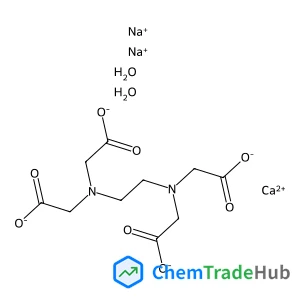
EthylenediaminetetraaceticacidcalciumDisodiumsalthydrate
CAS Number:
23411-34-9
Molecular Formula:
C10H16CaN2Na2O10
Recommended Suppliers






Disclaimer
This page provides academic journal information for reference and research purposes only. We are not affiliated with any journal publishers and do not handle publication submissions. For publication-related inquiries, please contact the respective journal publishers directly.
If you notice any inaccuracies in the information displayed, please contact us at support@chemtradehub.com. We will promptly review and address your concerns.