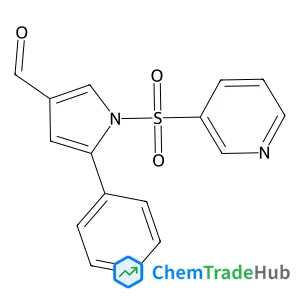
5-Phenyl-1-(pyridin-3-ylsulfonyl)-1H-pyrrole-3-carbaldehyde
CAS Number:
881676-90-0
Molecular Formula:
C16H12N2O3S
Yuki Takeuchi, Tetsuya Fujita, Nobuyuki Takeyasu
Surface-enhanced Raman scattering (SERS) spectra of organic compounds, para-methylthiophenol (p-MT), decylamine and 1-butanethiol (1-BT), were measured using a two-dimensional silver nanoparticle array at 532 nm excitation. For p-MT, it was observed that Raman peaks grew at 1580 and 1690 cm−1, which were never observed in the normal Raman spectrum, indicating oxidation from the methyl to carboxyl group. For both decylamine and 1-BT, an intensive SERS peak grew at 1580 cm−1. We measured the time-resolved SERS spectra of 1-BT at the laser intensity of 185 W mm−2 and confirmed that the spectral shapes changed as the total exposure increased. Another SERS peak was also observed at 3050 cm−1 for decylamine and 1-BT. From these results, it was considered that unsaturated bonds were formed in the alkanes, meaning that alkenes were produced from alkanes. Additionally, the SERS spectrum revealed that the chemically transformed alkane possesses a methyl group. The result indicates that dehydrogenation preferentially occurs at the secondary carbons, which is consistent with the stability of radicals on carbon atoms. The laser intensity threshold for plasmon-mediated chemical transformation was experimentally observed to be 2.7 and 40 W mm−2 for p-MT and 1-BT, respectively. The higher laser intensity is necessary for oxidation of alkanes compared with aromatic compounds, which is consistent with the chemical stability of organic compounds.
Weibin Cui, Yubo Wu, Hongkun Tian, Yanhou Geng, Fosong Wang
DOI: 10.1039/B713463K
Junhui Xu
DOI: 10.1039/B606429A
Qi Zeng, Ping Cai, Zhen Li, Jingui Qin, Ben Zhong Tang
DOI: 10.1039/B717764J
Yinghua Jin, Robert M. Coates
DOI: 10.1039/B605346G
Tianming Zuo, Kenneth Walker, Marilyn M. Olmstead, Frederic Melin, Brian C. Holloway, Luis Echegoyen, Harry C. Dorn, Manuel N. Chaur, Christopher J. Chancellor, Christine M. Beavers, Alan L. Balch, Andreas J. Athans
DOI: 10.1039/B716037B
Masanari Kimura, Masahiko Mori, Nahoko Mukai, Keisuke Kojima, Yoshinao Tamaru
DOI: 10.1039/B605728D
Jian-Jun Miao, Rui-Ling Fu, Jian-Min Zhu, Ke Xu, Jun-Jie Zhu, Hong-Yuan Chen
DOI: 10.1039/B604688F
Jye-Shane Yang, Guan-Jhih Huang, Yi-Hung Liu, Shie-Ming Peng
DOI: 10.1039/B717714C
Placidus B. Amama, Oluwaseyi Ogebule
DOI: 10.1039/B602623K
When considering alternatives to 1-(4-Chlorophenyl)-N-hydroxymethanimine (CAS: 3...
This compound should be stored in a cool, dry place away from direct sunlight. I...
3-(4-Bromophenyl)-5-(2-fluorophenyl)-1,2,4-oxadiazole is synthesized through a m...
5-Chloro-2-(4-chlorophenyl)-4-methyl-6-[3-(1-piperidinyl)propoxy]pyrimidine (CAS...
2-Chloro-4-(difluoromethoxy)pyridine is used in the pharmaceutical industry for ...
3-Chloro-6-methylpyridazine (CAS: 1121-79-5) is classified under the Globally Ha...
Several alternatives can be used in the synthesis of Methyl 4,5-dimethyl-2-nitro...
Alternatives to (2E,2'E)-3,3'-(1,4-Phenylene)bisacrylaldehyde include other acry...
3-Amino-5-chloropyridin-2-ol hydrochloride is an organic compound with the CAS n...
When handling 6,7-Difluoro-2,3-dihydro-4H-chromen-4-one, it is essential to wear...

Physical Chemistry Chemical Physics (PCCP) is an international journal co-owned by 19 physical chemistry and physics societies from around the world. This journal publishes original, cutting-edge research in physical chemistry, chemical physics and biophysical chemistry. To be suitable for publication in PCCP, articles must include significant innovation and/or insight into physical chemistry; this is the most important criterion that reviewers and Editors will judge against when evaluating submissions. The journal has a broad scope and welcomes contributions spanning experiment, theory, computation and data science. Topical coverage includes spectroscopy, dynamics, kinetics, statistical mechanics, thermodynamics, electrochemistry, catalysis, surface science, quantum mechanics, quantum computing and machine learning. Interdisciplinary research areas such as polymers and soft matter, materials, nanoscience, energy, surfaces/interfaces, and biophysical chemistry are welcomed if they demonstrate significant innovation and/or insight into physical chemistry. Joined experimental/theoretical studies are particularly appreciated when complementary and based on up-to-date approaches.