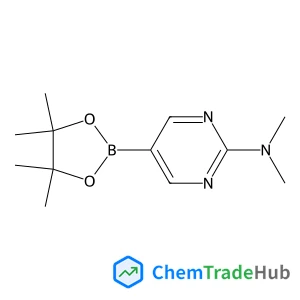
N,N-Dimethyl-5-(4,4,5,5-tetramethyl-1,3,2-dioxaborolan-2-yl)-2-pyrimidinamine
CAS Number:
1032759-30-0
Molecular Formula:
C12H20BN3O2
The first page of this article is displayed as the abstract.
Minh-Phuong Ngoc Bui, Sangyeop Lee, Kwi Nam Han, Xuan-Hung Pham, Cheng Ai Li, Jaebum Choo, Gi Hun Seong
DOI: 10.1039/B906939A
Xiaohui Zhuang, Xiayue Shi, Rui Zhu, Bin Sun
DOI: 10.1039/D0QO01188F
Jian-Shu Wang, Lingyun Yao, Jun Ying, Xiaoling Luo
DOI: 10.1039/D0QO01404D
Shaheen M. Sarkar, Everlyne N. Wanzala, Setsuya Shibahara, Keisuke Takahashi, Jun Ishihara, Susumi Hatakeyama
DOI: 10.1039/B912267B
You-Ming Zhang, Qi Lin, Tai-Bao Wei, Xiao-Ping Qin, Yan Li
DOI: 10.1039/B911125E
Ian J. S. Fairlamb, Amanda G. Jarvis, Adam F. Lee, Christian Müller, John M. Slattery, Robert J. Thatcher, Dieter Vogt, Adrian C. Whitwood
DOI: 10.1039/B906823F
Guanxing Zhu, Yujun Song, Qianyu Zhang, Weiwei Ding, Xinxin Chen, Yuannan Wang, Gang Zhang
DOI: 10.1039/D0QO01452D
Jason Chio, Mark Nitz, JoAnne McLaurin, Raymond M. Reilly
DOI: 10.1039/B913317H
Takushi Shiomi, Takahiro Adachi, Kenji Toribatake, Li Zhou, Hisao Nishiyama
DOI: 10.1039/B915759J
When considering alternatives to 1-(4-Chlorophenyl)-N-hydroxymethanimine (CAS: 3...
This compound should be stored in a cool, dry place away from direct sunlight. I...
3-(4-Bromophenyl)-5-(2-fluorophenyl)-1,2,4-oxadiazole is synthesized through a m...
5-Chloro-2-(4-chlorophenyl)-4-methyl-6-[3-(1-piperidinyl)propoxy]pyrimidine (CAS...
2-Chloro-4-(difluoromethoxy)pyridine is used in the pharmaceutical industry for ...
3-Chloro-6-methylpyridazine (CAS: 1121-79-5) is classified under the Globally Ha...
Several alternatives can be used in the synthesis of Methyl 4,5-dimethyl-2-nitro...
Alternatives to (2E,2'E)-3,3'-(1,4-Phenylene)bisacrylaldehyde include other acry...
3-Amino-5-chloropyridin-2-ol hydrochloride is an organic compound with the CAS n...
When handling 6,7-Difluoro-2,3-dihydro-4H-chromen-4-one, it is essential to wear...

ChemComm publishes urgent research which is of outstanding significance and interest to experts in the field, while also appealing to the journal’s broad chemistry readership. Our communication format is ideally suited to short, urgent studies that are of such importance that they require accelerated publication. Our scope covers all topics in chemistry, and research at the interface of chemistry and other disciplines (such as materials science, nanoscience, physics, engineering and biology) where there is a significant novelty in the chemistry aspects. Major topic areas covered include: Analytical Chemistry Catalysis Chemical Biology and medicinal chemistry Computational Chemistry and Machine Learning Energy and sustainable chemistry Environmental Chemistry Green Chemistry Inorganic Chemistry Materials Chemistry Nanoscience Organic Chemistry Physical Chemistry Polymer Chemistry Supramolecular Chemistry