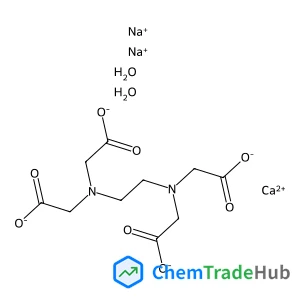
EthylenediaminetetraaceticacidcalciumDisodiumsalthydrate
CAS Number:
23411-34-9
Molecular Formula:
C10H16CaN2Na2O10
Dipendra Dahal, Lucas McDonald, Sabita Pokhrel, Sailaja Paruchuri, Michael Konopka, Yi Pang
There are a limited number of near-infrared (NIR) emitting (λem = 700–900 nm) molecular probes for imaging applications. A NIR-emitting probe that exhibits emission at ∼800 nm with a large Stokes shift was synthesized and found to exhibit excellent selectivity towards mitochondria for live-cell imaging. The photophysical properties were attributed to an excited “cyanine structure” via intramolecular charge transfer (ICT) involving a phenol group.
Shintaro Fujii, Haruna Cho, Yoshifumi Hashikawa, Tomoaki Nishino, Yasujiro Murata, Manabu Kiguchi
DOI: 10.1039/C9CP02469G
Mercè Deumal
DOI: 10.1039/C9CP00467J
Yuri S. Djikaev, Eli Ruckenstein
DOI: 10.1039/C9CP01386E
DOI: 10.1039/C9CP02077B
Hussein Fakhouri, Martina Perić, Franck Bertorelle, Philippe Dugourd, Xavier Dagany, Isabelle Russier-Antoine, Pierre-François Brevet, Rodolphe Antoine
DOI: 10.1039/C9CP00829B
Raffael Ruess, Sabina Scarabino, Andreas Ringleb, Kazuteru Nonomura, Nick Vlachopoulos, Anders Hagfeldt, Gunther Wittstock, Derck Schlettwein
DOI: 10.1039/C9CP01215J
Man Liu, Peter J. Chimtali, Xue-bin Huang, Ru-bo Zhang
DOI: 10.1039/C9CP00561G
Seokjin Moon, Yuh Hijikata
DOI: 10.1039/C8CP06159A
Anita Hamar Reksten, Andrea E. Russell, Peter W. Richardson, Stephen J. Thompson, Karina Mathisen, Frode Seland, Svein Sunde
DOI: 10.1039/C9CP01758E
A. Kortyna, A. J. Samin, T. A. Miller
DOI: 10.1039/C9CP90148E
1H-Indazole-6-carbonitrile finds applications in pharmaceuticals, where it serve...
Waste containing Dioctyl (2E)-2-butenedioate (CAS: 2997-85-5) should be collecte...
Sodium [(1,2-benzoxazol-3-ylmethyl)sulfonyl]azanide is primarily used in pharmac...
Dimethyl 4-(4,4,5,5-tetramethyl-1,3,2-dioxaborolan-2-yl)-2,6-pyridinedicarboxyla...
Waste containing 2-Fluoro-6-hydrazinopyridine (CAS: 80714-39-2) should be manage...
6-Formyl-2-pyridinecarboxylic acid is an organic compound with the molecular for...
Research trends for this compound indicate a focus on its potential applications...
9H-Tribenzo[b,d,f]azepine is typically synthesized via a multi-step process invo...
1-Cyclopropyl-7-ethoxy-6-fluoro-8-methoxy-4-oxo-1,4-dihydro-3-quinolinecarboxyli...
Waste containing Methyl 3-oxo-1,2,3,4-tetrahydro-6-quinoxalinecarboxylate (CAS: ...

ChemComm publishes urgent research which is of outstanding significance and interest to experts in the field, while also appealing to the journal’s broad chemistry readership. Our communication format is ideally suited to short, urgent studies that are of such importance that they require accelerated publication. Our scope covers all topics in chemistry, and research at the interface of chemistry and other disciplines (such as materials science, nanoscience, physics, engineering and biology) where there is a significant novelty in the chemistry aspects. Major topic areas covered include: Analytical Chemistry Catalysis Chemical Biology and medicinal chemistry Computational Chemistry and Machine Learning Energy and sustainable chemistry Environmental Chemistry Green Chemistry Inorganic Chemistry Materials Chemistry Nanoscience Organic Chemistry Physical Chemistry Polymer Chemistry Supramolecular Chemistry