













DNA detection by SERS: hybridisation parameters and the potential for asymmetric PCR
Literature Information
Publication Date
2020-01-13
DOI
10.1039/C9AN01732A
Impact Factor
4.616
Authors
Daniel Macdonald, Ewen Smith, Karen Faulds, Duncan Graham
View Original
Abstract
The use of surface enhanced Raman scattering (SERS) for the detection of DNA has significant potential in terms of sensitivity, multiplex target detection and robust signal detection from nanoparticles. Current methods are usually performed with short chain DNA fragments or require additional separation steps for detection of longer chain fragments. We present an integrated method for the rapid and sensitive detection of extended (≥100-base) nucleic acids with reduced preparation and sample separation steps. Key to this is the DNA sequence-specific assembly of silver nanoparticles labelled with a Raman tag to provide an enhanced signal from the tag and hence molecular recognition of the target DNA. DNA probe orientation and hybridisation procedures are critical for the success of this assay. Effective detection of extended nucleic acids was achieved with head-to-head probes and by adding polyethylene glycol 10 000 (PEG 10 000) to the hybridisation buffer. This gave a 34-fold discriminatory enhancement factor when applied to a synthetic target. A structured approach toward maximising hybridisation procedures and SERS response is described, followed by an initial demonstration of SERS detection of single-stranded DNA target amplified by asymmetric PCR which was used without further separation. This has implications for future developments in using SERS for DNA detection due to the new-found ability to integrate SERS with asymmetric PCR.
Related Literature
Gold nanoparticle-based immunochromatographic assay for rapid detection of imazalil
2023-10-06
Communication
DOI: 10.1039/D3NH00371J
Improving the electrochemical performance of Li2S cathodes based on point defect control with cation/anion dual doping
Wenli Pan, Nobuya Machida, Toshiyuki Matsunaga, Mukesh Kumar, Neha Thakur, Toshiki Watanabe, Atsushi Sakuda, Akitoshi Hayashi, Masahiro Tatsumisago, Yoshiharu Uchimoto
2023-10-26
Paper
DOI: 10.1039/D3TA05426H
Role of Er doping on isoamyl alcohol sensing performance of LaFeO3 microspheres and its prospects in wheat mildew detection
Kaichun Xu, Mengjie Han, Zichen Zheng, Jinyong Xu, Marc Debliquy, Chao Zhang
2023-11-09
Paper
DOI: 10.1039/D3TA05718F
Carrier density and delocalization signatures in doped carbon nanotubes from quantitative magnetic resonance
M. Alejandra Hermosilla-Palacios, Marissa Martinez, Evan A. Doud, Tobias Hertel, Alexander M. Spokoyny, Sofie Cambré, Wim Wenseleers, Yong-Hyun Kim, Andrew J. Ferguson, Jeffrey L. Blackburn
2023-11-22
Communication
DOI: 10.1039/D3NH00480E
Modulation of the assembly fashion among metal–organic frameworks for enantioretentive epoxide activation
Jun Guo, Xiaomin Xue, Fangfang Li, Meiting Zhao, Youcong Xing, Yanmin Song, Chang Long, Tingting Zhao, Zhiyong Tang
2023-11-19
Communication
DOI: 10.1039/D3NH00419H
Electrifying H2O2 synthesis with g-C3N4-based single atom catalysts
Jungki Ryu
2023-10-04
Editorial
DOI: 10.1039/D3NH90041J
Strategy for enhancement of magnesium ion diffusion in a vanadium tetra sulfide-layered structure for rechargeable magnesium batteries
Muhammad Kashif Naseem, Mian Azmat, Changliang Du, Rong Jiang, Hajra, Youqi Zhu, Meishuai Zou, Chuanbao Cao
2023-10-25
Paper
DOI: 10.1039/D3TA04634F
In situ formation of a ZnS/In interphase for reversible Zn metal anodes at ultrahigh currents and capacities
Chengwu Yang, Pattaraporn Woottapanit, Jin Cao, Yilei Yue, Dongdong Zhang, Jin Yi, Zhiyuan Zeng, Xinyu Zhang, Jiaqian Qin, Yonggang Wang
2023-10-31
Paper
DOI: 10.1039/D3TA05650C
Boosting the in-plane thermal conductivity of nanofibrillated cellulose films: alignment engineering of cross-linked AlN whiskers
Mengyang Niu, Zheng Zhao, Baokai Wang, Chang Yu, Mengyi Li, Jiajun Hu, Lifeng Zhu, Xu Hao, Shiqin Wan, Ming Yue, Weiwei Xuan, Qipeng Lu, Wenbin Cao, Kexin Chen, Qi Wang
2023-10-04
Paper
DOI: 10.1039/D3TA04770A
You might also like
Compound Q&A
What precautions should be taken when handling lithium chloride hydrate (1:1:1) (CAS: 16712-20-2)?
When handling lithium chloride hydrate (1:1:1) (CAS: 16712-20-2), it is importan...
16712-20-2Lithium chloride hyd...
Compound Q&A
Is 4-(4H-1,2,4-Triazol-4-yl)piperidine (CAS: 690261-92-8) safe?
4-(4H-1,2,4-Triazol-4-yl)piperidine is generally considered safe for use in phar...
690261-92-84-(4H-1,2,4-Triazol-...
Compound Q&A
How should waste containing 1,3-Thiazole-2-carboxamide (CAS: 16733-85-0) be handled?
Waste containing 1,3-Thiazole-2-carboxamide (CAS: 16733-85-0) should be collecte...
16733-85-01,3-Thiazole-2-carbo...
Compound Q&A
What regulatory guidelines apply to 5-(Difluoromethyl)-2-fluorobenzonitrile (CAS: 934175-58-3)?
5-(Difluoromethyl)-2-fluorobenzonitrile (CAS: 934175-58-3) is subject to regulat...
934175-58-35-(Difluoromethyl)-2...
Compound Q&A
How is Methyl 3-acetamido-2-thiophenecarboxylate (CAS: 22288-79-5) typically synthesized?
Methyl 3-acetamido-2-thiophenecarboxylate can be synthesized by the reaction of ...
22288-79-5Methyl 3-acetamido-2...
Compound Q&A
What is 4-Isoquinolinecarbonitrile (CAS: 34846-65-6)?
4-Isoquinolinecarbonitrile is a chemical compound with the CAS number 34846-65-6...
34846-65-64-Isoquinolinecarbon...
Compound Q&A
How should Methyl 1H-1,2,3-triazole-4-carboxylate (CAS: 877309-59-6) be stored?
Store Methyl 1H-1,2,3-triazole-4-carboxylate (CAS: 877309-59-6) in a cool, dry p...
877309-59-6Methyl 1H-1,2,3-tria...
Compound Q&A
What regulatory guidelines apply to 6-Bromo[1,3]thiazolo[5,4-b]pyridin-2-amine (CAS: 1160791-13-8)?
6-Bromo[1,3]thiazolo[5,4-b]pyridin-2-amine (CAS: 1160791-13-8) is subject to the...
1160791-13-86-Bromo[1,3]thiazolo...
Compound Q&A
Is (2S,3S)-2-Ammonio-3-(3,4-dihydroxyphenyl)-3-hydroxypropanoate (CAS: 23651-95-8) safe?
(2S,3S)-2-Ammonio-3-(3,4-dihydroxyphenyl)-3-hydroxypropanoate (CAS: 23651-95-8) ...
23651-95-8(2S,3S)-2-Ammonio-3-...
Compound Q&A
What are the physical and chemical properties of 7-bromo-3-methyl-3,4-dihydroquinazolin-4-one (CAS: 1293987-84-4)?
7-Bromo-3-methyl-3,4-dihydroquinazolin-4-one is a solid with a crystalline form....
1293987-84-47-bromo-3-methyl-3,4...
Source Journal
Analyst

CiteScore:
7.8
Self-citation Rate:
5.6%
Articles per Year:
653
Analyst publishes analytical and bioanalytical research that reports premier fundamental discoveries and inventions, and the applications of those discoveries, unconfined by traditional discipline barriers.
Recommended Compounds
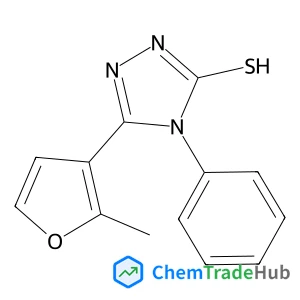
5-(2-Methyl-3-furyl)-4-phenyl-2,4-dihydro-3H-1,2,4-triazole-3-thione
CAS Number:
346464-59-3
Molecular Formula:
C13H11N3OS
![(1R,5R)-3-{[(2-Methyl-2-propanyl)oxy]carbonyl}-3-azabicyclo[3.1.0]hexane-1-carboxylic acid structure](https://static.chemtradehub.com/structs/116/1165450-63-4-bfe1.webp "(1R,5R)-3-{[(2-Methyl-2-propanyl)oxy]carbonyl}-3-azabicyclo[3.1.0]hexane-1-carboxylic acid structure")
(1R,5R)-3-{[(2-Methyl-2-propanyl)oxy]carbonyl}-3-azabicyclo[3.1.0]hexane-1-carboxylic acid
CAS Number:
1165450-63-4
Molecular Formula:
C11H17NO4


Recommended Suppliers





Disclaimer
This page provides academic journal information for reference and research purposes only. We are not affiliated with any journal publishers and do not handle publication submissions. For publication-related inquiries, please contact the respective journal publishers directly.
If you notice any inaccuracies in the information displayed, please contact us at support@chemtradehub.com. We will promptly review and address your concerns.