


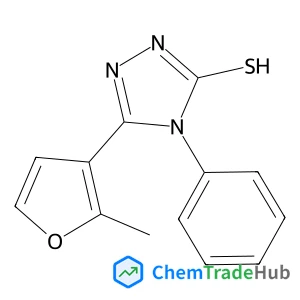
5-(2-Methyl-3-furyl)-4-phenyl-2,4-dihydro-3H-1,2,4-triazole-3-thione
CAS Number:
346464-59-3
Molecular Formula:
C13H11N3OS
Chengwu Yang, Pattaraporn Woottapanit, Jin Cao, Yilei Yue, Dongdong Zhang, Jin Yi, Zhiyuan Zeng, Xinyu Zhang, Jiaqian Qin, Yonggang Wang
Aqueous zinc-ion batteries (AZIBs) have been considered next-generation promising high-energy storage systems due to their cost-effectiveness and high safety. Nevertheless, the instability of the Zn metal anode posed by dendrite growth and volume changes presents a significant hurdle for AZIB commercialization. Here, we introduce a novel approach using a ZnIn2S4 nanoflower-coated carbon cloth (ZISG-CC) with hierarchical spatial channels to guide the nucleation and deposition of Zn, thereby constructing a stable Zn metal anode. The designed ZISG-CC electrode exhibits distinctive features, including an enlarged surface area, enhanced zincophilicity, and in situ formation of a ZnS/In interphase during the initial discharge process. These characteristics facilitate uniform Zn nucleation and the formation of a stable electrolyte–anode interface, enabling excellent reversibility of the Zn anode. As a result, the Zn/ZISG-CC anode demonstrates outstanding charge–discharge cycling performance in a symmetric cell, achieving 550 cycles at 10 mA cm−2/5 mA h cm−2 and 500 cycles at 20 mA cm−2/10 mA h cm−2. Furthermore, the Zn/ZISG-CC|MnO2-graphene full cell exhibits a high capacity retention of 87.5% after 1000 cycles at 1 A g−1, along with favorable flexibility. This study introduces a novel strategy that utilizes the interaction between the electrode and electrolyte to stabilize the electrolyte–anode interface, enabling advanced Zn anodes in high-performance AZIBs.

Main Group Chemistry

Bioorganic & Medicinal Chemistry Letters

Chinese Journal of Chemistry

Critical Reviews in Solid State and Materials Sciences

Medicinal Chemistry Research

Polycyclic Aromatic Compounds

Biocatalysis and Biotransformation

Journal of Asian Natural Products Research

Journal of the Indian Institute of Science

Bioorganic & Medicinal Chemistry
Ze Liu, Maofa Ge, Weigang Wang, Shi Yin, Shengrui Tong
DOI: 10.1039/C0CP00905A
Aleksey A. Kocherzhenko, Ferdinand C. Grozema, Laurens D. A. Siebbeles
DOI: 10.1039/C0CP01432J
Jean-François Dechézelles, Tangi Aubert, Fabien Grasset, Stéphane Cordier, Carlos Barthou, Catherine Schwob, Agnès Maître, Renaud A. L. Vallée, Henri Cramail, Serge Ravaine
DOI: 10.1039/C0CP00129E
Piotr Kowalczyk, Piotr A. Gauden, Artur P. Terzyk, Sylwester Furmaniak
DOI: 10.1039/B926206G
Erin A. Riley, Chris Bingham, Eric D. Bott, Bart Kahr, Philip J. Reid
DOI: 10.1039/C0CP01716G
Shengwei Liu, Jiaguo Yu, Wenguang Wang
DOI: 10.1039/C0CP00036A
Wenbin Zhang, Ian J. Burgess
DOI: 10.1039/C0CP01251C
Anna M. Chizhik, Regina Jäger, Alexey I. Chizhik, Sebastian Bär, Hans-Georg Mack, Marcus Sackrow, Catrinel Stanciu, Alexey Lyubimtsev, Michael Hanack, Alfred J. Meixner
DOI: 10.1039/C0CP02228D
When handling lithium chloride hydrate (1:1:1) (CAS: 16712-20-2), it is importan...
4-(4H-1,2,4-Triazol-4-yl)piperidine is generally considered safe for use in phar...
Waste containing 1,3-Thiazole-2-carboxamide (CAS: 16733-85-0) should be collecte...
5-(Difluoromethyl)-2-fluorobenzonitrile (CAS: 934175-58-3) is subject to regulat...
Methyl 3-acetamido-2-thiophenecarboxylate can be synthesized by the reaction of ...
4-Isoquinolinecarbonitrile is a chemical compound with the CAS number 34846-65-6...
Store Methyl 1H-1,2,3-triazole-4-carboxylate (CAS: 877309-59-6) in a cool, dry p...
6-Bromo[1,3]thiazolo[5,4-b]pyridin-2-amine (CAS: 1160791-13-8) is subject to the...
(2S,3S)-2-Ammonio-3-(3,4-dihydroxyphenyl)-3-hydroxypropanoate (CAS: 23651-95-8) ...
7-Bromo-3-methyl-3,4-dihydroquinazolin-4-one is a solid with a crystalline form....

Journal of Materials Chemistry A, B & C cover high quality studies across all fields of materials chemistry. The journals focus on those theoretical or experimental studies that report new understanding, applications, properties and synthesis of materials. The journals have a strong history of publishing quality reports of interest to interdisciplinary communities and providing an efficient and rigorous service through peer review and publication. The journals are led by an international team of Editors-in-Chief and Associate Editors who are all active researchers in their fields. Journal of Materials Chemistry A, B & C are separated by the intended application of the material studied. Broadly, applications in energy and sustainability are of interest to Journal of Materials Chemistry A, applications in biology and medicine are of interest to Journal of Materials Chemistry B, and applications in optical, magnetic and electronic devices are of interest to Journal of Materials Chemistry C. More than one Journal of Materials Chemistry journal may be suitable for certain fields and researchers are encouraged to submit their paper to the journal that they feel best fits for their particular article. Example topic areas within the scope of Journal of Materials Chemistry A are listed below. This list is neither exhaustive nor exclusive. Artificial photosynthesis Batteries Carbon dioxide conversion Catalysis Fuel cells Gas capture/separation/storage Green/sustainable materials Hydrogen generation Hydrogen storage Photocatalysis Photovoltaics Self-cleaning materials Self-healing materials Sensors Supercapacitors Thermoelectrics Water splitting Water treatment

![Ethyl 4-[8-chloro(5,5,6,6,7-~2~H_5_)-5,6-dihydro-11H-benzo[5,6]cyclohepta[1,2-b]pyridin-11-ylidene]-1-piperidinecarboxylate structure](https://static.chemtradehub.com/structs/102/1020719-57-6-37e2.webp "Ethyl 4-[8-chloro(5,5,6,6,7-~2~H_5_)-5,6-dihydro-11H-benzo[5,6]cyclohepta[1,2-b]pyridin-11-ylidene]-1-piperidinecarboxylate structure")
![8-Bromo-6-fluoro[1,2,4]triazolo[1,5-a]pyridin-2-amine structure](https://static.chemtradehub.com/structs/125/1257705-51-3-9f4a.webp "8-Bromo-6-fluoro[1,2,4]triazolo[1,5-a]pyridin-2-amine structure")






