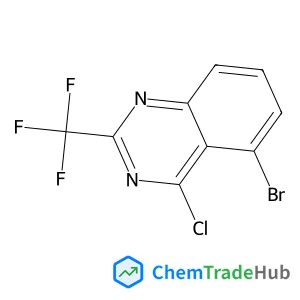
5-Bromo-4-chloro-2-(trifluoromethyl)quinazoline
CAS Number:
2089311-03-3
Molecular Formula:
C9H3BrClF3N2
Han Zhao, Ying Yan, Mingjian Chen, Tingting Hu, Kefeng Wu, Haisheng Liu, Changbei Ma
A sensitive and label-free fluorometric method has been developed for the determination of polynucleotide kinase (PNK) activity, by employing exonuclease III (Exo III)-assisted cyclic signal amplification and poly(thymine)-templated copper nanoparticles (polyT-CuNPs). In the presence of PNK, cDNA with 5′-hydroxyl termini was phosphorylated and then hybridized with tDNA to form the cDNA/tDNA duplex, which subsequently triggered the λ exonuclease cleavage reaction, eventually resulting in the release of tDNA. The released tDNA could unfold the hairpin structure of HP DNA to generate partially complementary duplex (tDNA/HP DNA), wherein the HP DNA possessed T-rich sequences (T30) and tDNA recognition sequence. With the help of Exo III digestion, the tDNA was able to initiate the cycle for the generation of T-rich sequences, the template for the formation of fluorescent CuNPs. Conversely, the cDNA could not be cleaved by λ exonuclease without PNK and individual HP DNA could not be hydrolyzed by Exo III. The T-rich sequence was caged in HP DNA, resulting in a weak fluorescence signal. Under optimized conditions, the fluorescence intensity was linearly correlated to a concentration range of 0.001 to 1 U mL−1 with a low detection limit of 2 × 10⁻⁴ U mL−1. Considering the intriguing analytical performance, this approach could be explored to screen T4 PNK inhibitors and hold promising applications in drug discovery and disease therapy.

Crystallography Reports

Journal of Saudi Chemical Society

Russian Journal of Organic Chemistry

Current Opinion in Solid State & Materials Science

Journal of Peptide Science

Saudi Pharmaceutical Journal

Chemical Communications

New Journal of Chemistry

Russian Journal of Bioorganic Chemistry

Chemistry Education Research and Practice
Savio J. A. Moniz, Daqian Guo, Mingchu Tang, Qi Jiang, Siming Chen, Huiyun Liu, Aiqin Wang, Tao Zhang, Junwang Tang
DOI: 10.1039/C8SE00265G
Kevin A. Bush, James A. Raiford, Eli J. Wolf, Simon A. Swifter, Caleb C. Boyd, Hsin-Ping Wang, Michael F. Toney, Stacey F. Bent
DOI: 10.1039/C8SE00314A
Chengtian Zhou, Alfred Junio Samson, Kyle Hofstetter, Venkataraman Thangadurai
DOI: 10.1039/C8SE00234G
RaviRanjan Kumar, Gunaseelan Dhanarajan, Moumita Bhaumik, Ramkrishna Sen
DOI: 10.1039/C7SE00010C
Masoud Aminzare, Yu-Chih Tseng, Anbalagan Ramakrishnan, Kuei-Hsien Chen, Yurij Mozharivskyj
DOI: 10.1039/C8SE00385H
Xianhui Zhao, Ahmad Naqi, Devin M. Walker, Tim Roberge, Matthew Kastelic
DOI: 10.1039/C8SE00344K
Zhonghao Wang, Xun Hu, Guojun Zou, Zhiwei Huang, Zhicheng Tang, Qing Liu, Guangzhi Hu, Dongsheng Geng
DOI: 10.1039/C8SE00629F
Meidan Ye, Xiaoyue Gao, Xiaodan Hong, Qun Liu, Chunfeng He
DOI: 10.1039/C7SE00137A
Waste containing 6-Chloro-5-(2'-hydroxy-3'-methoxy-4-biphenylyl)-3-(3-methoxyphe...
(3alpha,5alpha)-3-Hydroxypregnane-11,20-dione is primarily used in the pharmaceu...
The market for 4-Amino-6-chloro-2-pyridinecarboxylic acid (CAS: 546141-56-4) is ...
Alternatives to (2-Benzoylethyl)trimethylammonium chloride (CAS: 24472-88-6) in ...
N-[4-Nitro-3-(trifluoromethyl)phenyl]acetamide (CAS: 393-12-4) is generally safe...
Alternative reagents such as other phosphates or similar functional groups can b...
There are alternatives to N,N'-Bis(3-aminopropyl)-1,3-propanediamine (CAS: 4605-...
When handling Aluminium trihexadecanoate, it is important to use appropriate per...
(1,1-Dioxido-3-oxo-1,2-benzothiazol-2(3H)-yl)acetic acid is a chemical compound ...
Several alternatives to 5,5-dimethyloxolan-2-one (CAS: 3123-97-5) can be used in...

Analyst publishes analytical and bioanalytical research that reports premier fundamental discoveries and inventions, and the applications of those discoveries, unconfined by traditional discipline barriers.
![2-Methyl-2-propanyl [2-(2-oxa-6-azaspiro[3.3]hept-6-yl)ethyl]carbamate structure](https://static.chemtradehub.com/structs/141/1415562-38-7-c0a4.webp "2-Methyl-2-propanyl [2-(2-oxa-6-azaspiro[3.3]hept-6-yl)ethyl]carbamate structure")