



Tin–lead halide perovskites with improved thermal and air stability for efficient all-perovskite tandem solar cells
Literature Information
Publication Date
2018-08-07
DOI
10.1039/C8SE00314A
Impact Factor
6.367
Authors
Kevin A. Bush, James A. Raiford, Eli J. Wolf, Simon A. Swifter, Caleb C. Boyd, Hsin-Ping Wang, Michael F. Toney, Stacey F. Bent
View Original
Abstract
We report the fabrication of monolithic all-perovskite tandem solar cells with a stabilized power conversion efficiency of 19.1% and demonstrate improved thermal, atmospheric, and operational stability of the tin–lead perovskite (FA0.75Cs0.25Sn0.5Pb0.5I3) used as the low gap absorber. To achieve a high matched current density in the two-terminal tandem, we develop a route to fabricate uniform and thick tin–lead perovskites that enable the two-terminal tandem to attain external quantum efficiencies >80% in the near infrared. By post-processing the as-deposited tin–lead perovskite films with methylammonium chloride vapor, we increase grain sizes to over a micron and boost solar cell open circuit voltage and fill factor. Tin–lead perovskite solar cells made by this method exhibit the most stable operation at maximum power under simulated sunlight of any reported small bandgap perovskite solar cell to date. We show that an unencapsulated tin–lead perovskite solar cell maintains its full performance after 150 hours at 85C in air, which is substantially better than has been observed previously. This work identifies strategies for attaining highly efficient all-perovskite tandem solar cells while maintaining thermal and operational stability.
Recommended Journals

Journal of Peptide Science

Saudi Pharmaceutical Journal

Current Opinion in Solid State & Materials Science

Russian Journal of General Chemistry

Chemistry Education Research and Practice

Organic Process Research & Development

Nature Medicine

Crystallography Reports

Russian Journal of Bioorganic Chemistry

Acta Materialia
Related Literature
Relaxation dynamics of photoexcited resorcinol: internal conversion versus H atom tunnelling
Jamie D. Young, Michael Staniforth, Martin J. Paterson, Gareth M. Roberts, Vasilios G. Stavros
2013-10-11
Paper
DOI: 10.1039/C3CP53726A
High redox and performance stability of layered SmBa0.5Sr0.5Co1.5Cu0.5O5+δ perovskite cathodes for intermediate-temperature solid oxide fuel cells
Areum Jun, Jeeyoung Shin, Guntae Kim
2013-10-23
Paper
DOI: 10.1039/C3CP53883D
Strain relaxation and order–disorder phase transition in irradiated MgAl2O4
2013-11-18
Paper
DOI: 10.1039/C3CP53532K
Effects of atomic scale roughness at metal/insulator interfaces on metal work function
2013-09-26
Paper
DOI: 10.1039/C3CP53590H
Estimation of the refractive indices of imidazolium-based ionic liquids using their polarisability values
Pablo Díaz-Rodríguez, John C. Cancilla, Natalia V. Plechkova, Gemma Matute, Kenneth R. Seddon, José S. Torrecilla
2013-10-28
Paper
DOI: 10.1039/C3CP53685H
Interactions of polymers with reduced graphene oxide: van der Waals binding energies of benzene on graphene with defects
Mohamed Hassan
2013-10-25
Communication
DOI: 10.1039/C3CP53922A
Stopped-flow kinetic studies of the formation and disintegration of polyion complex micelles in aqueous solution
Sangui Chen, Zhiyuan Zhu, Shiyong Liu
2013-10-15
Paper
DOI: 10.1039/C3CP53608D
Variation of sigma-hole magnitude with M valence electron population in MXnY4−n molecules (n = 1–4; M = C, Si, Ge; X, Y = F, Cl, Br)
Sean A. C. McDowell, Jerelle A. Joseph
2013-11-22
Communication
DOI: 10.1039/C3CP53738B
Structure stability and high-temperature distortion resistance of trilayer complexes formed from graphenes and boron nitride nanosheets
K. M. Liew
2013-10-29
Paper
DOI: 10.1039/C3CP53343C
You might also like
Compound Q&A
How should waste containing 6-Chloro-5-(2'-hydroxy-3'-methoxy-4-biphenylyl)-3-(3-methoxyphenyl)-1H-pyrrolo[3,2-d]pyrimidine-2,4(3H,5H)-dione (CAS: 1346607-05-3) be handled?
Waste containing 6-Chloro-5-(2'-hydroxy-3'-methoxy-4-biphenylyl)-3-(3-methoxyphe...
1346607-05-36-Chloro-5-(2'-hydro...
Compound Q&A
What are the main uses of (3alpha,5alpha)-3-Hydroxypregnane-11,20-dione (CAS: 23930-19-0)?
(3alpha,5alpha)-3-Hydroxypregnane-11,20-dione is primarily used in the pharmaceu...
23930-19-0(3alpha,5alpha)-3-Hy...
Compound Q&A
What is the market or research trend for 4-Amino-6-chloro-2-pyridinecarboxylic acid (CAS: 546141-56-4)?
The market for 4-Amino-6-chloro-2-pyridinecarboxylic acid (CAS: 546141-56-4) is ...
546141-56-44-Amino-6-chloro-2-p...
Compound Q&A
Are there alternatives to (2-Benzoylethyl)trimethylammonium chloride (CAS: 24472-88-6) in synthesis?
Alternatives to (2-Benzoylethyl)trimethylammonium chloride (CAS: 24472-88-6) in ...
24472-88-6(2-Benzoylethyl)trim...
Compound Q&A
Is N-[4-Nitro-3-(trifluoromethyl)phenyl]acetamide (CAS: 393-12-4) safe?
N-[4-Nitro-3-(trifluoromethyl)phenyl]acetamide (CAS: 393-12-4) is generally safe...
393-12-4N-[4-Nitro-3-(triflu...
Compound Q&A
Are there alternatives to [(4R,5R,6S)-5-hydroxy-10-imino-3,7-dioxa-1,9-diazatricyclo[6.4.0.02,6]dodeca-8,11-dien-4-yl]methyl dihydrogen phosphate (CAS: 39679-56-6) in synthesis?
Alternative reagents such as other phosphates or similar functional groups can b...
39679-56-6[(4R,5R,6S)-5-hydrox...
Compound Q&A
Are there alternatives to N,N'-Bis(3-aminopropyl)-1,3-propanediamine (CAS: 4605-14-5) in synthesis?
There are alternatives to N,N'-Bis(3-aminopropyl)-1,3-propanediamine (CAS: 4605-...
4605-14-5N,N'-Bis(3-aminoprop...
Compound Q&A
What precautions should be taken when handling Aluminium trihexadecanoate (CAS: 555-35-1)?
When handling Aluminium trihexadecanoate, it is important to use appropriate per...
555-35-1Aluminium trihexadec...
Compound Q&A
What is (1,1-Dioxido-3-oxo-1,2-benzothiazol-2(3H)-yl)acetic acid (CAS: 52188-11-1)?
(1,1-Dioxido-3-oxo-1,2-benzothiazol-2(3H)-yl)acetic acid is a chemical compound ...
52188-11-1(1,1-Dioxido-3-oxo-1...
Compound Q&A
Are there alternatives to 5,5-dimethyloxolan-2-one (CAS: 3123-97-5) in synthesis?
Several alternatives to 5,5-dimethyloxolan-2-one (CAS: 3123-97-5) can be used in...
3123-97-55,5-dimethyloxolan-2...
Source Journal
Recommended Compounds
![2-Methyl-2-propanyl (2E)-5-chloro-2-[3-methoxy-4-(4-methyl-1H-imidazol-1-yl)benzylidene]pentanoate structure](https://static.chemtradehub.com/structs/122/1225232-42-7-ee03.webp "2-Methyl-2-propanyl (2E)-5-chloro-2-[3-methoxy-4-(4-methyl-1H-imidazol-1-yl)benzylidene]pentanoate structure")
2-Methyl-2-propanyl (2E)-5-chloro-2-[3-methoxy-4-(4-methyl-1H-imidazol-1-yl)benzylidene]pentanoate
CAS Number:
1225232-42-7
Molecular Formula:
C21H27ClN2O3
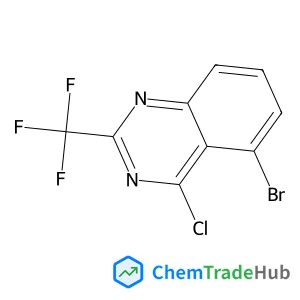
5-Bromo-4-chloro-2-(trifluoromethyl)quinazoline
CAS Number:
2089311-03-3
Molecular Formula:
C9H3BrClF3N2

Recommended Suppliers





Disclaimer
This page provides academic journal information for reference and research purposes only. We are not affiliated with any journal publishers and do not handle publication submissions. For publication-related inquiries, please contact the respective journal publishers directly.
If you notice any inaccuracies in the information displayed, please contact us at support@chemtradehub.com. We will promptly review and address your concerns.