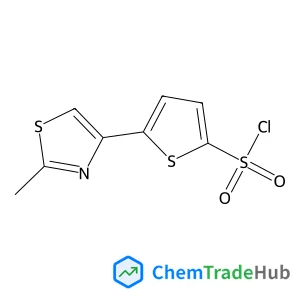
5-(2-Methyl-1,3-thiazol-4-yl)-2-thiophenesulfonyl chloride
CAS Number:
215434-25-6
Molecular Formula:
C8H6ClNO2S3
Savio J. A. Moniz, Daqian Guo, Mingchu Tang, Qi Jiang, Siming Chen, Huiyun Liu, Aiqin Wang, Tao Zhang, Junwang Tang
Although semiconducting gallium arsenide (GaAs) possesses an ideal band gap for efficient solar-driven fuel synthesis, it is extremely unstable in aqueous media, undergoing facile photocorrosion and therefore is seldom used. We have addressed this stability problem to some extent using a strategy of introducing a Ni–B surface catalyst onto p/n junction GaAs by in situ photoassisted electrodeposition. A monolithic layer of Ni–B/Ga(As)Ox was generated during the Ni–B deposition process, resulting in a Ni–B/Ga(As)Ox/GaAs photoanode structure. Such a structure was optimized by varying the GaAs surface architecture, electrolyte pH value and Ni–B deposition time to achieve optimal photoelectrochemical performance, together with improved stability. The optimized photoanode Ni–B/Ga(As)Ox/shallow GaAs with 0.5 h Ni–B deposition time (∼900 nm thickness of the Ni–B/Ga(As)Ox layer) exhibited a very high photocurrent, leading to a nearly 22 hour stable photocurrent density of 20 mA cm−2, while bare GaAs exhibits 60% photocurrent loss after three hours under continuous one sun illumination (100 mW cm−2) in alkaline media (pH = 14). This remarkable performance in both photocurrent and stability directly addresses the current severe limitations in the application of GaAs photoanodes for solar fuel synthesis, and they may be applicable to other unstable photoelectrodes.
Preeti Chauhan, Ragendu V., Mohan Kumar, Rajib Molla, Surya Dev Mishra, Sneha Basa, Vishal Rai
DOI: 10.1039/D3CS00715D
Hao-Yang Liu, Xiao Li, Zhi-Gang Wang
DOI: 10.1039/D3CS00138E
Jin-Tao Ren, Lei Chen, Hao-Yu Wang
DOI: 10.1039/D3CS00557G
DOI: 10.1039/D3CS00194F
Khoa Chung
DOI: 10.1039/D3SC02761A
Hong Zhang, Lin Fu, Wenli Zhang, Yupeng Yuan
DOI: 10.1039/D3SC04853E
Xianhai Tian, Yuliang Liu, Shahboz Yakubov, Jonathan Schütte, Shunsuke Chiba, Joshua P. Barham
DOI: 10.1039/D2CS00581F
Dameng Yang, Nicholas J. Turner
DOI: 10.1039/D3CS00391D
Quanpu Wang, Chao Fang
DOI: 10.1039/D3CS00489A
Waste containing 6-Chloro-5-(2'-hydroxy-3'-methoxy-4-biphenylyl)-3-(3-methoxyphe...
(3alpha,5alpha)-3-Hydroxypregnane-11,20-dione is primarily used in the pharmaceu...
The market for 4-Amino-6-chloro-2-pyridinecarboxylic acid (CAS: 546141-56-4) is ...
Alternatives to (2-Benzoylethyl)trimethylammonium chloride (CAS: 24472-88-6) in ...
N-[4-Nitro-3-(trifluoromethyl)phenyl]acetamide (CAS: 393-12-4) is generally safe...
Alternative reagents such as other phosphates or similar functional groups can b...
There are alternatives to N,N'-Bis(3-aminopropyl)-1,3-propanediamine (CAS: 4605-...
When handling Aluminium trihexadecanoate, it is important to use appropriate per...
(1,1-Dioxido-3-oxo-1,2-benzothiazol-2(3H)-yl)acetic acid is a chemical compound ...
Several alternatives to 5,5-dimethyloxolan-2-one (CAS: 3123-97-5) can be used in...
![Benzo[b]naphtho[2,1-d]thiophene structure](https://static.chemtradehub.com/structs/239/239-35-0-ff90.webp "Benzo[b]naphtho[2,1-d]thiophene structure")