




Conversion of landfill gas to liquid fuels through a TriFTS (tri-reforming and Fischer–Tropsch synthesis) process: a feasibility study
Literature Information
Publication Date
2018-12-26
DOI
10.1039/C8SE00344K
Impact Factor
6.367
Authors
Xianhui Zhao, Ahmad Naqi, Devin M. Walker, Tim Roberge, Matthew Kastelic
View Original
Abstract
Biogas produced in landfills contains large amounts of methane (a potent greenhouse gas) and hence requires collection and treatment according to EPA regulations. Tri-reforming of such biogas (CH4 + CO2) is a combination of dry reforming, steam reforming, and partial oxidation to produce syngas (CO + H2). This syngas can be converted to liquid hydrocarbons using Fischer–Tropsch Synthesis (FTS). A novel technology of combining tri-reforming and FTS (TriFTS) is proposed and utilized to convert landfill gas (LFG) to high value added liquid hydrocarbon fuels such as gasoline, diesel, and jet fuel. This article explores the feasibility of TriFTS from an experimental and process economics point of view. Landfill gas collected from a local landfill was used in this study. After removing contaminant gases such as H2S and NH3via condensation and adsorption, NiMg/Ce0.6Zr0.4O2 pellets were used in a tri-reforming reactor to produce H2 and CO in a ratio suitable for FTS. The conversions of CH4 and CO2 were 99% and 60%, respectively. The H2/CO molar ratio was 1.7. In the FTS section, a Co/SiO2 eggshell catalyst was used to synthesize liquid hydrocarbon with high selectivity for middle distillate cuts. The CO conversion in FTS was 71% and the liquid hydrocarbon product was similar to that of low sulfur diesel. The experimental results were used to conduct a preliminary economic analysis of a commercial scale TriFTS process. The results indicate that 45% of the energy contained in the LFG can be recovered in the liquid fuel generated, with the rest going to meet the energy demands of the conversion process including heat losses. The breakeven cost of diesel fuel produced was estimated as $3.24 per gal but reduces to $2.71 per gal if the LFG is assumed to be free of cost as would be the case for landfill operators. Additional renewable fuel credits will make the process even more economically attractive. This study suggests that conversion of LFG to liquid fuels is a promising new technology ripe for commercialization.
Recommended Journals

Journal of Asian Natural Products Research

Electroanalysis

NDT & E International

Critical Reviews in Solid State and Materials Sciences

Atomization and Sprays

Topics in Catalysis

Bioorganic & Medicinal Chemistry Letters

Biocatalysis and Biotransformation

Bioorganic & Medicinal Chemistry

Journal of the Indian Institute of Science
Related Literature
Configuration interaction singles based on the real-space numerical grid method: Kohn–Sham versus Hartree–Fock orbitals
Jaewook Kim, Kwangwoo Hong, Sunghwan Choi, Sang-Yeon Hwang, Woo Youn Kim
2015-04-01
Paper
DOI: 10.1039/C5CP00352K
Optimized multi-site local orbitals in the large-scale DFT program CONQUEST
Ayako Nakata
2015-03-27
Paper
DOI: 10.1039/C5CP00934K
Fe3O4 and Au nanoparticles dispersed on the graphene support as a highly active catalyst toward the reduction of 4-nitrophenol
Yan Wang, Hai Li, Jijun Zhang, Xinyu Yan, Zexiang Chen
2015-11-16
Paper
DOI: 10.1039/C5CP05336F
DOS and electron attachment effects in the electron-induced vibrational excitation of terphenylthiol SAMs
2015-10-26
Paper
DOI: 10.1039/C5CP04067A
First principles study of organic sensitizers for dye sensitized solar cells: effects of anchoring groups on optoelectronic properties and dye aggregation
Santhanamoorthi Nachimuthu, Wei-Chieh Chen, Jyh-Chiang Jiang
2015-11-27
Paper
DOI: 10.1039/C5CP04877J
Quantum dynamics of the photostability of pyrazine
Matthieu Sala, Stéphane Guérin, Fabien Gatti
2015-09-01
Paper
DOI: 10.1039/C5CP04605J
Cerium oxide as a promoter for the electro-oxidation reaction of ethanol: in situ XAFS characterization of the Pt nanoparticles supported on CeO2 nanoparticles and nanorods
Juan Corchado-García, Luis E. Betancourt, Carlos A. Vélez, Sanjaya D. Senanayake, Dario Stacchiola, Kotaro Sasaki, Maxime J.-F. Guinel, Yunyun Zhou, Chin Li Cheung, Carlos R. Cabrera
2015-10-26
Paper
DOI: 10.1039/C5CP04813C
Computational prediction of the electronic structure and optical properties of graphene-like β-CuN3
Xu Zhang, Xudong Zhao, Yu Jing, Dihua Wu, Zhen Zhou
2015-11-06
Paper
DOI: 10.1039/C5CP06208J
You might also like
Compound Q&A
How should waste containing 6-Chloro-5-(2'-hydroxy-3'-methoxy-4-biphenylyl)-3-(3-methoxyphenyl)-1H-pyrrolo[3,2-d]pyrimidine-2,4(3H,5H)-dione (CAS: 1346607-05-3) be handled?
Waste containing 6-Chloro-5-(2'-hydroxy-3'-methoxy-4-biphenylyl)-3-(3-methoxyphe...
1346607-05-36-Chloro-5-(2'-hydro...
Compound Q&A
What are the main uses of (3alpha,5alpha)-3-Hydroxypregnane-11,20-dione (CAS: 23930-19-0)?
(3alpha,5alpha)-3-Hydroxypregnane-11,20-dione is primarily used in the pharmaceu...
23930-19-0(3alpha,5alpha)-3-Hy...
Compound Q&A
What is the market or research trend for 4-Amino-6-chloro-2-pyridinecarboxylic acid (CAS: 546141-56-4)?
The market for 4-Amino-6-chloro-2-pyridinecarboxylic acid (CAS: 546141-56-4) is ...
546141-56-44-Amino-6-chloro-2-p...
Compound Q&A
Are there alternatives to (2-Benzoylethyl)trimethylammonium chloride (CAS: 24472-88-6) in synthesis?
Alternatives to (2-Benzoylethyl)trimethylammonium chloride (CAS: 24472-88-6) in ...
24472-88-6(2-Benzoylethyl)trim...
Compound Q&A
Is N-[4-Nitro-3-(trifluoromethyl)phenyl]acetamide (CAS: 393-12-4) safe?
N-[4-Nitro-3-(trifluoromethyl)phenyl]acetamide (CAS: 393-12-4) is generally safe...
393-12-4N-[4-Nitro-3-(triflu...
Compound Q&A
Are there alternatives to [(4R,5R,6S)-5-hydroxy-10-imino-3,7-dioxa-1,9-diazatricyclo[6.4.0.02,6]dodeca-8,11-dien-4-yl]methyl dihydrogen phosphate (CAS: 39679-56-6) in synthesis?
Alternative reagents such as other phosphates or similar functional groups can b...
39679-56-6[(4R,5R,6S)-5-hydrox...
Compound Q&A
Are there alternatives to N,N'-Bis(3-aminopropyl)-1,3-propanediamine (CAS: 4605-14-5) in synthesis?
There are alternatives to N,N'-Bis(3-aminopropyl)-1,3-propanediamine (CAS: 4605-...
4605-14-5N,N'-Bis(3-aminoprop...
Compound Q&A
What precautions should be taken when handling Aluminium trihexadecanoate (CAS: 555-35-1)?
When handling Aluminium trihexadecanoate, it is important to use appropriate per...
555-35-1Aluminium trihexadec...
Compound Q&A
What is (1,1-Dioxido-3-oxo-1,2-benzothiazol-2(3H)-yl)acetic acid (CAS: 52188-11-1)?
(1,1-Dioxido-3-oxo-1,2-benzothiazol-2(3H)-yl)acetic acid is a chemical compound ...
52188-11-1(1,1-Dioxido-3-oxo-1...
Compound Q&A
Are there alternatives to 5,5-dimethyloxolan-2-one (CAS: 3123-97-5) in synthesis?
Several alternatives to 5,5-dimethyloxolan-2-one (CAS: 3123-97-5) can be used in...
3123-97-55,5-dimethyloxolan-2...
Source Journal
Recommended Compounds
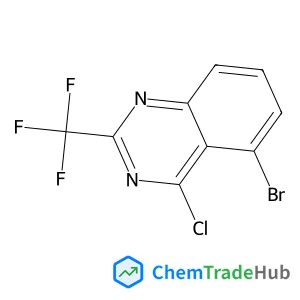
5-Bromo-4-chloro-2-(trifluoromethyl)quinazoline
CAS Number:
2089311-03-3
Molecular Formula:
C9H3BrClF3N2
Recommended Suppliers




Disclaimer
This page provides academic journal information for reference and research purposes only. We are not affiliated with any journal publishers and do not handle publication submissions. For publication-related inquiries, please contact the respective journal publishers directly.
If you notice any inaccuracies in the information displayed, please contact us at support@chemtradehub.com. We will promptly review and address your concerns.