












Raman spectroscopy for rapid intra-operative margin analysis of surgically excised tumour specimens
Literature Information
Publication Date
2019-10-08
DOI
10.1039/C9AN01163C
Impact Factor
4.616
Authors
Angela Shore
View Original
Abstract
Raman spectroscopy, a form of vibrational spectroscopy, has the ability to provide sensitive and specific biochemical analysis of tissue. This review article provides an in-depth analysis of the suitability of different Raman spectroscopy techniques in providing intra-operative margin analysis in a range of solid tumour pathologies. Surgical excision remains the primary treatment of a number of solid organ cancers. Incomplete excision of a tumour and positive margins on histopathological analysis is associated with a worse prognosis, the need for adjuvant therapies with significant side effects and a resulting financial burden. The provision of intra-operative margin analysis of surgically excised tumour specimens would be beneficial for a number of pathologies, as there are no widely adopted and accurate methods of margin analysis, beyond histopathology. The limitations of Raman spectroscopic studies to date are discussed and future work necessary to enable translation to clinical use is identified. We conclude that, although there remain a number of challenges in translating current techniques into a clinically effective tool, studies so far demonstrate that Raman Spectroscopy has the attributes to successfully perform highly accurate intra-operative margin analysis in a clinically relevant environment.
Recommended Journals
Related Literature
An investigation of Cu–Re–ZnO catalysts for the hydrogenolysis of glycerol under continuous flow conditions
Mzamo L. Shozi, Venkata D. B. C. Dasireddy, Sooboo Singh, Pheladi Mohlala, David J. Morgan, Sarwat Iqbal, Holger B. Friedrich
2017-06-28
Paper
DOI: 10.1039/C7SE00199A
Two-electron oxidation of water to form hydrogen peroxide catalysed by silicon-porphyrins
Sebastian Nybin Remello, Fazalurahman Kuttassery, Siby Mathew, Arun Thomas, Daisuke Yamamoto, Yu Nabetani, Keito Sano, Hiroshi Tachibana, Haruo Inoue
2018-03-27
Paper
DOI: 10.1039/C8SE00102B
Light-driven generation of chlorine and hydrogen from brine using highly selective Ru/Ti oxide redox catalysts
L. McCafferty, C. O'Rourke, A. Mills, A. Kafizas, I. P. Parkin, J. A. Darr
2017-01-11
Communication
DOI: 10.1039/C6SE00057F
FeS2 microspheres wrapped by N-doped rGO from an Fe-based ionic liquid precursor for rechargeable lithium ion batteries
Chengfeng Du, Jianrong Li, Xiaoying Huang
2018-11-21
Paper
DOI: 10.1039/C8SE00539G
Design aspects of all atomic layer deposited TiO2–Fe2O3 scaffold-absorber photoanodes for water splitting
Arto Hiltunen, Tero-Petri Ruoko, Tomi Iivonen, Kimmo Lahtonen, Harri Ali-Löytty, Essi Sarlin, Mika Valden, Markku Leskelä, Nikolai Tkachenko
2018-07-31
Paper
DOI: 10.1039/C8SE00252E
Boosting pseudocapacitive charge storage in in situ functionalized carbons with a high surface area for high-energy asymmetric supercapacitors
Hao Zhang, Mingjie Lu, Huanlei Wang, Yan Lyu, Dong Li, Shijiao Sun, Jing Shi, Wei Liu
2018-08-08
Paper
DOI: 10.1039/C8SE00348C
Advances in constructing polymeric carbon-nitride-based nanocomposites and their applications in energy chemistry
Zhonghao Wang, Xun Hu, Guojun Zou, Zhiwei Huang, Zhicheng Tang, Qing Liu, Guangzhi Hu, Dongsheng Geng
2019-01-21
Review Article
DOI: 10.1039/C8SE00629F
You might also like
Compound Q&A
How should waste containing 6-Chloro-5-(2'-hydroxy-3'-methoxy-4-biphenylyl)-3-(3-methoxyphenyl)-1H-pyrrolo[3,2-d]pyrimidine-2,4(3H,5H)-dione (CAS: 1346607-05-3) be handled?
Waste containing 6-Chloro-5-(2'-hydroxy-3'-methoxy-4-biphenylyl)-3-(3-methoxyphe...
1346607-05-36-Chloro-5-(2'-hydro...
Compound Q&A
What are the main uses of (3alpha,5alpha)-3-Hydroxypregnane-11,20-dione (CAS: 23930-19-0)?
(3alpha,5alpha)-3-Hydroxypregnane-11,20-dione is primarily used in the pharmaceu...
23930-19-0(3alpha,5alpha)-3-Hy...
Compound Q&A
What is the market or research trend for 4-Amino-6-chloro-2-pyridinecarboxylic acid (CAS: 546141-56-4)?
The market for 4-Amino-6-chloro-2-pyridinecarboxylic acid (CAS: 546141-56-4) is ...
546141-56-44-Amino-6-chloro-2-p...
Compound Q&A
Are there alternatives to (2-Benzoylethyl)trimethylammonium chloride (CAS: 24472-88-6) in synthesis?
Alternatives to (2-Benzoylethyl)trimethylammonium chloride (CAS: 24472-88-6) in ...
24472-88-6(2-Benzoylethyl)trim...
Compound Q&A
Is N-[4-Nitro-3-(trifluoromethyl)phenyl]acetamide (CAS: 393-12-4) safe?
N-[4-Nitro-3-(trifluoromethyl)phenyl]acetamide (CAS: 393-12-4) is generally safe...
393-12-4N-[4-Nitro-3-(triflu...
Compound Q&A
Are there alternatives to [(4R,5R,6S)-5-hydroxy-10-imino-3,7-dioxa-1,9-diazatricyclo[6.4.0.02,6]dodeca-8,11-dien-4-yl]methyl dihydrogen phosphate (CAS: 39679-56-6) in synthesis?
Alternative reagents such as other phosphates or similar functional groups can b...
39679-56-6[(4R,5R,6S)-5-hydrox...
Compound Q&A
Are there alternatives to N,N'-Bis(3-aminopropyl)-1,3-propanediamine (CAS: 4605-14-5) in synthesis?
There are alternatives to N,N'-Bis(3-aminopropyl)-1,3-propanediamine (CAS: 4605-...
4605-14-5N,N'-Bis(3-aminoprop...
Compound Q&A
What precautions should be taken when handling Aluminium trihexadecanoate (CAS: 555-35-1)?
When handling Aluminium trihexadecanoate, it is important to use appropriate per...
555-35-1Aluminium trihexadec...
Compound Q&A
What is (1,1-Dioxido-3-oxo-1,2-benzothiazol-2(3H)-yl)acetic acid (CAS: 52188-11-1)?
(1,1-Dioxido-3-oxo-1,2-benzothiazol-2(3H)-yl)acetic acid is a chemical compound ...
52188-11-1(1,1-Dioxido-3-oxo-1...
Compound Q&A
Are there alternatives to 5,5-dimethyloxolan-2-one (CAS: 3123-97-5) in synthesis?
Several alternatives to 5,5-dimethyloxolan-2-one (CAS: 3123-97-5) can be used in...
3123-97-55,5-dimethyloxolan-2...
Source Journal
Analyst

CiteScore:
7.8
Self-citation Rate:
5.6%
Articles per Year:
653
Analyst publishes analytical and bioanalytical research that reports premier fundamental discoveries and inventions, and the applications of those discoveries, unconfined by traditional discipline barriers.
Recommended Compounds
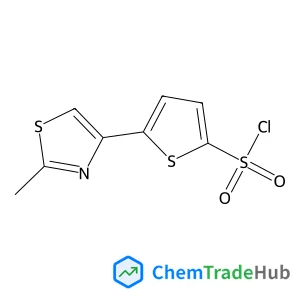
5-(2-Methyl-1,3-thiazol-4-yl)-2-thiophenesulfonyl chloride
CAS Number:
215434-25-6
Molecular Formula:
C8H6ClNO2S3
![2-morpholino-2-[2-(trifluoromethyl)pyrimidin-5-yl]ethanamine structure](https://static.chemtradehub.com/structs/119/1192570-20-9-2810.webp "2-morpholino-2-[2-(trifluoromethyl)pyrimidin-5-yl]ethanamine structure")
2-morpholino-2-[2-(trifluoromethyl)pyrimidin-5-yl]ethanamine
CAS Number:
1192570-20-9
Molecular Formula:
C11H15F3N4O
Recommended Suppliers







Disclaimer
This page provides academic journal information for reference and research purposes only. We are not affiliated with any journal publishers and do not handle publication submissions. For publication-related inquiries, please contact the respective journal publishers directly.
If you notice any inaccuracies in the information displayed, please contact us at support@chemtradehub.com. We will promptly review and address your concerns.