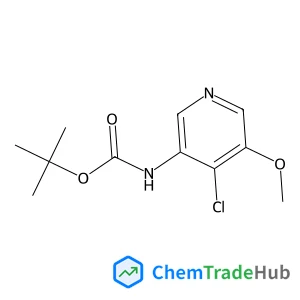
tert-Butyl 4-chloro-5-methoxypyridin-3-ylcarbamate
CAS Number:
1045858-17-0
Molecular Formula:
C11H15ClN2O3
Mzamo L. Shozi, Venkata D. B. C. Dasireddy, Sooboo Singh, Pheladi Mohlala, David J. Morgan, Sarwat Iqbal, Holger B. Friedrich
Cu and Re monometallic and bimetallic catalysts supported on ZnO were synthesized via wet impregnation. The catalysts were characterized using XRD, TPR, Pulse TPD, TEM, SEM, XPS and BET surface area. TPR results showed that the presence of rhenium increases the reduction temperature of the catalysts and TPD showed that the presence of copper decreases the Brønsted acidity of the catalysts. SEM showed an improved distribution of metal oxide on the support after the incorporation of rhenium. These catalysts were evaluated in the hydrogenolysis of glycerol in a continuous flow fixed bed reactor in a temperature range of 150–250 °C and a H2 pressure of 60 bar. All catalysts were active, with activity being higher over the rhenium containing catalysts. At the lowest temperature (150 °C), 1,2-propanediol had the highest selectivity which decreased with increase in temperature. Subsequently, the selectivity to lower alcohols, such as methanol, ethanol and 1-propanol, and ethylene glycol increased with temperature as 1,2-propanediol reacted further to these products due to C–C bond cleavage. This was also observed when the hydrogen content was increased at constant temperature (250 °C). All catalysts were found to be stable in terms of activity and selectivity to lower alcohols over a period of at least 24 hours at 250 °C and 60 bar H2 pressure.
Xingxing Tan, Xiaodong Ma, Jiaqi Feng
DOI: 10.1039/D3SC02871B
J. Nolan McNeill, Jeremy P. Bard, Darren W. Johnson, Michael M. Haley
DOI: 10.1039/D3CS00737E
Yifeng Tang, Jeremiah Y. Kim, Carman K. M. IP, Azadeh Bahmani, Qing Chen, Matthew G. Rosenberger, Aaron P. Esser-Kahn, Andrew L. Ferguson
DOI: 10.1039/D3SC03613H
Qilong Wu, Fangfang Zhu, Gordon Wallace, Xiangdong Yao, Jun Chen
DOI: 10.1039/D3CS00714F
Ning-Yu Huang, Yu-Tao Zheng, Di Chen, Zhen-Yu Chen, Chao-Zhu Huang, Qiang Xu
DOI: 10.1039/D2CS00289B
Waste containing 6-Chloro-5-(2'-hydroxy-3'-methoxy-4-biphenylyl)-3-(3-methoxyphe...
(3alpha,5alpha)-3-Hydroxypregnane-11,20-dione is primarily used in the pharmaceu...
The market for 4-Amino-6-chloro-2-pyridinecarboxylic acid (CAS: 546141-56-4) is ...
Alternatives to (2-Benzoylethyl)trimethylammonium chloride (CAS: 24472-88-6) in ...
N-[4-Nitro-3-(trifluoromethyl)phenyl]acetamide (CAS: 393-12-4) is generally safe...
Alternative reagents such as other phosphates or similar functional groups can b...
There are alternatives to N,N'-Bis(3-aminopropyl)-1,3-propanediamine (CAS: 4605-...
When handling Aluminium trihexadecanoate, it is important to use appropriate per...
(1,1-Dioxido-3-oxo-1,2-benzothiazol-2(3H)-yl)acetic acid is a chemical compound ...
Several alternatives to 5,5-dimethyloxolan-2-one (CAS: 3123-97-5) can be used in...
![(3-{[4-(Aminomethyl)-6-(trifluoromethyl)-2-pyridinyl]oxy}phenyl)[(3R,4R)-3-fluoro-4-hydroxy-1-pyrrolidinyl]methanone structure](https://static.chemtradehub.com/structs/200/2007885-39-2-affc.webp "(3-{[4-(Aminomethyl)-6-(trifluoromethyl)-2-pyridinyl]oxy}phenyl)[(3R,4R)-3-fluoro-4-hydroxy-1-pyrrolidinyl]methanone structure")
![2-morpholino-2-[2-(trifluoromethyl)pyrimidin-5-yl]ethanamine structure](https://static.chemtradehub.com/structs/119/1192570-20-9-2810.webp "2-morpholino-2-[2-(trifluoromethyl)pyrimidin-5-yl]ethanamine structure")