



Boosting pseudocapacitive charge storage in in situ functionalized carbons with a high surface area for high-energy asymmetric supercapacitors
Literature Information
Publication Date
2018-08-08
DOI
10.1039/C8SE00348C
Impact Factor
6.367
Authors
Hao Zhang, Mingjie Lu, Huanlei Wang, Yan Lyu, Dong Li, Shijiao Sun, Jing Shi, Wei Liu
View Original
Abstract
Achieving both a high surface area and high heteroatom doping in carbon materials is a major challenge for aqueous-based supercapacitors. Herein, we choose an efficient carbonization–activation pathway to tune the porosity and heteroatom doping level of carbon materials by using jellyfish as the precursor and KOH as the activating agent. Highly Functionalized Jellyfish-Derived Activated Carbons (HFJDACs) possess a high surface area of up to 3300 m2 g−1 with nitrogen and oxygen heteroatom doping. Carbon activated at 500 °C displays a capacitance as high as 743 F g−1 and 639 F cm−3, while carbons activated at a temperature higher than 500 °C exhibit a favorable capacitance retention of >48.1% at 100 A g−1. These values are among the highest reported in the literature, and therefore these carbon materials can be used as the ideal negative electrode in asymmetric supercapacitors to circumvent the capacitance mismatch between oxide-based positive electrodes and carbon-based negative electrodes. The assembled asymmetric capacitor employing HFJDACs can achieve a high energy density of 43.4 W h kg−1 and an amazing cycle life with capacitance retention of 110% after 20 000 cycles. These results demonstrate that adapting a scalable synthesis strategy for designing carbons with well-developed porosity and high level heteroatom doping is promising for advanced supercapacitors.
Recommended Journals

Russian Chemical Bulletin

Journal of Saudi Chemical Society

Journal of Peptide Science

Current Opinion in Solid State & Materials Science

Acta Materialia

Crystallography Reports

Current Opinion in Colloid & Interface Science

Organic Process Research & Development

Chemical Communications

Russian Journal of Applied Chemistry
Related Literature
Stopped-flow kinetic studies of the formation and disintegration of polyion complex micelles in aqueous solution
Sangui Chen, Zhiyuan Zhu, Shiyong Liu
2013-10-15
Paper
DOI: 10.1039/C3CP53608D
Metal-free, polyether-mediated H2-release from ammonia borane: roles of hydrogen bonding interactions in promoting dehydrogenation
Yongmin Kim, Hyunjae Baek, Jin Hee Lee, Shinyoung Yeo, Kibum Kim, Son-Jong Hwang, Bit Eun
2013-08-05
Paper
DOI: 10.1039/C3CP52591K
Estimation of the refractive indices of imidazolium-based ionic liquids using their polarisability values
Pablo Díaz-Rodríguez, John C. Cancilla, Natalia V. Plechkova, Gemma Matute, Kenneth R. Seddon, José S. Torrecilla
2013-10-28
Paper
DOI: 10.1039/C3CP53685H
Modeling biofilms with dual extracellular electron transfer mechanisms
Ryan Renslow, Jerome Babauta, Andrew Kuprat, Jim Schenk, Cornelius Ivory, Jim Fredrickson, Haluk Beyenal
2013-10-11
Paper
DOI: 10.1039/C3CP53759E
Free energy barriers for CO2 and N2 in zeolite NaKA: an ab initio molecular dynamics approach
Amber Mace, Kari Laasonen, Aatto Laaksonen
2013-10-28
Paper
DOI: 10.1039/C3CP52821A
Selective photoredox using graphene-based composite photocatalysts
2013-09-18
Perspective
DOI: 10.1039/C3CP53325E
Experimental and theoretical investigation of correlated fine structure branching ratios arising from state-selected predissociation of BrO (A2Π3/2)
Michael P. Grubb, Kristin S. Dooley, C. Daniel Freeman, Kirk A. Peterson, Simon W. North
2013-10-29
Paper
DOI: 10.1039/C3CP53766H
A roaming wavepacket in the dynamics of electronically excited 2-hydroxypyridine
Lionel Poisson, Benoît Soep, Majdi Hochlaf, Martial Boggio-Pasqua, Jean-Michel Mestdagh
2013-10-18
Paper
DOI: 10.1039/C3CP52923A
Catalytic activity of NiMnO3 for visible light-driven and electrochemical water oxidation
Dachao Hong, Yusuke Yamada, Akifumi Nomura
2013-09-24
Communication
DOI: 10.1039/C3CP53518E
Protein destabilisation in ionic liquids: the role of preferential interactions in denaturation
Angelo Miguel Figueiredo, Joao Sardinha, Geoffrey R. Moore, Eurico J. Cabrita
2013-10-03
Paper
DOI: 10.1039/C3CP53395F
You might also like
Compound Q&A
How should waste containing 6-Chloro-5-(2'-hydroxy-3'-methoxy-4-biphenylyl)-3-(3-methoxyphenyl)-1H-pyrrolo[3,2-d]pyrimidine-2,4(3H,5H)-dione (CAS: 1346607-05-3) be handled?
Waste containing 6-Chloro-5-(2'-hydroxy-3'-methoxy-4-biphenylyl)-3-(3-methoxyphe...
1346607-05-36-Chloro-5-(2'-hydro...
Compound Q&A
What are the main uses of (3alpha,5alpha)-3-Hydroxypregnane-11,20-dione (CAS: 23930-19-0)?
(3alpha,5alpha)-3-Hydroxypregnane-11,20-dione is primarily used in the pharmaceu...
23930-19-0(3alpha,5alpha)-3-Hy...
Compound Q&A
What is the market or research trend for 4-Amino-6-chloro-2-pyridinecarboxylic acid (CAS: 546141-56-4)?
The market for 4-Amino-6-chloro-2-pyridinecarboxylic acid (CAS: 546141-56-4) is ...
546141-56-44-Amino-6-chloro-2-p...
Compound Q&A
Are there alternatives to (2-Benzoylethyl)trimethylammonium chloride (CAS: 24472-88-6) in synthesis?
Alternatives to (2-Benzoylethyl)trimethylammonium chloride (CAS: 24472-88-6) in ...
24472-88-6(2-Benzoylethyl)trim...
Compound Q&A
Is N-[4-Nitro-3-(trifluoromethyl)phenyl]acetamide (CAS: 393-12-4) safe?
N-[4-Nitro-3-(trifluoromethyl)phenyl]acetamide (CAS: 393-12-4) is generally safe...
393-12-4N-[4-Nitro-3-(triflu...
Compound Q&A
Are there alternatives to [(4R,5R,6S)-5-hydroxy-10-imino-3,7-dioxa-1,9-diazatricyclo[6.4.0.02,6]dodeca-8,11-dien-4-yl]methyl dihydrogen phosphate (CAS: 39679-56-6) in synthesis?
Alternative reagents such as other phosphates or similar functional groups can b...
39679-56-6[(4R,5R,6S)-5-hydrox...
Compound Q&A
Are there alternatives to N,N'-Bis(3-aminopropyl)-1,3-propanediamine (CAS: 4605-14-5) in synthesis?
There are alternatives to N,N'-Bis(3-aminopropyl)-1,3-propanediamine (CAS: 4605-...
4605-14-5N,N'-Bis(3-aminoprop...
Compound Q&A
What precautions should be taken when handling Aluminium trihexadecanoate (CAS: 555-35-1)?
When handling Aluminium trihexadecanoate, it is important to use appropriate per...
555-35-1Aluminium trihexadec...
Compound Q&A
What is (1,1-Dioxido-3-oxo-1,2-benzothiazol-2(3H)-yl)acetic acid (CAS: 52188-11-1)?
(1,1-Dioxido-3-oxo-1,2-benzothiazol-2(3H)-yl)acetic acid is a chemical compound ...
52188-11-1(1,1-Dioxido-3-oxo-1...
Compound Q&A
Are there alternatives to 5,5-dimethyloxolan-2-one (CAS: 3123-97-5) in synthesis?
Several alternatives to 5,5-dimethyloxolan-2-one (CAS: 3123-97-5) can be used in...
3123-97-55,5-dimethyloxolan-2...
Source Journal
Recommended Compounds
![(3-{[4-(Aminomethyl)-6-(trifluoromethyl)-2-pyridinyl]oxy}phenyl)[(3R,4R)-3-fluoro-4-hydroxy-1-pyrrolidinyl]methanone structure](https://static.chemtradehub.com/structs/200/2007885-39-2-affc.webp "(3-{[4-(Aminomethyl)-6-(trifluoromethyl)-2-pyridinyl]oxy}phenyl)[(3R,4R)-3-fluoro-4-hydroxy-1-pyrrolidinyl]methanone structure")
(3-{[4-(Aminomethyl)-6-(trifluoromethyl)-2-pyridinyl]oxy}phenyl)[(3R,4R)-3-fluoro-4-hydroxy-1-pyrrolidinyl]methanone
CAS Number:
2007885-39-2
Molecular Formula:
C18H17F4N3O3
![2-morpholino-2-[2-(trifluoromethyl)pyrimidin-5-yl]ethanamine structure](https://static.chemtradehub.com/structs/119/1192570-20-9-2810.webp "2-morpholino-2-[2-(trifluoromethyl)pyrimidin-5-yl]ethanamine structure")
2-morpholino-2-[2-(trifluoromethyl)pyrimidin-5-yl]ethanamine
CAS Number:
1192570-20-9
Molecular Formula:
C11H15F3N4O
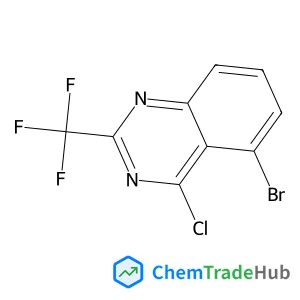
5-Bromo-4-chloro-2-(trifluoromethyl)quinazoline
CAS Number:
2089311-03-3
Molecular Formula:
C9H3BrClF3N2
Recommended Suppliers






Disclaimer
This page provides academic journal information for reference and research purposes only. We are not affiliated with any journal publishers and do not handle publication submissions. For publication-related inquiries, please contact the respective journal publishers directly.
If you notice any inaccuracies in the information displayed, please contact us at support@chemtradehub.com. We will promptly review and address your concerns.