













Light-driven generation of chlorine and hydrogen from brine using highly selective Ru/Ti oxide redox catalysts
Literature Information
Publication Date
2017-01-11
DOI
10.1039/C6SE00057F
Impact Factor
6.367
Authors
L. McCafferty, C. O'Rourke, A. Mills, A. Kafizas, I. P. Parkin, J. A. Darr
View Original
Abstract
Ultrafine ruthenium–titanium oxide catalysts were directly produced using a continuous hydrothermal flow synthesis process and assessed as chloride oxidation catalysts. Selectivity towards chlorine (over oxygen) evolution was shown to generally increase with decreasing ruthenium content. The optimum catalyst was then used to make an anode for a light-driven brine-splitting demonstrator device to produce hydrogen and chlorine gases.
Related Literature
Optimization of Al2O3/TiO2 nanolaminate thin films prepared with different oxide ratios, for use in organic light-emitting diode encapsulation, via plasma-enhanced atomic layer deposition
Lae Ho Kim, Yong Jin Jeong, Tae Kyu An, Seonuk Park, Jin Hyuk Jang, Sooji Nam, Jaeyoung Jang, Se Hyun Kim, Chan Eon Park
2015-11-23
Paper
DOI: 10.1039/C5CP06713H
Reaction between HN and SN: a possible channel for the interstellar formation of N2 and SH in the cold interstellar clouds
Priya Bhasi, Zanele P. Nhlabatsi, Sanyasi Sitha
2015-11-12
Paper
DOI: 10.1039/C5CP05190H
The interface between HOPG and 1-butyl-3-methyl-imidazolium hexafluorophosphate
C. Müller, K. Németh, S. Vesztergom, T. Pajkossy
2015-11-27
Paper
DOI: 10.1039/C5CP05406K
pH-responsive ion transport in polyelectrolyte multilayers of poly(diallyldimethylammonium chloride) (PDADMAC) and poly(4-styrenesulfonic acid-co-maleic acid) (PSS-MA) bearing strong- and weak anionic groups
Eliana Maza, Jimena S. Tuninetti, Nikolaos Politakos, Wolfgang Knoll, Sergio Moya, Omar Azzaroni
2015-10-05
Paper
DOI: 10.1039/C5CP03965G
Catalytic etching of monolayer graphene at low temperature via carbon oxidation
Jun Eon Jin, Jae-Hyun Lee, Jun Hee Choi, Ho-Kyun Jang, Junhong Na, Dongmok Whang, Do-Hyun Kim, Gyu Tae Kim
2015-07-17
Paper
DOI: 10.1039/C5CP03139G
Morphology-dependent interplay of reduction behaviors, oxygen vacancies and hydroxyl reactivity of CeO2 nanocrystals
Yuxian Gao, Rongtan Li, Shilong Chen, Liangfeng Luo, Tian Cao, Weixin Huang
2015-11-05
Paper
DOI: 10.1039/C5CP04570C
Mechanistic insights into nitrogen fixation by nitrogenase enzymes
Y. Wang, K. Chan
2015-09-09
Paper
DOI: 10.1039/C5CP04034E
Multi-center covalency: revisiting the nature of anion–π interactions
Cina Foroutan-Nejad, Zahra Badri
2015-10-26
Paper
DOI: 10.1039/C5CP05777A
Computational prediction of the electronic structure and optical properties of graphene-like β-CuN3
Xu Zhang, Xudong Zhao, Yu Jing, Dihua Wu, Zhen Zhou
2015-11-06
Paper
DOI: 10.1039/C5CP06208J
Ab initio electronic structure study of a model water splitting dimer complex
Amendra Fernando, Christine M. Aikens
2015-11-17
Paper
DOI: 10.1039/C5CP04112K
You might also like
Compound Q&A
How should waste containing 6-Chloro-5-(2'-hydroxy-3'-methoxy-4-biphenylyl)-3-(3-methoxyphenyl)-1H-pyrrolo[3,2-d]pyrimidine-2,4(3H,5H)-dione (CAS: 1346607-05-3) be handled?
Waste containing 6-Chloro-5-(2'-hydroxy-3'-methoxy-4-biphenylyl)-3-(3-methoxyphe...
1346607-05-36-Chloro-5-(2'-hydro...
Compound Q&A
What are the main uses of (3alpha,5alpha)-3-Hydroxypregnane-11,20-dione (CAS: 23930-19-0)?
(3alpha,5alpha)-3-Hydroxypregnane-11,20-dione is primarily used in the pharmaceu...
23930-19-0(3alpha,5alpha)-3-Hy...
Compound Q&A
What is the market or research trend for 4-Amino-6-chloro-2-pyridinecarboxylic acid (CAS: 546141-56-4)?
The market for 4-Amino-6-chloro-2-pyridinecarboxylic acid (CAS: 546141-56-4) is ...
546141-56-44-Amino-6-chloro-2-p...
Compound Q&A
Are there alternatives to (2-Benzoylethyl)trimethylammonium chloride (CAS: 24472-88-6) in synthesis?
Alternatives to (2-Benzoylethyl)trimethylammonium chloride (CAS: 24472-88-6) in ...
24472-88-6(2-Benzoylethyl)trim...
Compound Q&A
Is N-[4-Nitro-3-(trifluoromethyl)phenyl]acetamide (CAS: 393-12-4) safe?
N-[4-Nitro-3-(trifluoromethyl)phenyl]acetamide (CAS: 393-12-4) is generally safe...
393-12-4N-[4-Nitro-3-(triflu...
Compound Q&A
Are there alternatives to [(4R,5R,6S)-5-hydroxy-10-imino-3,7-dioxa-1,9-diazatricyclo[6.4.0.02,6]dodeca-8,11-dien-4-yl]methyl dihydrogen phosphate (CAS: 39679-56-6) in synthesis?
Alternative reagents such as other phosphates or similar functional groups can b...
39679-56-6[(4R,5R,6S)-5-hydrox...
Compound Q&A
Are there alternatives to N,N'-Bis(3-aminopropyl)-1,3-propanediamine (CAS: 4605-14-5) in synthesis?
There are alternatives to N,N'-Bis(3-aminopropyl)-1,3-propanediamine (CAS: 4605-...
4605-14-5N,N'-Bis(3-aminoprop...
Compound Q&A
What precautions should be taken when handling Aluminium trihexadecanoate (CAS: 555-35-1)?
When handling Aluminium trihexadecanoate, it is important to use appropriate per...
555-35-1Aluminium trihexadec...
Compound Q&A
What is (1,1-Dioxido-3-oxo-1,2-benzothiazol-2(3H)-yl)acetic acid (CAS: 52188-11-1)?
(1,1-Dioxido-3-oxo-1,2-benzothiazol-2(3H)-yl)acetic acid is a chemical compound ...
52188-11-1(1,1-Dioxido-3-oxo-1...
Compound Q&A
Are there alternatives to 5,5-dimethyloxolan-2-one (CAS: 3123-97-5) in synthesis?
Several alternatives to 5,5-dimethyloxolan-2-one (CAS: 3123-97-5) can be used in...
3123-97-55,5-dimethyloxolan-2...
Source Journal
Recommended Compounds
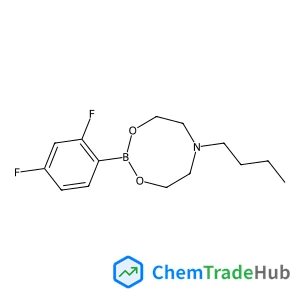
6-Butyl-2-(2,4-difluorophenyl)-1,3,6,2-dioxazaborocane
CAS Number:
1190988-98-7
Molecular Formula:
C14H20BF2NO2
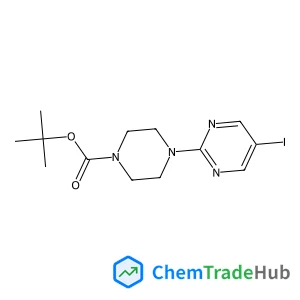
2-Methyl-2-propanyl 4-(5-iodo-2-pyrimidinyl)-1-piperazinecarboxylate
CAS Number:
1027616-32-5
Molecular Formula:
C13H19IN4O2
![2-Methyl-2-propanyl [2-(2-oxa-6-azaspiro[3.3]hept-6-yl)ethyl]carbamate structure](https://static.chemtradehub.com/structs/141/1415562-38-7-c0a4.webp "2-Methyl-2-propanyl [2-(2-oxa-6-azaspiro[3.3]hept-6-yl)ethyl]carbamate structure")
2-Methyl-2-propanyl [2-(2-oxa-6-azaspiro[3.3]hept-6-yl)ethyl]carbamate
CAS Number:
1415562-38-7
Molecular Formula:
C12H22N2O3
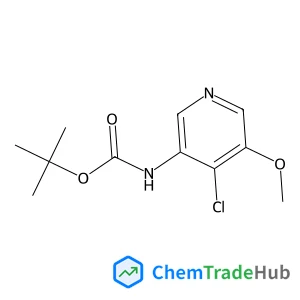
tert-Butyl 4-chloro-5-methoxypyridin-3-ylcarbamate
CAS Number:
1045858-17-0
Molecular Formula:
C11H15ClN2O3
Recommended Suppliers





Disclaimer
This page provides academic journal information for reference and research purposes only. We are not affiliated with any journal publishers and do not handle publication submissions. For publication-related inquiries, please contact the respective journal publishers directly.
If you notice any inaccuracies in the information displayed, please contact us at support@chemtradehub.com. We will promptly review and address your concerns.