












Recent advances in open tubular capillary liquid chromatography
Literature Information
Publication Date
2019-04-03
DOI
10.1039/C9AN00329K
Impact Factor
4.616
Authors
Shing Chung Lam, Estrella Sanz Rodriguez, Paul R. Haddad, Brett Paull
View Original
Abstract
This review covers advances and applications of open tubular capillary liquid chromatography (OT-LC) over the period 2007–2018. Under the right conditions OT-LC columns have the potential to offer superior column efficiency, higher overall peak capacity, and higher column permeability compared to packed capillary and monolithic columns. However, such advantages are highly dependent upon column format and dimensions, and to date in liquid chromatography the advantages of open tubular format columns have been most widely discussed and applied in the field of proteomics. In this review we have focused on the wider variety of separation mechanisms and applications which can be achieved following the modification of the inner wall of the capillary with a thin-layer stationary phase. In particular the latest advances in stationary phase development and formation, together with new column formats and dimensions are reviewed. Detection options for OT-LC are also discussed and recent advances in this area highlighted. Finally, this review summarises existing applications of OT-LC and illustrates the future potential for this technique.
Related Literature
High-performance natural-sunlight-driven Ag/AgCl photocatalysts with a cube-like morphology and blunt edges via a bola-type surfactant-assisted synthesis
Zhong-Fei Xu, Guangwei Geng, Dongjun Wang
2020-01-11
Paper
DOI: 10.1039/C9CP05273A
Computational approaches to studying methylated H4K20 recognition by DNA repair factor 53BP1
Zhendong Li, Jingxiao Bao
2020-02-06
Paper
DOI: 10.1039/C9CP05635A
One-electron oxidation of ds(5′-GGG-3′) and ds(5′-G(8OG)G-3′) and the nature of hole distribution: a density functional theory (DFT) study
Anil Kumar, Amitava Adhikary, Michael D. Sevilla, David M. Close
2020-02-03
Paper
DOI: 10.1039/C9CP06244K
Theoretical study on thermal curing mechanism of arylethynyl-containing resins
Zuowei Chen, Liquan Wang, Jiaping Lin, Lei Du
2020-03-02
Paper
DOI: 10.1039/C9CP06892A
Interfacial structure in the liquid–liquid extraction of rare earth elements by phosphoric acid ligands: a molecular dynamics study
Balarama Sridhar Dwadasi, Sriram Goverapet Srinivasan, Beena Rai
2020-02-05
Paper
DOI: 10.1039/C9CP05719F
Is the origin of green fluorescence in unsymmetrical four-ring bent-core liquid crystals single or double proton transfer?
Venkatesh Gude, Manobina Karmakar, Avishek Dey, Prasanta Kumar Datta, Kumar Biradha
2020-02-03
Paper
DOI: 10.1039/C9CP06307B
DNP NMR spectroscopy of cross-linked organic polymers: rational guidelines towards optimal sample preparation
Wei-Chih Liao, Atsuko Ogawa, Kazuhiko Sato, Christophe Copéret
2019-12-12
Paper
DOI: 10.1039/C9CP05208A
Correction: Influence of residual water and cation acidity on the ionic transport mechanism in proton-conducting ionic liquids
Liming Wang, Tatiana Zinkevich, Sylvio Indris
2020-02-19
Correction
DOI: 10.1039/D0CP90046J
Electronic structure, doping effect and topological signature in realistic intermetallics Li3−xNaxM (x = 3, 2, 1, 0; M = N, P, As, Sb, Bi)
Lei Jin, Xiaoming Zhang, Tingli He, Weizhen Meng, Xuefang Dai, Guodong Liu
2020-02-28
Paper
DOI: 10.1039/C9CP06033B
Correction: Calculation of vibrationally resolved absorption and fluorescence spectra of the rylenes
Jonas Greiner, Dage Sundholm
2020-02-07
Correction
DOI: 10.1039/D0CP90033H
You might also like
Compound Q&A
What is the market or research trend for N-(4-Methoxybenzyl)-2-pyridinamine (CAS: 52818-63-0)?
N-(4-Methoxybenzyl)-2-pyridinamine (CAS: 52818-63-0) is increasingly being used ...
52818-63-0N-(4-Methoxybenzyl)-...
Compound Q&A
What precautions should be taken when handling Ethyl 4-(2-chlorophenyl)-1,3-thiazole-2-carboxylate (CAS: 1050507-06-6)?
When handling Ethyl 4-(2-chlorophenyl)-1,3-thiazole-2-carboxylate, appropriate p...
1050507-06-6Ethyl 4-(2-chlorophe...
Compound Q&A
What regulatory guidelines apply to diethyldiselane (CAS: 628-39-7)?
Diethyldiselane (CAS: 628-39-7) is classified under the Globally Harmonized Syst...
628-39-7Diethyldiselane
Compound Q&A
What is the market or research trend for oxocopper (CAS: 12053-18-8)?
The market for oxocopper (CAS: 12053-18-8) is primarily driven by its use in cat...
12053-18-8oxocopper; oxo-(oxoc...
Compound Q&A
What is the market or research trend for 5-{[(2-Methyl-2-propanyl)oxy]carbonyl}-5-azaspiro[2.4]heptane-7-carboxylic acid?
The market for 5-{[(2-Methyl-2-propanyl)oxy]carbonyl}-5-azaspiro[2.4]heptane-7-c...
1268519-54-55-{[(2-Methyl-2-prop...
Compound Q&A
What is 2-(1-Pyrrolidinyl)-4-pyridinamine (CAS: 35981-63-6)?
2-(1-Pyrrolidinyl)-4-pyridinamine is a chemical compound with the CAS number 359...
35981-63-62-(1-Pyrrolidinyl)-4...
Compound Q&A
What are the physical and chemical properties of 2-(3-Pyridinyl)-1-azabicyclo[2.2.2]octane (CAS: 91556-75-1)?
2-(3-Pyridinyl)-1-azabicyclo[2.2.2]octane (CAS: 91556-75-1) is a crystalline sol...
91556-75-12-(3-Pyridinyl)-1-az...
Compound Q&A
How is (S)-Alpha-allyl-proline hydrochloride (CAS: 129704-91-2) typically synthesized?
(S)-Alpha-allyl-proline hydrochloride is usually synthesized via a Wittig reacti...
129704-91-2(S)-Alpha-allyl-prol...
Compound Q&A
What is 3-Methyl-1,2-oxazole-5-carboxylic acid (CAS: 4857-42-5)?
3-Methyl-1,2-oxazole-5-carboxylic acid (CAS: 4857-42-5) is an organic compound w...
4857-42-53-Methyl-1,2-oxazole...
Compound Q&A
How is Lys-SMCC-DM1 (CAS: 1281816-04-3) typically synthesized?
Lys-SMCC-DM1 is synthesized via a multi-step process involving the coupling of S...
1281816-04-3Lys-SMCC-DM1
Source Journal
Analyst

CiteScore:
7.8
Self-citation Rate:
5.6%
Articles per Year:
653
Analyst publishes analytical and bioanalytical research that reports premier fundamental discoveries and inventions, and the applications of those discoveries, unconfined by traditional discipline barriers.
Recommended Compounds
![[3-(2,6-Dichlorophenyl)-5-isopropyl-1,2-oxazol-4-yl]methanol structure](https://static.chemtradehub.com/structs/278/278597-30-1-5c79.webp "[3-(2,6-Dichlorophenyl)-5-isopropyl-1,2-oxazol-4-yl]methanol structure")
[3-(2,6-Dichlorophenyl)-5-isopropyl-1,2-oxazol-4-yl]methanol
CAS Number:
278597-30-1
Molecular Formula:
C13H13Cl2NO2
![Methyl 3-({2'-[(E)-(hydroxyhydrazono)methyl]-4-biphenylyl}methyl)-2-oxo-2,3-dihydro-1H-benzimidazole-4-carboxylate structure](https://static.chemtradehub.com/structs/149/1499167-72-4-034a.webp "Methyl 3-({2'-[(E)-(hydroxyhydrazono)methyl]-4-biphenylyl}methyl)-2-oxo-2,3-dihydro-1H-benzimidazole-4-carboxylate structure")
Methyl 3-({2'-[(E)-(hydroxyhydrazono)methyl]-4-biphenylyl}methyl)-2-oxo-2,3-dihydro-1H-benzimidazole-4-carboxylate
CAS Number:
1499167-72-4
Molecular Formula:
C23H20N4O4
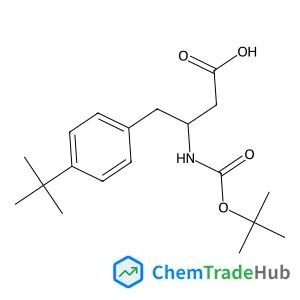
(S)-3-((tert-Butoxycarbonyl)amino)-4-(4-(tert-butyl)phenyl)butanoic acid
CAS Number:
403661-85-8
Molecular Formula:
C19H29NO4
Recommended Suppliers



Disclaimer
This page provides academic journal information for reference and research purposes only. We are not affiliated with any journal publishers and do not handle publication submissions. For publication-related inquiries, please contact the respective journal publishers directly.
If you notice any inaccuracies in the information displayed, please contact us at support@chemtradehub.com. We will promptly review and address your concerns.