



A garnet structure-based all-solid-state Li battery without interface modification: resolving incompatibility issues on positive electrodes
Literature Information
Publication Date
2018-11-08
DOI
10.1039/C8SE00436F
Impact Factor
6.367
Authors
Hao Zheng, Hans Peter Buchkremer
View Original
Abstract
The development of high-performance Li7La3Zr2O12 (LLZO)-based all-solid-state lithium batteries (SSLB) is usually hampered by highly resistive interfaces due to the need for sintering at elevated temperatures to form ionic diffusion paths through the grains. Many strategies have been proposed to solve the problem but the achievements have been limited. Herein, a new design principle is introduced, based on co-sintering crystalline LCO and Ta-substituted LLZO instead of using the more reactive Li–Co–O precursors and Al-substituted LLZO, which allows the fabrication of high specific areal density and low cell area resistance without the interface modification of LLZO-based SSLB. Detailed studies using micro-Raman and EDS mapping revealed that the well-sintered interfaces are free from detrimental secondary phases. To demonstrate that a true bulk-type SSLB can be constructed by this straightforward strategy, the material loading for a composite positive electrode was increased to about 10 times that in previous reports, which resulted in a high areal capacity of 1.63 mA h cm−2 (i.e. 110 mA h g−1) when discharged with a current density of 50 μA cm−2. It also allows one to discharge the fabricated SSLB at a very high current density of 500 μA cm−2 at 50 °C due to the minimized cell areal resistance. The new fabrication strategy for the LLZO-based SSLB paves the way for achieving SSLB with high safety and energy density.
Recommended Journals

Atomization and Sprays

Bioorganic & Medicinal Chemistry Letters

NDT & E International

Journal of the Indian Institute of Science

Medicinal Chemistry Research

Cellulose

Critical Reviews in Solid State and Materials Sciences

Topics in Catalysis

Journal of Chemical Sciences

Herald of the Russian Academy of Sciences
Related Literature
Selective photoredox using graphene-based composite photocatalysts
2013-09-18
Perspective
DOI: 10.1039/C3CP53325E
Charge transport properties of spin crossover systems
2013-10-25
Perspective
DOI: 10.1039/C3CP54028F
Accelerated electron transport from photosystem I to redox partners by covalently linked ferredoxin
Gal Wittenberg, William Sheffler, Dana Darchi, David Baker
2013-10-01
Paper
DOI: 10.1039/C3CP53264J
Experimental and theoretical investigation of correlated fine structure branching ratios arising from state-selected predissociation of BrO (A2Π3/2)
Michael P. Grubb, Kristin S. Dooley, C. Daniel Freeman, Kirk A. Peterson, Simon W. North
2013-10-29
Paper
DOI: 10.1039/C3CP53766H
Electronic spectroscopy of transient species in solid neon: the indene-motif polycyclic hydrocarbon cation family C9Hy+ (y = 7–9) and their neutrals
Adam Nagy, Iryna Garkusha, Jan Fulara, John P. Maier
2013-10-10
Perspective
DOI: 10.1039/C3CP52172A
Estimation of the refractive indices of imidazolium-based ionic liquids using their polarisability values
Pablo Díaz-Rodríguez, John C. Cancilla, Natalia V. Plechkova, Gemma Matute, Kenneth R. Seddon, José S. Torrecilla
2013-10-28
Paper
DOI: 10.1039/C3CP53685H
Slice imaging of methyl bromide photofragmentation at 193 nm
M. Laura Lipciuc, Peter C. Samartzis, Xueming Yang
2013-11-25
Paper
DOI: 10.1039/C3CP53139B
Influence of the tyrosine environment on the second harmonic generation of iturinic antimicrobial lipopeptides at the air–water interface
Mehmet Nail Nasir, Emmanuel Benichou, Claire Loison, Isabelle Russier-Antoine, Françoise Besson, Pierre-François Brevet
2013-10-11
Paper
DOI: 10.1039/C3CP53098A
Effects of atomic scale roughness at metal/insulator interfaces on metal work function
2013-09-26
Paper
DOI: 10.1039/C3CP53590H
Solvatochromism of pyranine-derived photoacids
Christian Spies, Björn Finkler, Nursel Acar, Gregor Jung
2013-10-08
Paper
DOI: 10.1039/C3CP53082E
You might also like
Compound Q&A
How should waste containing 6-Chloro-5-(2'-hydroxy-3'-methoxy-4-biphenylyl)-3-(3-methoxyphenyl)-1H-pyrrolo[3,2-d]pyrimidine-2,4(3H,5H)-dione (CAS: 1346607-05-3) be handled?
Waste containing 6-Chloro-5-(2'-hydroxy-3'-methoxy-4-biphenylyl)-3-(3-methoxyphe...
1346607-05-36-Chloro-5-(2'-hydro...
Compound Q&A
What are the main uses of (3alpha,5alpha)-3-Hydroxypregnane-11,20-dione (CAS: 23930-19-0)?
(3alpha,5alpha)-3-Hydroxypregnane-11,20-dione is primarily used in the pharmaceu...
23930-19-0(3alpha,5alpha)-3-Hy...
Compound Q&A
What is the market or research trend for 4-Amino-6-chloro-2-pyridinecarboxylic acid (CAS: 546141-56-4)?
The market for 4-Amino-6-chloro-2-pyridinecarboxylic acid (CAS: 546141-56-4) is ...
546141-56-44-Amino-6-chloro-2-p...
Compound Q&A
Are there alternatives to (2-Benzoylethyl)trimethylammonium chloride (CAS: 24472-88-6) in synthesis?
Alternatives to (2-Benzoylethyl)trimethylammonium chloride (CAS: 24472-88-6) in ...
24472-88-6(2-Benzoylethyl)trim...
Compound Q&A
Is N-[4-Nitro-3-(trifluoromethyl)phenyl]acetamide (CAS: 393-12-4) safe?
N-[4-Nitro-3-(trifluoromethyl)phenyl]acetamide (CAS: 393-12-4) is generally safe...
393-12-4N-[4-Nitro-3-(triflu...
Compound Q&A
Are there alternatives to [(4R,5R,6S)-5-hydroxy-10-imino-3,7-dioxa-1,9-diazatricyclo[6.4.0.02,6]dodeca-8,11-dien-4-yl]methyl dihydrogen phosphate (CAS: 39679-56-6) in synthesis?
Alternative reagents such as other phosphates or similar functional groups can b...
39679-56-6[(4R,5R,6S)-5-hydrox...
Compound Q&A
Are there alternatives to N,N'-Bis(3-aminopropyl)-1,3-propanediamine (CAS: 4605-14-5) in synthesis?
There are alternatives to N,N'-Bis(3-aminopropyl)-1,3-propanediamine (CAS: 4605-...
4605-14-5N,N'-Bis(3-aminoprop...
Compound Q&A
What precautions should be taken when handling Aluminium trihexadecanoate (CAS: 555-35-1)?
When handling Aluminium trihexadecanoate, it is important to use appropriate per...
555-35-1Aluminium trihexadec...
Compound Q&A
What is (1,1-Dioxido-3-oxo-1,2-benzothiazol-2(3H)-yl)acetic acid (CAS: 52188-11-1)?
(1,1-Dioxido-3-oxo-1,2-benzothiazol-2(3H)-yl)acetic acid is a chemical compound ...
52188-11-1(1,1-Dioxido-3-oxo-1...
Compound Q&A
Are there alternatives to 5,5-dimethyloxolan-2-one (CAS: 3123-97-5) in synthesis?
Several alternatives to 5,5-dimethyloxolan-2-one (CAS: 3123-97-5) can be used in...
3123-97-55,5-dimethyloxolan-2...
Source Journal
Recommended Compounds
-1,2-cyclohexanediamine structure](https://static.chemtradehub.com/structs/928/928769-12-4-a4f0.webp "N,N'-Bis[3-(2-methoxyphenyl)-2-hydroxybenzyl](1R,2R)-1,2-cyclohexanediamine structure")
N,N'-Bis[3-(2-methoxyphenyl)-2-hydroxybenzyl](1R,2R)-1,2-cyclohexanediamine
CAS Number:
928769-12-4
Molecular Formula:
C34H38N2O4
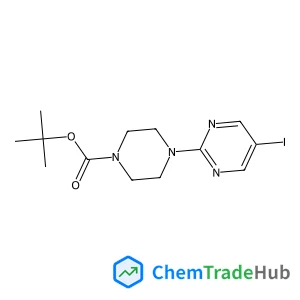
2-Methyl-2-propanyl 4-(5-iodo-2-pyrimidinyl)-1-piperazinecarboxylate
CAS Number:
1027616-32-5
Molecular Formula:
C13H19IN4O2
Recommended Suppliers




Disclaimer
This page provides academic journal information for reference and research purposes only. We are not affiliated with any journal publishers and do not handle publication submissions. For publication-related inquiries, please contact the respective journal publishers directly.
If you notice any inaccuracies in the information displayed, please contact us at support@chemtradehub.com. We will promptly review and address your concerns.