












Solvatochromism of pyranine-derived photoacids
Literature Information
Publication Date
2013-10-08
DOI
10.1039/C3CP53082E
Impact Factor
3.676
Authors
Christian Spies, Björn Finkler, Nursel Acar, Gregor Jung
View Original
Abstract
Photoacidity is frequently found in aromatic alcohols where the equilibrium dissociation constant increases by some orders of magnitude upon electronic excitation. In this study we investigated the solvatochromism of a family of recently synthesized super-photoacids and their methylated counterparts based on pyrene. The chemical similarity of these molecules on the one hand and their differing photoacidity with pKa* values between −0.8 and −3.9 on the other allow for gaining insights into the mechanisms contributing to excited-state proton transfer. Three different solvent scales, namely Lippert–Mataga, Kamlet–Taft and Catalán, were independently employed in this study and gave consistent results. We found the strongest correlation of the excited-state acidity with the dipolarity of the excited state, pem ranging from −1775 cm−1 to −2500 cm−1, and a concomitant change in the permanent dipole moment of roughly 14 Debye. Spectral changes due to varying basicity of the solvent, which probes the conjugated property of the solute, are found to be less indicative of the graduation of excited-state acidity, i.e. bem values between −700 and −1200 cm−1. The solvent acidity is the only parameter with a distinct influence on the electronic spectra of the deprotonated species. The low values of aem ∼ 400 cm−1, which are 3–4× smaller than aabs and aexc, indicate the low basicity of these species in the excited state. Triggered by semiempirical theoretical calculations, the energetic splitting between the two lowest excited states could be related to the excited-state acidity and points to alterations in the electronic mixing of locally excited and charge-transfer states, caused by the substituents. Differences between the threefold negatively charged pyranine and the new neutral photoacids are also discussed.
Recommended Journals
Related Literature
High rectification in organic diodes based on liquid crystalline phthalocyanines
Petru Apostol, Juliana Eccher, Marta Elisa Rosso Dotto, Cassiano Batesttin Costa, Thiago Cazati, Elizabeth A. Hillard, Harald Bock, Ivan H. Bechtold
2015-11-11
Paper
DOI: 10.1039/C5CP05582B
An adaptive finite-element method for large-scale ab initio molecular dynamics simulations
Eiji Tsuchida, Yoong-Kee Choe, Takahiro Ohkubo
2015-04-20
Paper
DOI: 10.1039/C5CP00320B
Resistive switching memory devices based on electrical conductance tuning in poly(4-vinyl phenol)–oxadiazole composites
Yanmei Sun, Fengjuan Miao, Rui Li, Dianzhong Wen
2015-10-08
Paper
DOI: 10.1039/C5CP05481H
Single water solvation dynamics in the 4-aminobenzonitrile–water cluster cation revealed by picosecond time-resolved infrared spectroscopy
Mitsuhiko Miyazaki, Takashi Nakamura, Matthias Wohlgemuth, Roland Mitrić, Otto Dopfer, Masaaki Fujii
2015-10-08
Paper
DOI: 10.1039/C5CP05400A
A comparative first principles study on trivalent ion incorporated SSZ-13 zeolites
Cui Wen, Lu Geng, Lina Han, Jiancheng Wang, Liping Chang, Dejin Kong, Jianwen Liu
2015-10-07
Paper
DOI: 10.1039/C5CP04788A
Gas-phase chemistry of ruthenium and rhodium carbonyl complexes
Zhi Qin, Fangli Fan, Hiromitsu Haba, Yukiko Komori, Xiaolei Wu
2015-11-05
Paper
DOI: 10.1039/C5CP05670E
Cerium oxide as a promoter for the electro-oxidation reaction of ethanol: in situ XAFS characterization of the Pt nanoparticles supported on CeO2 nanoparticles and nanorods
Juan Corchado-García, Luis E. Betancourt, Carlos A. Vélez, Sanjaya D. Senanayake, Dario Stacchiola, Kotaro Sasaki, Maxime J.-F. Guinel, Yunyun Zhou, Chin Li Cheung, Carlos R. Cabrera
2015-10-26
Paper
DOI: 10.1039/C5CP04813C
Ultrafast charge carrier relaxation and charge transfer processes in CdS/CdTe thin films
Ruvini Dharmadasa, I. M. Dharmadasa, Thad Druffel
2015-05-27
Paper
DOI: 10.1039/C5CP01652E
Fe– and Co–P4-embedded graphenes as electrocatalysts for the oxygen reduction reaction: theoretical insights
Liyan Feng, Yuejie Liu, Jingxiang Zhao
2015-10-22
Paper
DOI: 10.1039/C5CP05551B
You might also like
Compound Q&A
How should waste containing 6-Chloro-5-(2'-hydroxy-3'-methoxy-4-biphenylyl)-3-(3-methoxyphenyl)-1H-pyrrolo[3,2-d]pyrimidine-2,4(3H,5H)-dione (CAS: 1346607-05-3) be handled?
Waste containing 6-Chloro-5-(2'-hydroxy-3'-methoxy-4-biphenylyl)-3-(3-methoxyphe...
1346607-05-36-Chloro-5-(2'-hydro...
Compound Q&A
What are the main uses of (3alpha,5alpha)-3-Hydroxypregnane-11,20-dione (CAS: 23930-19-0)?
(3alpha,5alpha)-3-Hydroxypregnane-11,20-dione is primarily used in the pharmaceu...
23930-19-0(3alpha,5alpha)-3-Hy...
Compound Q&A
What is the market or research trend for 4-Amino-6-chloro-2-pyridinecarboxylic acid (CAS: 546141-56-4)?
The market for 4-Amino-6-chloro-2-pyridinecarboxylic acid (CAS: 546141-56-4) is ...
546141-56-44-Amino-6-chloro-2-p...
Compound Q&A
Are there alternatives to (2-Benzoylethyl)trimethylammonium chloride (CAS: 24472-88-6) in synthesis?
Alternatives to (2-Benzoylethyl)trimethylammonium chloride (CAS: 24472-88-6) in ...
24472-88-6(2-Benzoylethyl)trim...
Compound Q&A
Is N-[4-Nitro-3-(trifluoromethyl)phenyl]acetamide (CAS: 393-12-4) safe?
N-[4-Nitro-3-(trifluoromethyl)phenyl]acetamide (CAS: 393-12-4) is generally safe...
393-12-4N-[4-Nitro-3-(triflu...
Compound Q&A
Are there alternatives to [(4R,5R,6S)-5-hydroxy-10-imino-3,7-dioxa-1,9-diazatricyclo[6.4.0.02,6]dodeca-8,11-dien-4-yl]methyl dihydrogen phosphate (CAS: 39679-56-6) in synthesis?
Alternative reagents such as other phosphates or similar functional groups can b...
39679-56-6[(4R,5R,6S)-5-hydrox...
Compound Q&A
Are there alternatives to N,N'-Bis(3-aminopropyl)-1,3-propanediamine (CAS: 4605-14-5) in synthesis?
There are alternatives to N,N'-Bis(3-aminopropyl)-1,3-propanediamine (CAS: 4605-...
4605-14-5N,N'-Bis(3-aminoprop...
Compound Q&A
What precautions should be taken when handling Aluminium trihexadecanoate (CAS: 555-35-1)?
When handling Aluminium trihexadecanoate, it is important to use appropriate per...
555-35-1Aluminium trihexadec...
Compound Q&A
What is (1,1-Dioxido-3-oxo-1,2-benzothiazol-2(3H)-yl)acetic acid (CAS: 52188-11-1)?
(1,1-Dioxido-3-oxo-1,2-benzothiazol-2(3H)-yl)acetic acid is a chemical compound ...
52188-11-1(1,1-Dioxido-3-oxo-1...
Compound Q&A
Are there alternatives to 5,5-dimethyloxolan-2-one (CAS: 3123-97-5) in synthesis?
Several alternatives to 5,5-dimethyloxolan-2-one (CAS: 3123-97-5) can be used in...
3123-97-55,5-dimethyloxolan-2...
Source Journal
Physical Chemistry Chemical Physics

CiteScore:
5.5
Self-citation Rate:
10.3%
Articles per Year:
3036
Physical Chemistry Chemical Physics (PCCP) is an international journal co-owned by 19 physical chemistry and physics societies from around the world. This journal publishes original, cutting-edge research in physical chemistry, chemical physics and biophysical chemistry. To be suitable for publication in PCCP, articles must include significant innovation and/or insight into physical chemistry; this is the most important criterion that reviewers and Editors will judge against when evaluating submissions. The journal has a broad scope and welcomes contributions spanning experiment, theory, computation and data science. Topical coverage includes spectroscopy, dynamics, kinetics, statistical mechanics, thermodynamics, electrochemistry, catalysis, surface science, quantum mechanics, quantum computing and machine learning. Interdisciplinary research areas such as polymers and soft matter, materials, nanoscience, energy, surfaces/interfaces, and biophysical chemistry are welcomed if they demonstrate significant innovation and/or insight into physical chemistry. Joined experimental/theoretical studies are particularly appreciated when complementary and based on up-to-date approaches.
Recommended Compounds
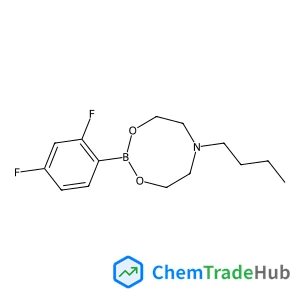
6-Butyl-2-(2,4-difluorophenyl)-1,3,6,2-dioxazaborocane
CAS Number:
1190988-98-7
Molecular Formula:
C14H20BF2NO2
![2-Methyl-2-propanyl [2-(2-oxa-6-azaspiro[3.3]hept-6-yl)ethyl]carbamate structure](https://static.chemtradehub.com/structs/141/1415562-38-7-c0a4.webp "2-Methyl-2-propanyl [2-(2-oxa-6-azaspiro[3.3]hept-6-yl)ethyl]carbamate structure")
2-Methyl-2-propanyl [2-(2-oxa-6-azaspiro[3.3]hept-6-yl)ethyl]carbamate
CAS Number:
1415562-38-7
Molecular Formula:
C12H22N2O3
Recommended Suppliers






Disclaimer
This page provides academic journal information for reference and research purposes only. We are not affiliated with any journal publishers and do not handle publication submissions. For publication-related inquiries, please contact the respective journal publishers directly.
If you notice any inaccuracies in the information displayed, please contact us at support@chemtradehub.com. We will promptly review and address your concerns.