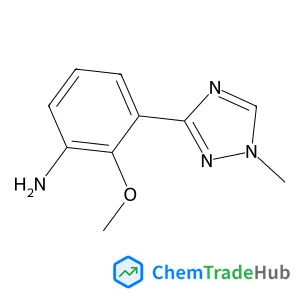
2-Methoxy-3-(1-methyl-1H-1,2,4-triazol-3-yl)aniline
CAS Number:
1609394-10-6
Molecular Formula:
C10H12N4O
He Huang, Hendrik du Toit, Sultan Ben-Jaber, Gaowei Wu, Luca Panariello, Ivan P. Parkin, Asterios Gavriilidis
A microfluidic reactor was developed to enhance the speed (reaction time <4 min) and control of the synthesis of gold nanoparticles (3–25 nm) with or without capping agents using carbon monoxide as gaseous reductant, which is easy to remove from the reaction mixture by venting. Gas–liquid segmented flow was formed inside a 1 mm inner diameter coiled flow inverter with aqueous gold precursor and the reducing gas to produce gold nanoparticles with polydispersity as low as 5%. The uncapped gold nanoparticles make the product attractive for surface-enhanced Raman scattering, and showed an average enhancement factor of 1.94 × 10⁵. Various capping agents (tri-sodium citrate, polysorbate 80, oleylamine and poly(ethyleneglycol) 2-mercaptoethyl ether acetic acid) and different operational parameters were also tested, demonstrating that the proposed synthesis is flexible and can continuously produce a variety of gold nanoparticles, with potential for other applications.
William C. Drewe, Stephen Neidle
DOI: 10.1039/B814576H
Hirotaka Koga, Takuya Kitaoka, Hiroyuki Wariishi
DOI: 10.1039/B812216D
Stephanie Lauru, Nigel S. Simpkins, David Gethin, Claire Wilson
DOI: 10.1039/B810441G
Ines Neundorf, Jan Hoyer, Katrin Splith, Robert Rennert, Harmel W. Peindy N’Dongo, Ulrich Schatzschneider
DOI: 10.1039/B812799A
Taichi Kano, Keiji Maruoka
DOI: 10.1039/B809301F
James P. Collman, Richard A. Decréau
DOI: 10.1039/B808070B
Dianne M. Fisher, Ronald R. Fenton, Janice R. Aldrich-Wright
DOI: 10.1039/B811723C
Elisabeth Kühn, Véronique Bulach, Mir Wais Hosseini
DOI: 10.1039/B812831F
Martin J. Hollamby, Kieran Trickett, Ana Vesperinas, Carl Rivett, David C. Steytler, Zoe Schnepp, Jon Jones, Richard K. Heenan, Robert M. Richardson, Otto Glatter, Julian Eastoe
DOI: 10.1039/B811563J
Timothy G. Carter, Wassana Yantasee, Thanapon Sangvanich, Glen E. Fryxell, Darren W. Johnson, R. Shane Addleman
DOI: 10.1039/B810576F
1H-Indazole-6-carbonitrile finds applications in pharmaceuticals, where it serve...
Waste containing Dioctyl (2E)-2-butenedioate (CAS: 2997-85-5) should be collecte...
Sodium [(1,2-benzoxazol-3-ylmethyl)sulfonyl]azanide is primarily used in pharmac...
Dimethyl 4-(4,4,5,5-tetramethyl-1,3,2-dioxaborolan-2-yl)-2,6-pyridinedicarboxyla...
Waste containing 2-Fluoro-6-hydrazinopyridine (CAS: 80714-39-2) should be manage...
6-Formyl-2-pyridinecarboxylic acid is an organic compound with the molecular for...
Research trends for this compound indicate a focus on its potential applications...
9H-Tribenzo[b,d,f]azepine is typically synthesized via a multi-step process invo...
1-Cyclopropyl-7-ethoxy-6-fluoro-8-methoxy-4-oxo-1,4-dihydro-3-quinolinecarboxyli...
Waste containing Methyl 3-oxo-1,2,3,4-tetrahydro-6-quinoxalinecarboxylate (CAS: ...

Reaction Chemistry & Engineering is an interdisciplinary journal reporting cutting-edge research focused on enhancing the understanding and efficiency of reactions. Reaction engineering leverages the interface where fundamental molecular chemistry meets chemical engineering and technology. Challenges in chemistry can be overcome by the application of new technologies, while engineers may find improved solutions for process development from the latest developments in reaction chemistry. Reaction Chemistry & Engineering is a unique forum for researchers whose interests span the broad areas of chemical engineering and chemical sciences to come together in solving problems of importance to wider society. All papers should be written to be approachable by readers across the engineering and chemical sciences. Papers that consider multiple scales, from the laboratory up to and including plant scale, are particularly encouraged.